
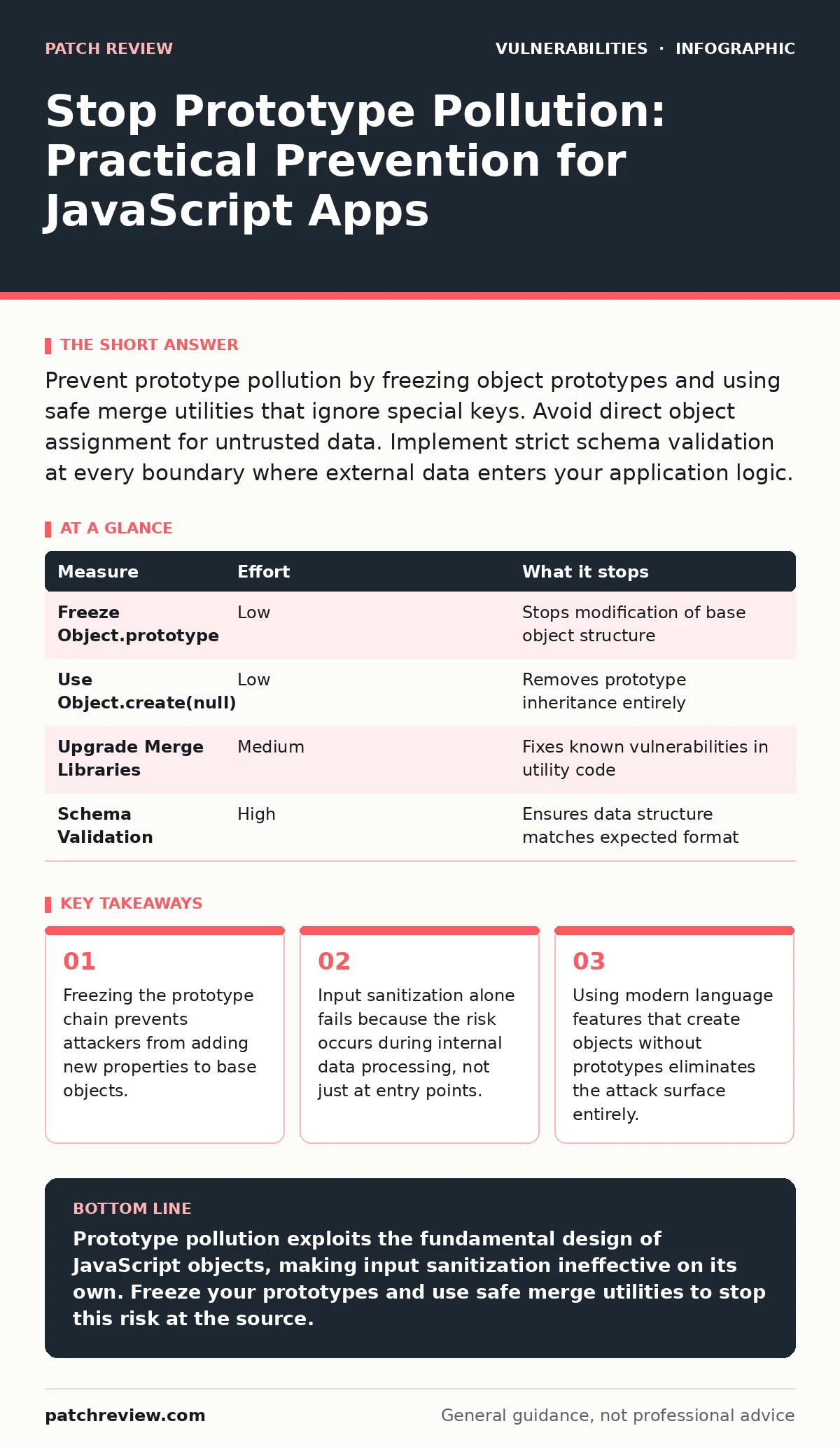
Prevent prototype pollution by freezing object prototypes and using safe merge utilities that ignore special keys. Avoid direct object assignment for untrusted data. Implement strict schema validation at every boundary where external data enters your application logic.
The Hidden Cost of Flexible Objects
JavaScript relies on a mechanism called prototypal inheritance to allow objects to share properties and methods. This design enables rapid development but introduces a subtle structural weakness. When an application merges two objects, it often copies properties from a source to a target without checking the nature of those properties.
An attacker can craft input that includes special keys, such as __proto__ or constructor. When the merge function processes this input, it modifies the base prototype itself. This change affects every object that inherits from that prototype, not just the specific instance being processed.
This behavior is distinct from typical injection flaws. The damage does not require executing code directly. It alters the state of the entire application environment. A single polluted property can change logic flows, bypass checks, or expose sensitive data structures.
Why Standard Sanitization Fails
Many developers assume that cleaning user input at the entry point is sufficient. They strip out known malicious strings or validate data types before processing. This approach misses the core mechanic of the vulnerability.
The risk arises when the application combines trusted internal data with untrusted external data. Even if the initial input is valid JSON, the merging process creates the hazard. The vulnerability lives in the utility function that performs the merge, not in the raw string received from the network.
Imagine a configuration system that allows users to override default settings. The system loads a default object and merges the user’s preferences on top. If the user provides a key that maps to a prototype property, the merge function updates the global prototype. Every subsequent object created in the application now carries this malicious property.
Freezing the Prototype Chain
The most effective immediate defense is to make the prototype chain immutable. JavaScript provides a built-in method called Object.freeze. This method prevents any changes to an object’s properties and its prototype.
When you freeze the Object.prototype, attackers cannot add new properties to it. Any attempt to modify the prototype fails silently or throws an error, depending on the environment. This stops the pollution from spreading to other objects in the application.
This measure is low effort and provides high protection. It addresses the root cause by removing the ability to modify the base structure. However, it may break libraries or code that rely on dynamically adding methods to prototypes. You must test your application thoroughly after implementing this change.
Using Safe Merge Utilities
Many popular libraries include deep merge functions that are vulnerable to this issue. These functions recursively copy properties without checking for prototype keys. You should replace these with safer alternatives.
Modern versions of many utility libraries have patched this behavior. They explicitly ignore keys that correspond to prototype properties. If you use an older version, upgrade it immediately. If you write your own merge functions, ensure they skip __proto__, constructor, and prototype.
A safer approach is to use Object.create(null) to create objects that have no prototype. These objects cannot be polluted because they do not inherit from Object.prototype. They also do not have access to standard methods like toString unless you attach them explicitly. This creates a clean slate that is immune to prototype-based attacks.
| Measure | Effort | What it stops |
|---|---|---|
| Freeze Object.prototype | Low | Stops modification of base object structure |
| Use Object.create(null) | Low | Removes prototype inheritance entirely |
| Upgrade Merge Libraries | Medium | Fixes known vulnerabilities in utility code |
| Schema Validation | High | Ensures data structure matches expected format |
Enforcing Strict Schema Validation
Validation acts as a final barrier against unexpected data structures. A schema validator checks that incoming data matches a predefined structure. It rejects any keys that are not explicitly allowed.
This method is particularly effective when combined with other measures. It ensures that even if a merge function is vulnerable, the malicious key never reaches it. The validator drops the request or data before processing begins.
Implementing strict validation requires upfront design work. You must define every field and its type for all incoming data. This effort pays off by reducing the attack surface significantly. It also improves data consistency across your application.
Detecting Pollution in Legacy Code
Existing applications often contain hidden merge operations. These may be in custom utility functions or third-party dependencies. Identifying these requires a systematic review of the codebase.
Search for patterns where objects are assigned or merged. Look for loops that iterate over object keys and copy them to another object. Check for usage of eval or JSON.parse combined with object manipulation.
Static analysis tools can help find these patterns automatically. They scan the code for risky operations and flag them for review. This process is similar to identifying insecure deserialization risks, where untrusted data is reconstructed into objects. Both require careful handling of object state.
Integrating with Broader Security Practices
Prototype pollution is one of many risks in modern web applications. It often overlaps with other vulnerabilities. For example, a polluted object might help an attacker bypass authentication checks, leading to authentication bypass vulnerabilities.
It can also facilitate data exposure. If an attacker can add a property to a prototype, they might access sensitive data stored in other objects. This is related to exposure management, which focuses on reducing the visibility of internal state.
While Content Security Policy helps mitigate script injection, it does not stop prototype pollution. You must address the issue at the application logic level. Combining these measures creates a layered defense that is harder to breach.
Checklist for Immediate Action
You can reduce your risk significantly by taking these steps today. Start with the easiest fixes and move to more complex changes.
- Freeze
Object.prototypein your application entry point to prevent modification. - Replace any custom deep merge functions with safe, vetted utilities or
Object.create(null). - Implement strict schema validation for all external data inputs.
These actions address the most common attack vectors. They require minimal code changes but provide substantial protection. Regularly review your dependencies and code for new risks.
Key takeaways
- Freezing the prototype chain prevents attackers from adding new properties to base objects.
- Input sanitization alone fails because the risk occurs during internal data processing, not just at entry points.
- Using modern language features that create objects without prototypes eliminates the attack surface entirely.
Prototype pollution exploits the fundamental design of JavaScript objects, making input sanitization ineffective on its own. Freeze your prototypes and use safe merge utilities to stop this risk at the source.
Frequently asked questions
Does input validation stop prototype pollution?
No, because the vulnerability occurs during internal object merging, not during initial input reception. Validation must happen before the merge operation.
Is freezing the prototype safe for all applications?
It is generally safe, but it may break code that relies on adding methods to prototypes. Test your application thoroughly after implementing this change.
How does this differ from path traversal vulnerabilities?
Path traversal exploits file system access, while prototype pollution exploits object inheritance. They require different prevention strategies and affect different parts of the system.
How this guide was produced: written by the Patch Review editorial team with AI assistance, checked against the public references listed below, and reviewed when the facts change. See our editorial policy or report an error.