
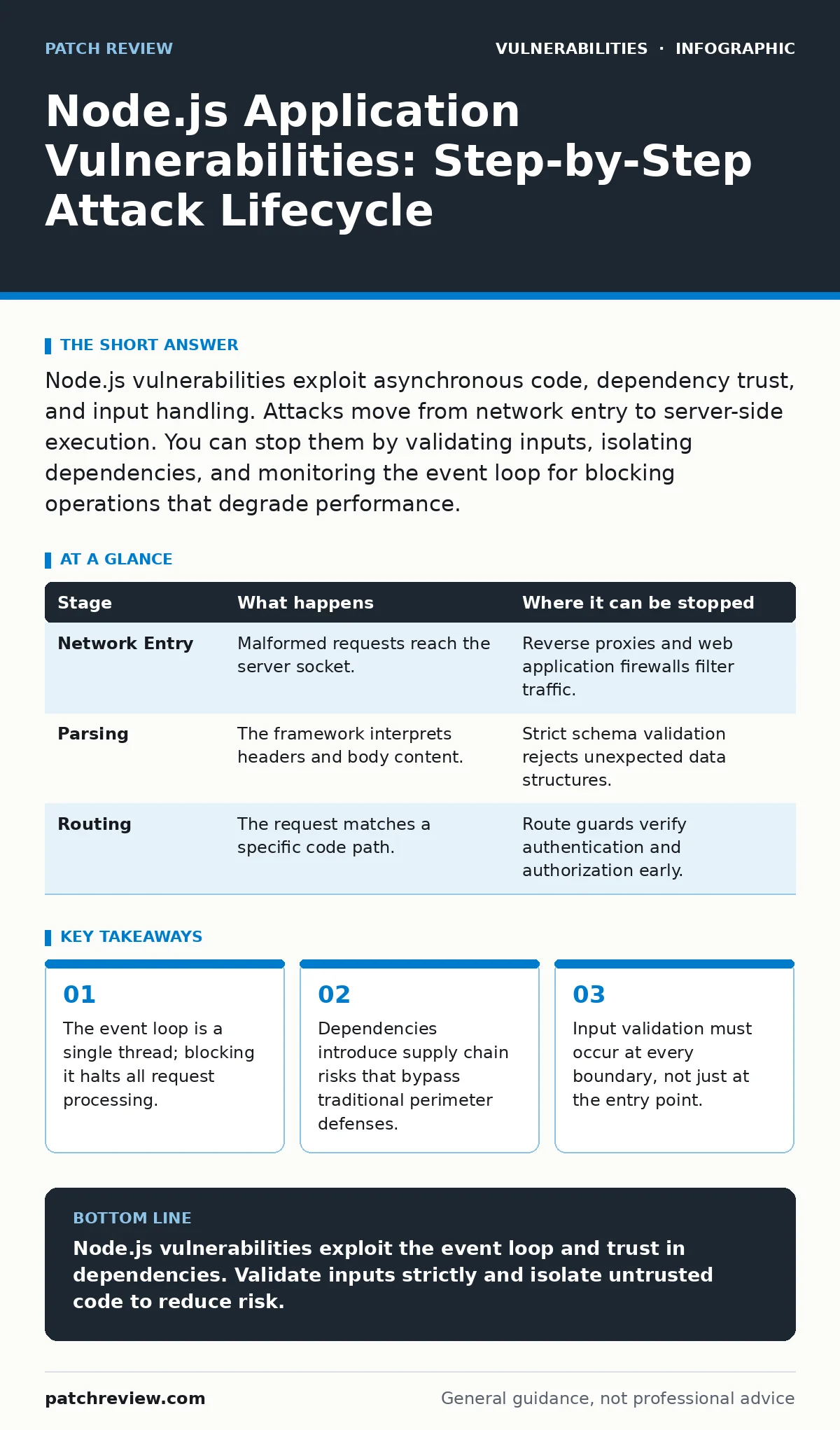
Node.js vulnerabilities exploit asynchronous code, dependency trust, and input handling. Attacks move from network entry to server-side execution. You can stop them by validating inputs, isolating dependencies, and monitoring the event loop for blocking operations that degrade performance.
The Entry Point and Network Exposure
Node.js applications typically run as web servers listening on specific ports. The first stage of any vulnerability exploitation begins with network access. An attacker sends a crafted request to the server. This request appears normal to firewalls but contains malicious payloads. The server accepts the connection and passes the request to the application logic.
The application framework parses the HTTP headers and body. It extracts parameters, cookies, and payloads. If the framework or middleware lacks strict parsing rules, malformed data can slip through. This is where initial reconnaissance happens. The attacker tests for known signatures or open ports.
Imagine a server that accepts large file uploads without size limits. The attacker sends a massive payload. The server buffers this data in memory. This consumes resources before any application logic even runs. The vulnerability relies on the assumption that all incoming data is benign and well-formed.
| Stage | What happens | Where it can be stopped |
|---|---|---|
| Network Entry | Malformed requests reach the server socket. | Reverse proxies and web application firewalls filter traffic. |
| Parsing | The framework interprets headers and body content. | Strict schema validation rejects unexpected data structures. |
| Routing | The request matches a specific code path. | Route guards verify authentication and authorization early. |
Dependency Trust and Supply Chain Risks
Node.js relies heavily on the npm ecosystem. Applications import hundreds of third-party modules. This creates a supply chain dependency. An attacker does not always need to hack your code directly. They can compromise a popular library you use. This is a supply chain attack.
The vulnerability relies on trust. You trust that the code in node_modules is safe. When a malicious update is published, your application pulls it in during deployment or runtime. The malicious code executes with the same privileges as your application. This bypasses traditional input validation because the threat comes from inside the house.
See how this connects to logging library vulnerabilities. A compromised logging module can exfiltrate data silently. It records sensitive information and sends it to an external server. The application continues to function normally. You lose data without any visible error messages or performance drops.
Input Handling and Deserialization
Once the request reaches your application code, it must be processed. Node.js often handles JSON or other data formats. If you deserialize untrusted data, you risk code injection. Deserialization converts a string back into an object. If the input is malicious, it can create objects that execute arbitrary code.
The flaw relies on the application treating input as executable code or trusted objects. Functions like eval or dynamic require calls are dangerous. They interpret strings as code. An attacker crafts a string that looks like data but acts like a command. This is remote code execution.
Imagine a search feature that takes user input and passes it to a database query. If the input is not sanitized, it alters the query structure. This is SQL injection. The attacker reads or modifies database records. The vulnerability exists because the boundary between data and code is blurred. Secure code review catches these patterns before deployment.
Event Loop Blocking and Resource Exhaustion
Node.js uses a single-threaded event loop. This design is efficient for I/O operations but fragile for CPU-intensive tasks. If a function blocks the event loop, no other requests can be processed. This is a denial of service vector. The attacker sends a request that triggers a complex calculation.
The vulnerability relies on the lack of concurrency for CPU tasks. The attacker does not need to crash the server. They just need to slow it down. A single request can hold up hundreds of other requests. This creates a cascading failure. Users experience timeouts. The server appears to hang.
This connects to side-channel attacks. An attacker measures the time it takes to respond to different inputs. If one input takes longer, it reveals information about the internal state. Timing attacks exploit the deterministic nature of the event loop. You can mitigate this by offloading heavy tasks to worker threads.
Privilege Escalation and File System Access
Many applications need to read or write files. Node.js provides fs module functions for this. If user input influences file paths, you risk path traversal. The attacker uses sequences like ../ to move up the directory tree. They access files outside the intended folder.
The vulnerability relies on insufficient path validation. The application assumes the input is a valid filename. It does not check if the path escapes the allowed directory. This allows reading configuration files, private keys, or source code. It can also allow writing malicious scripts.
See how this relates to path traversal vulnerabilities. The fix is not just sanitizing input. You must resolve the absolute path and verify it starts with the allowed base directory. Do not trust the user-provided string. Use system functions to canonicalize the path. This prevents tricking the file system with encoded characters.
Error Handling and Information Leakage
When an error occurs, the application must handle it. Default error handlers often stack traces. These traces reveal internal file paths, library versions, and code structure. This information helps attackers plan further exploits. It turns a minor error into a major intelligence gain.
The flaw relies on verbose error reporting in production. Developers leave debug modes on. They do not sanitize error messages. The attacker triggers an error intentionally. They read the stack trace. They identify the exact version of a library. They search for known exploits for that version.
Imagine a server that returns a 500 error with a full stack trace. The attacker sees a reference to a specific database driver. They know the driver version. They find a public exploit for that version. They execute it. The vulnerability is not the code itself. It is the information it leaks.
Mitigation and Continuous Monitoring
You cannot prevent all vulnerabilities. You must reduce the attack surface. Validate all inputs at the boundary. Use allowlists instead of blocklists. Assume all input is hostile. Isolate dependencies. Pin versions to known good hashes. Monitor the event loop for latency spikes.
This approach requires discipline. You must review code regularly. You must update dependencies promptly. This connects to emergency patching. When a critical flaw is found, you must apply a fix quickly. But rushing fixes can introduce new bugs. Balance speed with testing.
Imagine a system that automatically rolls back if a new dependency causes errors. This reduces risk. You still need human oversight. Automation helps, but it does not replace understanding. You must know how your application works. You must know where the trust boundaries are.
The Human Factor and Process
Technology alone does not stop attacks. Processes matter. You need a culture of security. Developers must understand the risks. They must write code that is secure by design. They must test for vulnerabilities. They must respond to incidents quickly.
The vulnerability often lies in the process. Rushed releases skip checks. Lack of training leads to bad habits. Silos prevent communication. Security must be integrated into every stage. From design to deployment. From monitoring to incident response.
Imagine a team that treats security as an afterthought. They add checks at the end. They find flaws too late. Fixing them is expensive. It delays releases. It frustrates users. Security must be built in from the start. It must be a shared responsibility.
| Stage | What happens | Where it can be stopped |
|---|---|---|
| Exploitation | The attacker executes the malicious code. | Runtime application self-protection blocks suspicious behavior. |
| Impact | Data is stolen or service is disrupted. | Incident response plans limit damage and restore service. |
| Recovery | The system is patched and restored. | Post-incident analysis prevents recurrence. |
Key takeaways
- The event loop is a single thread; blocking it halts all request processing.
- Dependencies introduce supply chain risks that bypass traditional perimeter defenses.
- Input validation must occur at every boundary, not just at the entry point.
Node.js vulnerabilities exploit the event loop and trust in dependencies. Validate inputs strictly and isolate untrusted code to reduce risk.
Frequently asked questions
How do I secure Node.js dependencies?
Pin specific versions in your package.json. Use lock files to ensure consistency. Regularly update dependencies and scan for known vulnerabilities using automated tools.
Can Node.js handle high traffic securely?
Yes, but you must manage the event loop carefully. Offload CPU-intensive tasks to worker threads. Use clustering to distribute load across multiple cores. Monitor for blocking operations.
What is the biggest risk in Node.js apps?
Unvalidated input is the biggest risk. It leads to injection attacks and path traversal. Always validate and sanitize input at every boundary. Never trust user-supplied data.
How do I detect an ongoing attack?
Monitor logs for unusual patterns. Look for spikes in error rates or latency. Use intrusion detection systems to alert on known exploit signatures. Review access logs for suspicious IP addresses.
How this guide was produced: written by the Patch Review editorial team with AI assistance, checked against the public references listed below, and reviewed when the facts change. See our editorial policy or report an error.