NetScaler vulnerabilities rarely exist in isolation. Misconfigurations, such as open directory listings or weak access controls, often compound code flaws. Understanding the distinction between n-day vulnerabilities and emergency patching scenarios prevents wasted effort and ensures you address the actual attack surface rather than chasing false positives or ignoring silent risks.
Myth: The firewall blocks all NetScaler exploits
Reality: Firewalls filter traffic based on rules, but they do not inspect the logic of the application layer. Attackers often use legitimate credentials or bypass controls by exploiting how the device processes requests.
Imagine a firewall configured to allow HTTPS traffic on standard ports. An attacker sends a malformed HTTP request that triggers a buffer overflow within the web interface. The firewall sees valid TCP packets and allows them through. This is why network perimeter defenses are insufficient for application-layer security.
You must understand that deep packet inspection helps, but it is not a substitute for securing the application itself. Many attacks succeed because the traffic looks normal to the network device. This misconception leads teams to believe they are safe when they are only partially protected.
Myth: Patches fix every security issue immediately
Reality: Applying a patch addresses a specific code defect, but it does not correct misconfigurations or residual vulnerabilities that existed before the update. You must verify the configuration after every patch cycle.
Suppose you apply an emergency patch for a critical vulnerability. The patch closes the code gap, but the administrator had previously enabled debug modes for troubleshooting. These settings remain active and expose sensitive data. The patch did not remove the misconfiguration.
This is where risk-based vulnerability management becomes relevant. You cannot assume the patch solves the problem. You must audit the configuration state. Many organizations fail here because they treat patching as a one-time event rather than a continuous validation process.
Myth: Internal networks are safe from NetScaler attacks
Reality: Internal networks often trust traffic implicitly, allowing attackers who breach the perimeter to move laterally with ease. NetScaler devices frequently sit at the boundary, making them prime targets for internal pivoting.
Consider an attacker who gains access to a low-privilege account on the internal network. They scan for NetScaler management interfaces. Because internal firewalls often allow unrestricted access to management ports, the attacker connects directly. They exploit a known vulnerability that was patched externally but not internally.
This scenario highlights the danger of trusting internal traffic. You must apply the same scrutiny to internal connections as you do to external ones. Network segmentation must include strict controls on management interfaces and administrative access paths.
Myth: Automated scanners find all logical flaws
Reality: Automated tools excel at finding known code signatures, but they struggle with business logic errors and complex authentication bypasses. Human review remains necessary for logical security.
Imagine a vulnerability where the application fails to verify user permissions for specific actions. An automated scanner sends standard requests and receives standard responses. It does not understand the context of the action. A human tester might notice that a user can access another user's data.
This is similar to insecure direct object references (IDOR), where the application relies on user input to access data without proper validation. Automated tools rarely detect these nuances. You must combine automated scanning with manual penetration testing to uncover these hidden risks.
Myth: Directory listings are harmless if unlinked
Reality: Exposed directory listings allow attackers to enumerate files, discover sensitive documentation, and find backup files that contain credentials or configuration details. Even unlinked directories can be discovered through brute force.
Suppose a NetScaler configuration inadvertently enables directory listing on a maintenance folder. The folder is not linked from the main site, but an attacker uses a wordlist to guess the path. They find a backup of the configuration file containing hashed passwords.
This relates to directory listing exposure, a common misconfiguration that attackers exploit to gather intelligence. You must explicitly disable directory browsing in the web server settings. Do not assume that obscurity protects your data. Active monitoring for exposed directories is necessary.
Myth: Low CVSS scores mean low risk
Reality: The Common Vulnerability Scoring System (CVSS) measures technical severity, not business impact. A low-score vulnerability might be easy to exploit in your specific environment, leading to significant damage.
Consider a vulnerability with a low CVSS score because it requires user interaction. If your NetScaler serves internal employees who routinely click links in emails, the likelihood of exploitation is high. The technical score ignores this context.
This is why you must contextualize risk. n-day vulnerabilities, which have known patches, are often ignored because they are "old." However, if your patching process is slow, these become critical. You must assess the exploitability within your specific network architecture, not just the abstract score.
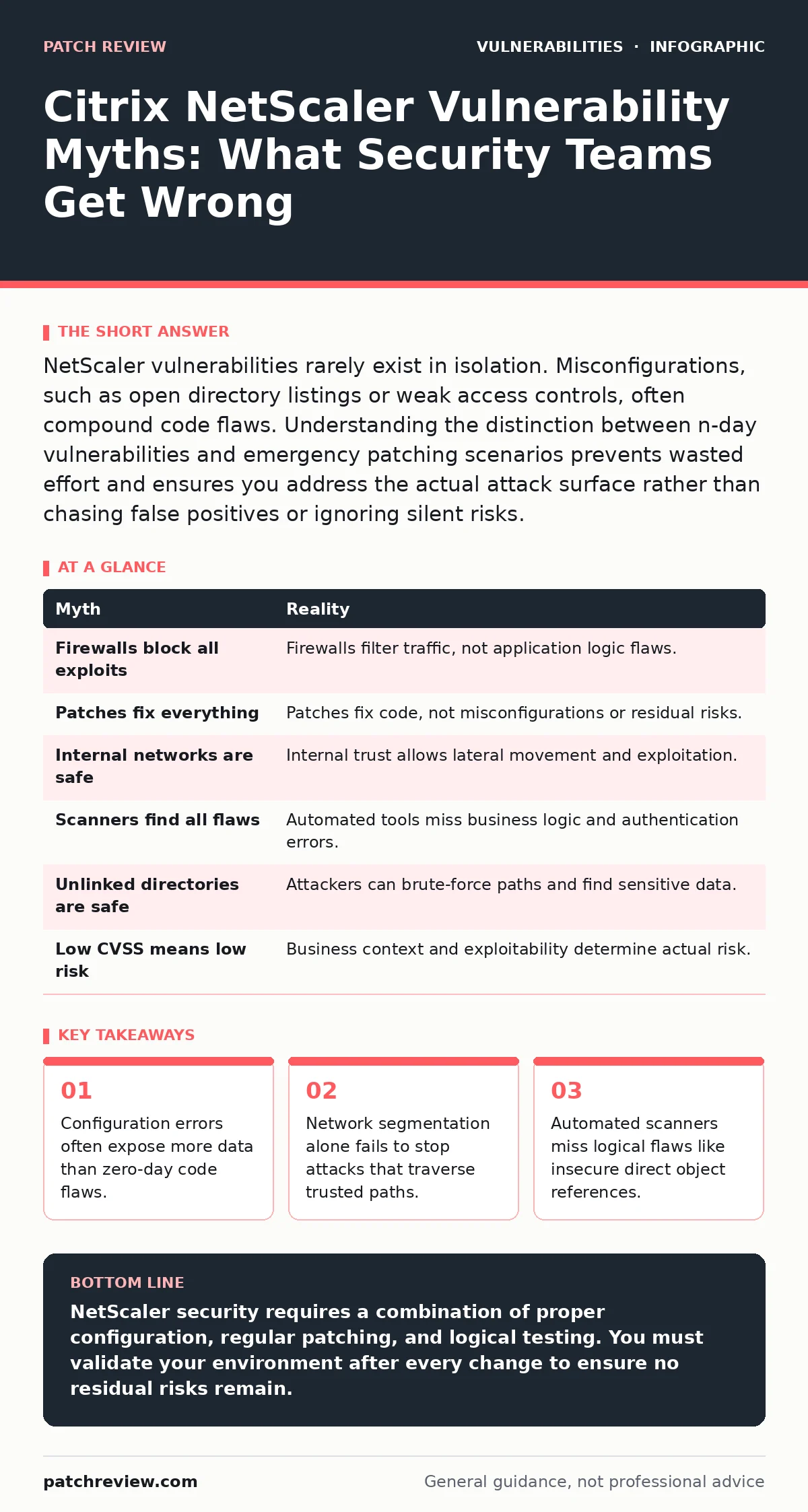
| Myth | Reality |
|---|---|
| Firewalls block all exploits | Firewalls filter traffic, not application logic flaws. |
| Patches fix everything | Patches fix code, not misconfigurations or residual risks. |
| Internal networks are safe | Internal trust allows lateral movement and exploitation. |
| Scanners find all flaws | Automated tools miss business logic and authentication errors. |
| Unlinked directories are safe | Attackers can brute-force paths and find sensitive data. |
| Low CVSS means low risk | Business context and exploitability determine actual risk. |
Key takeaways
- Configuration errors often expose more data than zero-day code flaws.
- Network segmentation alone fails to stop attacks that traverse trusted paths.
- Automated scanners miss logical flaws like insecure direct object references.
- Emergency patching requires testing to avoid breaking critical infrastructure.
NetScaler security requires a combination of proper configuration, regular patching, and logical testing. You must validate your environment after every change to ensure no residual risks remain.
Frequently asked questions
How often should I patch NetScaler devices?
You should patch as soon as a verified fix is available, especially for critical vulnerabilities. Balance this with testing to ensure stability.
Can I use NetScaler without internet access?
Yes, but you must still secure management interfaces and monitor for internal threats. Isolation does not eliminate configuration risks.
What is the biggest risk after patching?
Residual misconfigurations are the biggest risk. Ensure that debug modes and default settings are disabled after every update.
How do I detect logical flaws?
Combine automated scanning with manual penetration testing. Focus on authentication, authorization, and data access controls.
How this guide was produced: written by the Patch Review editorial team with AI assistance, checked against the public references listed below, and reviewed when the facts change. See our editorial policy or report an error.