
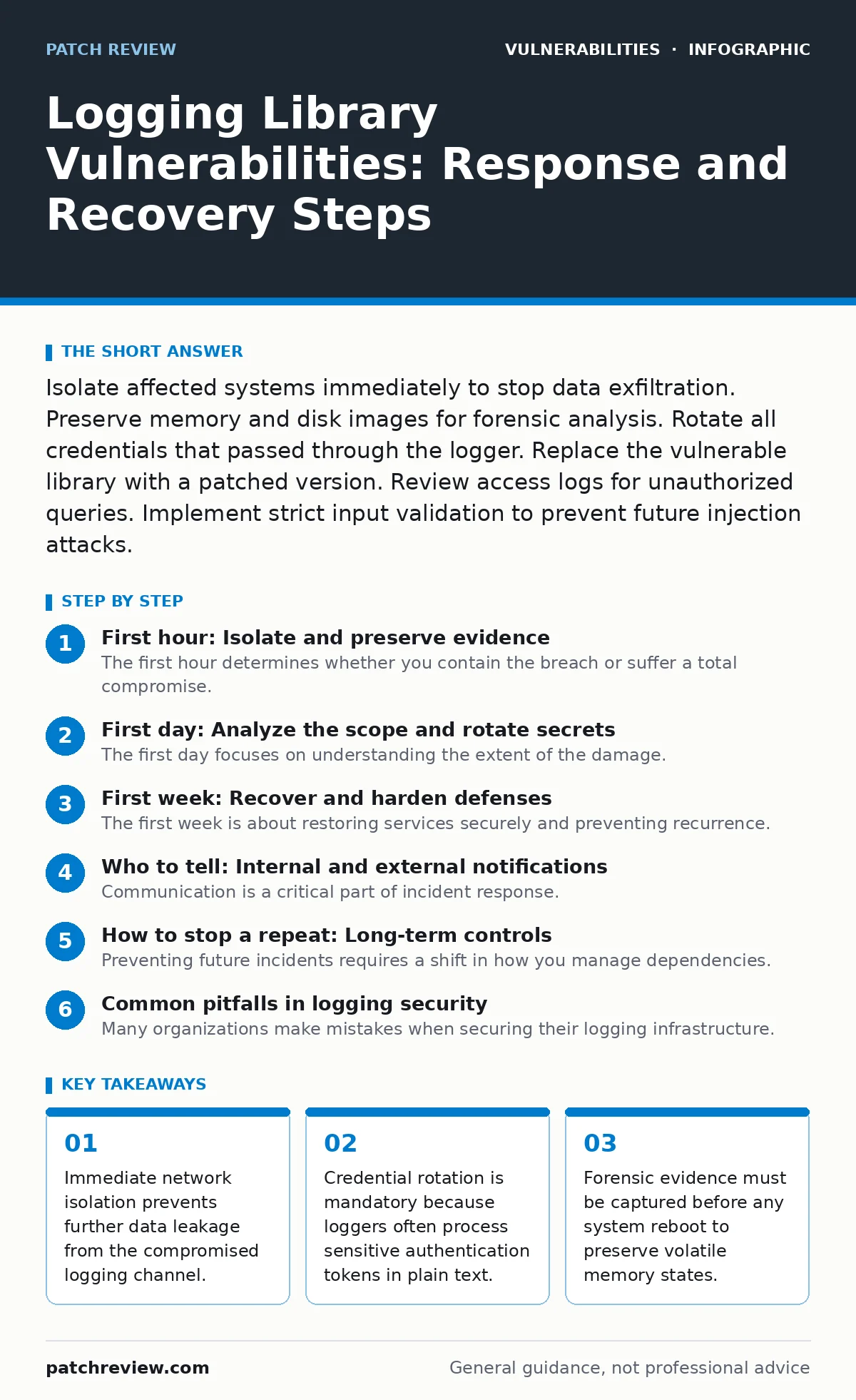
Isolate affected systems immediately to stop data exfiltration. Preserve memory and disk images for forensic analysis. Rotate all credentials that passed through the logger. Replace the vulnerable library with a patched version. Review access logs for unauthorized queries. Implement strict input validation to prevent future injection attacks.
First hour: Isolate and preserve evidence
The first hour determines whether you contain the breach or suffer a total compromise. Logging libraries process high-volume data streams, giving an attacker a persistent channel to exfiltrate sensitive information. You must act quickly to cut off this channel while preserving the digital scene for later analysis.
- Disconnect affected servers from the network immediately.
- Capture volatile memory from live systems.
- Identify all instances using the vulnerable library.
- Disable the logging service without stopping the application.
- Notify the incident response team lead.
- Document all actions taken with timestamps.
You must isolate the affected systems from the network immediately. This stops the attacker from continuing to send stolen data to their command and control servers. Do not shut down the machine if you can avoid it. Powering off the system clears the random access memory. That memory contains evidence of running processes and open network connections. Losing this data makes forensic analysis significantly harder.
Identify every system that uses the vulnerable logging library. Attackers often move laterally across infrastructure. If one server is compromised, others in the same cluster may be at risk. Check your configuration management tools to find all deployments. Do not rely on manual checks. Automated inventory tools provide a complete list. This ensures you do not miss a hidden instance that continues to leak data.
First day: Analyze the scope and rotate secrets
The first day focuses on understanding the extent of the damage. You need to determine what data passed through the logger and which systems were accessed. This phase requires careful analysis of logs, configuration files, and network traffic records. Rushing this step leads to missed indicators of compromise.
Analyze the application logs for unusual patterns. Look for excessive error messages or unexpected data formats. Attackers often use logging libraries to execute code injection attacks. These attacks can leave traces in the log files themselves. Search for commands that should not appear in normal operation. This helps you identify the specific vulnerability being exploited.
Rotate all credentials that may have passed through the logger. Logging libraries often capture request headers, query parameters, and session tokens. If an attacker controls the logger, they can read these sensitive values. Reset API keys, database passwords, and user session tokens. This step is critical because the attacker may have already stolen valid authentication tokens.
Review access logs for unauthorized queries. Compare recent activity against baseline behavior. Look for access to sensitive endpoints or data stores that the application does not normally touch. This helps you identify if the attacker used the logging library to pivot to other systems. You must assume that any secret processed by the logger is compromised.
First week: Recover and harden defenses
The first week is about restoring services securely and preventing recurrence. You must replace the vulnerable library, verify the integrity of your systems, and implement additional controls. This phase ensures that the application remains functional while eliminating the security gap.
Replace the vulnerable logging library with a patched version. Do not simply revert to a previous configuration. Update to the latest stable release that addresses the specific vulnerability. Verify the integrity of the new library files. Use checksums to ensure the binaries have not been tampered with during the update process. This prevents an attacker from reintroducing the backdoor.
Implement strict input validation for all log entries. Logging libraries should never execute untrusted data. Sanitize all inputs before they are passed to the logging function. This prevents injection attacks from exploiting the library again. Use allowlists for expected data formats. Reject any input that does not match the expected pattern. This reduces the attack surface significantly.
Monitor the system for signs of recurring activity. Set up alerts for unusual logging behavior. Watch for spikes in log volume or unexpected data destinations. This helps you detect if the attacker has found another way to exploit the system. Continuous monitoring is essential for maintaining security posture.
Who to tell: Internal and external notifications
Communication is a critical part of incident response. You must inform the right people at the right time. Delaying notifications can lead to regulatory violations and reputational damage. Be precise about what happened and what you are doing to fix it.
Inform your internal security team immediately. They need to coordinate the response efforts. Share your findings with the development team. They need to understand the technical details to fix the code. Notify management about the potential business impact. They need to make decisions about resource allocation and external communications.
If customer data was compromised, you must notify them. Check your legal obligations for breach notification. Provide clear information about what data was exposed. Explain the steps you are taking to protect them. This maintains trust and compliance with privacy regulations.
How to stop a repeat: Long-term controls
Preventing future incidents requires a shift in how you manage dependencies. You must establish processes for continuous monitoring and rapid response. This reduces the risk of similar vulnerabilities affecting your infrastructure.
Implement automated dependency scanning. Integrate these tools into your continuous integration pipeline. This catches vulnerable libraries before they reach production. Review third-party components regularly. Do not assume that open-source libraries are secure by default. Verify their security posture before adoption.
Use minimal logging configurations. Log only what is necessary for debugging and auditing. Avoid logging sensitive data such as passwords or personal information. This reduces the impact of a logging library compromise. Implement log aggregation with strict access controls. This prevents attackers from reading logs even if they compromise the application.
See also: Replay Attack Response: Containment, Recovery, and Prevention Steps · Warning Signs of GitLab Vulnerabilities in Self-Hosted Instances
Common pitfalls in logging security
Many organizations make mistakes when securing their logging infrastructure. Understanding these pitfalls helps you avoid common errors. These mistakes often lead to prolonged exposure and greater damage.
Assuming that logging libraries are secure by default is a major error. These libraries process untrusted data from users and external systems. They are frequent targets for injection attacks. You must treat all log inputs as hostile. Validate and sanitize every piece of data before logging.
Ignoring the sensitivity of log data is another common mistake. Logs often contain personal identifiable information and authentication tokens. Treating logs as harmless operational data leads to data breaches. Classify log data based on its sensitivity. Apply appropriate encryption and access controls.
Forensic considerations for logging incidents
Forensic analysis of logging incidents requires specific techniques. You must preserve evidence carefully to support investigation. This helps you understand the attack and improve your defenses.
Capture full memory images from affected systems. Analyze these images for injected code and network connections. Review disk images for modified log files. Compare current configurations against known good baselines. This helps you identify changes made by the attacker. Document every step of the analysis. This creates a record for legal and compliance purposes.
Key takeaways
- Immediate network isolation prevents further data leakage from the compromised logging channel.
- Credential rotation is mandatory because loggers often process sensitive authentication tokens in plain text.
- Forensic evidence must be captured before any system reboot to preserve volatile memory states.
Frequently asked questions
What is the immediate first step when a logging library vulnerability is discovered?
Isolate the affected systems from the network immediately to stop data exfiltration. Do not reboot the machines, as this destroys volatile memory evidence needed for forensic analysis.
How do I know if my logging library has been compromised?
Look for unusual patterns in log data, such as unexpected commands or data formats. Check for unauthorized access to sensitive endpoints and monitor for spikes in log volume or unexpected data destinations.
Should I rotate all credentials after a logging library breach?
Yes, you must rotate all credentials that may have passed through the logger. Logging libraries often capture session tokens and API keys in plain text, making them likely targets for theft.
How can I prevent logging library vulnerabilities in the future?
Implement automated dependency scanning in your development pipeline. Use strict input validation for all log entries and avoid logging sensitive data. Regularly update libraries and review their security posture.
How this guide was produced: written by the Patch Review editorial team with AI assistance, checked against the public references listed below, and reviewed when the facts change. See our editorial policy or report an error.