
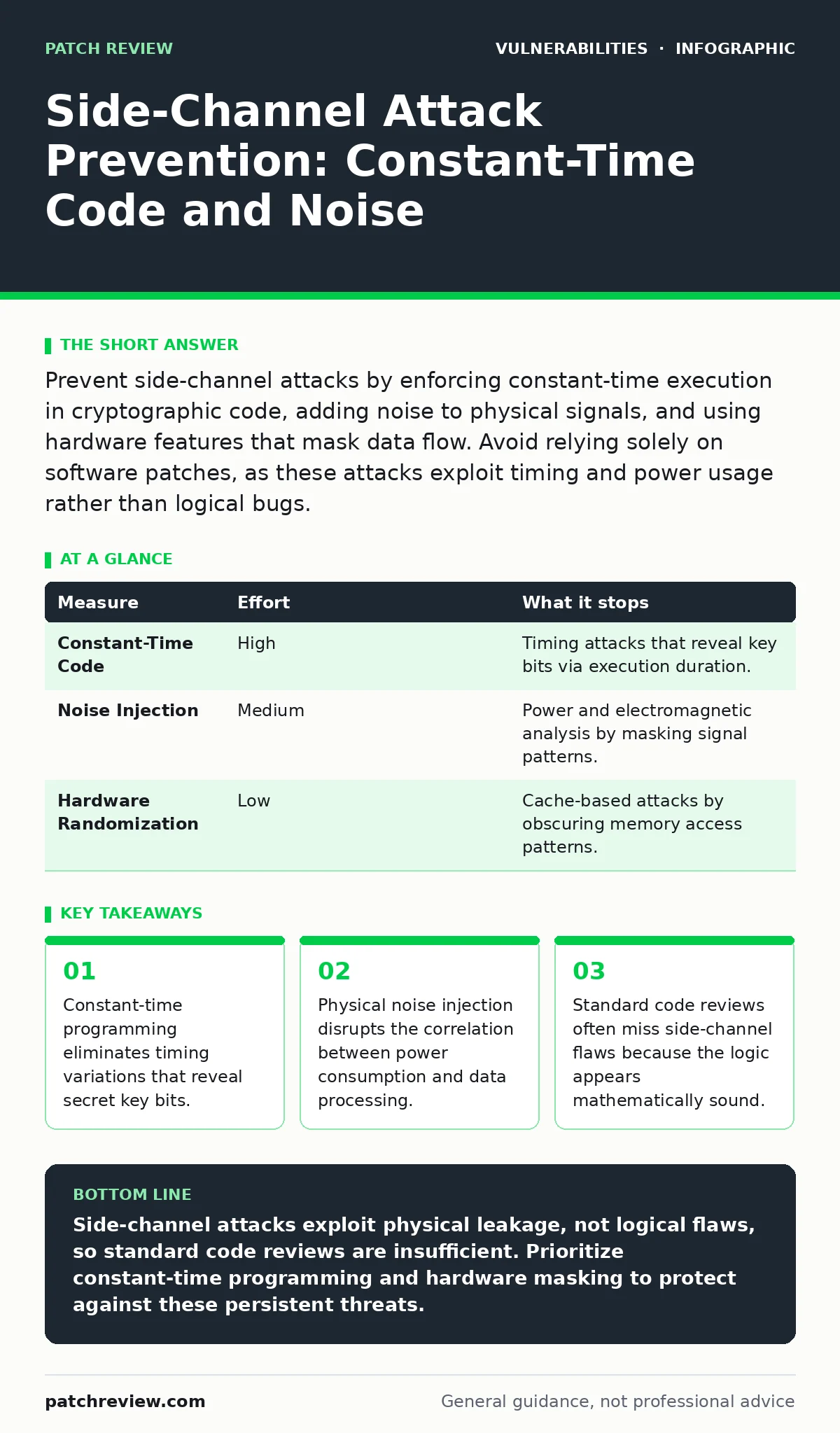
Prevent side-channel attacks by enforcing constant-time execution in cryptographic code, adding noise to physical signals, and using hardware features that mask data flow. Avoid relying solely on software patches, as these attacks exploit timing and power usage rather than logical bugs.
Timing Is the Enemy of Secrecy
Side-channel attacks do not break the mathematics of encryption. They exploit the physical implementation of that encryption. When a computer processes data, it emits measurable signals. These signals include execution time, power consumption, electromagnetic radiation, and even sound. An attacker correlates these signals with the secret data being processed. This allows them to reconstruct keys without ever guessing the password or breaking the cipher. You are defending against an observer, not a mathematician.
The core problem is that most code paths depend on the data they process. If a check fails early, the function returns quickly. If it succeeds, it runs longer. This difference in duration is the leak. To stop this, you must ensure that the execution path and duration remain identical regardless of the input data. This approach requires a fundamental shift in how you write cryptographic primitives. It moves the focus from logical correctness to physical consistency.
Constant-Time Implementation Logic
The most effective software defense is constant-time programming. This technique ensures that operations take the same amount of time regardless of the secret values involved. Consider a simple comparison function. A naive implementation compares bytes one by one. If the first byte matches, it moves to the second. If the first byte differs, it stops immediately. This early exit reveals that the first byte was wrong. An attacker can deduce the key byte by byte, measuring the time taken for each guess.
To fix this, you must compare all bytes and aggregate the result. You perform the comparison for every byte, storing the difference in a variable. You then combine these differences to produce a final result. The loop runs for every byte, even if a mismatch occurs early. This prevents the early return that leaks timing information. You must also avoid conditional branches that depend on secret data. Use bitwise operations instead of if-statements for control flow. This ensures the CPU follows the same instruction path every time.
| Measure | Effort | What it stops |
|---|---|---|
| Constant-Time Code | High | Timing attacks that reveal key bits via execution duration. |
| Noise Injection | Medium | Power and electromagnetic analysis by masking signal patterns. |
| Hardware Randomization | Low | Cache-based attacks by obscuring memory access patterns. |
Masking Physical Signals
Software changes alone are often insufficient against physical probes. Attackers can measure power consumption with high precision. They can also capture electromagnetic emissions from the circuit board. These signals correlate directly with the transistors switching on and off. To disrupt this correlation, you must introduce noise. This is known as masking. You add random data to the secret value before processing. You then process both the secret and the random data. The attacker sees a mix of signal and noise, making it difficult to isolate the secret.
This technique increases computational overhead. You are doing extra work to generate and manage the random masks. However, it significantly raises the barrier for entry. The attacker needs more measurements to average out the noise. This makes the attack impractical for many low-resource adversaries. You should apply this at the hardware level where possible. Modern secure elements and trusted platform modules often include built-in masking capabilities. Using these hardware features is more reliable than implementing masking in software.
Cache and Memory Access Patterns
Modern processors use caches to speed up data access. These caches are organized in sets and ways. When your code accesses memory, it may cause a cache hit or a cache miss. A hit is faster. A miss is slower. This difference creates a timing side channel. An attacker can monitor the cache state to infer what data your program is accessing. This is known as a cache-timing attack. It is particularly effective against cryptographic algorithms that use lookup tables.
To mitigate this, you must manage cache usage carefully. You can disable cache for sensitive operations. This forces all accesses to go to main memory, which takes a consistent amount of time. However, this slows down performance significantly. Alternatively, you can use cache-oblivious algorithms. These algorithms are designed to minimize cache dependencies. They do not rely on the cache state for their logic. You should also be aware that shared resources can leak information between processes. This is a common vector in virtualized environments. You may want to review your exposure management practices to ensure isolated environments for sensitive workloads.
What Does Not Work
Many standard security measures fail against side-channel attacks. Static code analysis tools often miss these flaws. They look for logical errors, such as buffer overflows or injection vulnerabilities. They do not measure execution time or power usage. A piece of code can be logically perfect and still leak secrets. Similarly, standard penetration testing tools do not detect side channels. They test for input validation and authentication bypass vulnerabilities. They do not monitor physical signals. You cannot rely on traditional testing methods to find these issues.
Another common misconception is that using a standard library solves the problem. While reputable libraries often implement constant-time functions, they are not immune. Implementations can have subtle bugs that introduce timing variations. You must verify that the library you use has been audited for side-channel resistance. Do not assume that because it is widely used, it is safe. Even if you are dealing with n-day vulnerabilities in other systems, side-channel flaws persist until the implementation is fundamentally changed. They are not fixed by simple patches. They require a redesign of the underlying logic.
See also: How to Prevent Clickjacking: Frame Busting and Header Defense
Prioritizing Your Defense Strategy
You should rank your prevention measures by the risk they remove. The highest priority is constant-time programming. This addresses the most common and easiest-to-exploit vector. It requires careful coding and verification. The second priority is hardware masking. This protects against physical probes that software cannot fully mitigate. The third priority is environmental control. This includes limiting access to the physical device and monitoring for unusual power usage. These measures create layers of defense. If one layer fails, the others may still protect the secret.
You must also consider the threat model. If your device is in a controlled environment, physical attacks are less likely. In this case, focus on software timing attacks. If your device is distributed to users, you must assume physical access. In this case, hardware masking and tamper resistance are critical. You should integrate these considerations into your design phase. It is much harder to add side-channel resistance after the code is written. Early planning saves significant rework later.
Immediate Action Items
You can take steps today to reduce your risk. First, audit your cryptographic code for conditional branches. Look for if-statements that depend on secret data. Replace them with bitwise operations. Second, review your use of standard libraries. Ensure they are from reputable sources with known side-channel resistance. Third, implement constant-time comparison functions for any authentication checks. This prevents timing attacks on passwords and tokens. These steps provide a strong foundation. They address the most common software-based side channels.
- Audit cryptographic code for data-dependent branches.
- Verify library implementations for side-channel resistance.
- Implement constant-time comparison for authentication.
Key takeaways
- Constant-time programming eliminates timing variations that reveal secret key bits.
- Physical noise injection disrupts the correlation between power consumption and data processing.
- Standard code reviews often miss side-channel flaws because the logic appears mathematically sound.
Side-channel attacks exploit physical leakage, not logical flaws, so standard code reviews are insufficient. Prioritize constant-time programming and hardware masking to protect against these persistent threats.
Frequently asked questions
Can I prevent side-channel attacks with a firewall?
No, firewalls filter network traffic and do not monitor physical signals or execution timing within your own systems.
Do side-channel attacks work on cloud servers?
Yes, shared cloud environments can leak data through cache and memory access patterns between virtual machines.
Is constant-time programming always faster?
No, constant-time code often performs extra operations to ensure consistent timing, which can reduce performance.
Should I worry about side-channels if I use HTTPS?
Yes, if your server implementation has timing leaks, attackers can potentially extract private keys despite the encryption protocol.
How this guide was produced: written by the Patch Review editorial team with AI assistance, checked against the public references listed below, and reviewed when the facts change. See our editorial policy or report an error.