
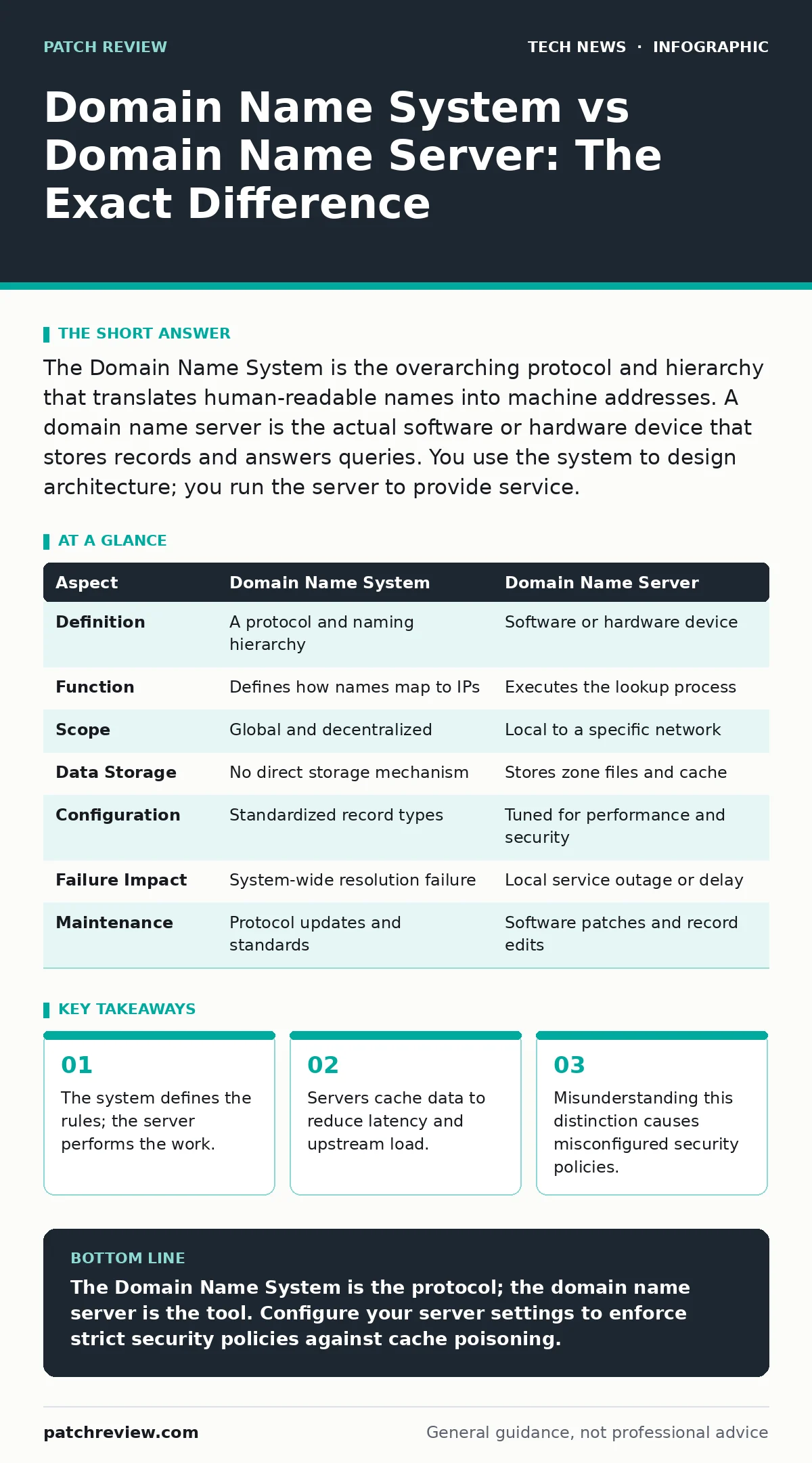
The Domain Name System is the overarching protocol and hierarchy that translates human-readable names into machine addresses. A domain name server is the actual software or hardware device that stores records and answers queries. You use the system to design architecture; you run the server to provide service.
Domain Name System vs Domain Name Server: The Core Difference
The confusion between the Domain Name System and a domain name server stems from their shared acronym. The Domain Name System is the distributed hierarchical naming system for computers, services, or other resources connected to the Internet. It is a protocol standard. A domain name server is a specific application or device that implements this protocol.
It holds the database of records and answers requests for translation. Think of the system as the laws of traffic and the server as the police officer directing cars. You cannot have one without the other in a functional network. The system provides the structure; the server provides the action. This distinction matters when you configure infrastructure or troubleshoot connectivity issues.
What Is the Domain Name System
The Domain Name System is a decentralized global database. It maps domain names to Internet Protocol addresses. This mapping allows users to access websites using memorable names instead of numerical strings. The system operates through a hierarchy of servers. At the top are root servers that direct queries to top-level domain servers. Those servers then point to authoritative name servers for specific domains.
This structure distributes the load and prevents single points of failure. The system also handles email routing and other service records. It is the foundational layer of Internet navigation. Without this system, every human interaction with the web would require memorizing complex numerical addresses. The system ensures consistency across different networks and providers.
What Is a Domain Name Server
A domain name server is a specialized computer system that responds to queries. It stores zone files containing resource records. When a client requests a name resolution, the server checks its local cache. If the answer is not cached, it queries other servers in the hierarchy. The server then returns the result to the client. There are different types of servers in this process.
Recursive resolvers handle the heavy lifting of looking up answers. Authoritative servers hold the definitive records for specific domains. You run a domain name server to provide this service to your users. It is software that listens on specific ports and processes requests. The server must be reliable and fast to maintain user experience.
Point-by-Point Comparison
| Aspect | Domain Name System | Domain Name Server |
|---|---|---|
| Definition | A protocol and naming hierarchy | Software or hardware device |
| Function | Defines how names map to IPs | Executes the lookup process |
| Scope | Global and decentralized | Local to a specific network |
| Data Storage | No direct storage mechanism | Stores zone files and cache |
| Configuration | Standardized record types | Tuned for performance and security |
| Failure Impact | System-wide resolution failure | Local service outage or delay |
| Maintenance | Protocol updates and standards | Software patches and record edits |
When to Choose the System Focus
You focus on the Domain Name System when designing architecture. This choice applies when you are planning how different services interact. You consider the system when defining record types for email or security. Understanding the hierarchy helps you troubleshoot complex routing issues. It is also relevant when implementing global policies. You choose this perspective when you need to explain concepts to stakeholders. It helps in documenting how data flows across boundaries. The system view is abstract but necessary for high-level planning. It ensures that your infrastructure aligns with global standards. This approach prevents compatibility issues with external services.
When to Choose the Server Focus
You choose the domain name server when deploying infrastructure. This applies when you are installing software on a machine. You configure the server to handle specific zones and clients. Tuning the server improves response times for your users. You manage the server to apply security patches and updates. It is the correct focus when troubleshooting local resolution failures. You adjust cache settings on the server to optimize performance. This choice is practical and operational. It involves direct interaction with configuration files. The server is the tool you use to enforce your security policies. It is the first line of defense against certain attacks.
Where They Overlap in Practice
The overlap occurs in daily operations and security. You cannot secure the server without understanding the system. Misconfigured records in the server can break the system for your users. Attackers often target the server to disrupt the system. Caching mechanisms in the server rely on system-defined time-to-live values. You must balance performance with accuracy in this overlap. Improper caching can lead to stale data being served. This affects user experience and security. You need to monitor both the server health and the system integrity. They are two sides of the same coin. Ignoring one leads to vulnerabilities in the other.
Security Implications for Beginners
Understanding this difference is critical for security. You secure the server to protect the system. Attackers may try to hijack the server to redirect traffic. They might corrupt the cache to serve malicious sites. You must implement strict access controls on the server. Regular audits of zone files are necessary. You should also validate responses from the system. This prevents attackers from injecting false data. The separation of concerns helps you isolate incidents. If the server is compromised, the system itself remains intact. You can restore the server from backups. This resilience is built into the design. You must maintain this discipline to stay secure.
Key takeaways
- The system defines the rules; the server performs the work.
- Servers cache data to reduce latency and upstream load.
- Misunderstanding this distinction causes misconfigured security policies.
The Domain Name System is the protocol; the domain name server is the tool. Configure your server settings to enforce strict security policies against cache poisoning.
Frequently asked questions
Can I run a domain name server without the Domain Name System?
No, the server implements the system's protocols. Without the system's rules, the server has no standard to follow for translation.
Do I need to understand both for basic troubleshooting?
Yes, basic issues often involve
How this guide was produced: written by the Patch Review editorial team with AI assistance, checked against the public references listed below, and reviewed when the facts change. See our editorial policy or report an error.