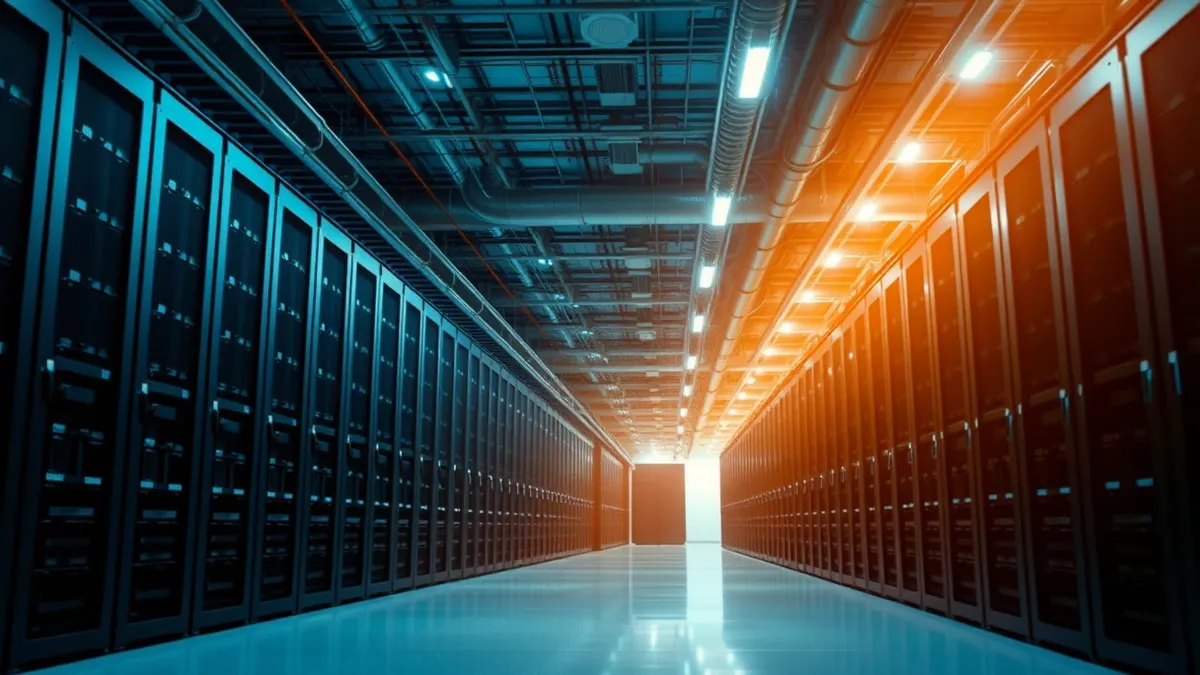
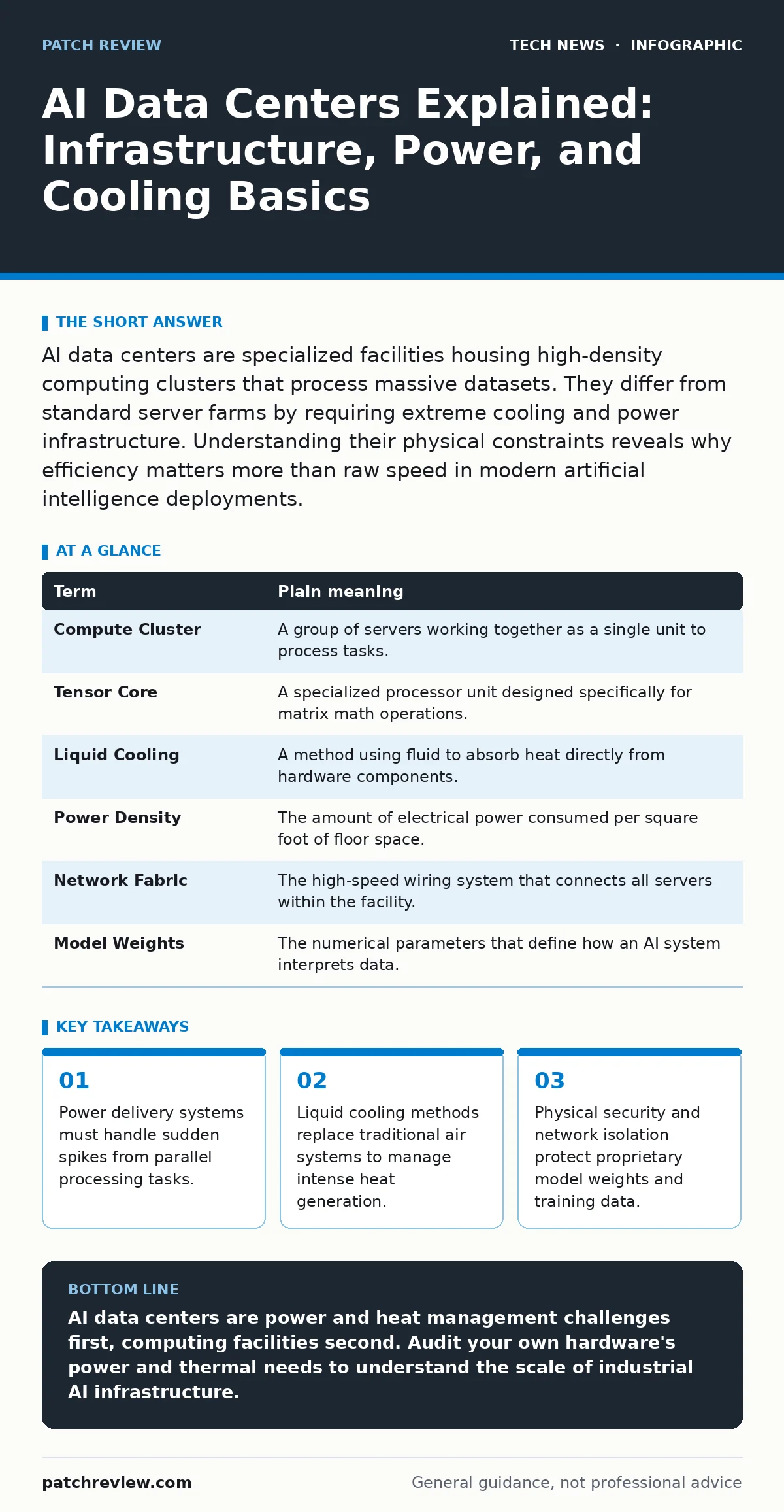
AI data centers are specialized facilities housing high-density computing clusters that process massive datasets. They differ from standard server farms by requiring extreme cooling and power infrastructure. Understanding their physical constraints reveals why efficiency matters more than raw speed in modern artificial intelligence deployments.
The Industrial Kitchen Analogy
Imagine a commercial kitchen preparing a banquet for thousands. Standard data centers resemble a home kitchen handling daily meals. AI data centers operate like that industrial kitchen during peak service. The chefs are the processors. The ingredients are the datasets. The heat generated by the stoves represents the thermal output of the hardware. If the ventilation fails, the kitchen shuts down. This analogy carries through every aspect of AI infrastructure design and operation.
Key Terms in Plain English
Understanding the vocabulary removes confusion about how these facilities function. The table below defines the core components you will encounter when studying artificial intelligence infrastructure.
| Term | Plain meaning |
|---|---|
| Compute Cluster | A group of servers working together as a single unit to process tasks. |
| Tensor Core | A specialized processor unit designed specifically for matrix math operations. |
| Liquid Cooling | A method using fluid to absorb heat directly from hardware components. |
| Power Density | The amount of electrical power consumed per square foot of floor space. |
| Network Fabric | The high-speed wiring system that connects all servers within the facility. |
| Model Weights | The numerical parameters that define how an AI system interprets data. |
Power Density and Physical Constraints
Standard servers require modest electrical support. AI workloads demand significantly more energy in a smaller footprint. This creates high power density. Imagine the industrial kitchen again. If you install ten industrial ovens in a space meant for two, the electrical grid overloads. AI data centers must upgrade their entire power delivery infrastructure. This includes transformers, switchgear, and backup generators. The cost of power infrastructure often exceeds the cost of the computing hardware itself.
Thermal Management Strategies
Heat is the primary enemy of high-performance computing. Air cooling works for general purpose servers. It fails for dense AI clusters. The industrial kitchen needs powerful exhaust fans and walk-in coolers. AI facilities use liquid cooling. Cold plates sit directly on the processors. Fluid circulates through these plates to absorb heat. This fluid then travels to a heat exchanger. Some facilities use water from nearby bodies. Others use evaporative cooling towers. The choice depends on local water availability and environmental regulations.
Network Fabric and Data Movement
Processing speed means nothing if data cannot move fast enough. The network fabric connects the compute clusters. Imagine the kitchen staff passing ingredients between stations. If the hallway is narrow, the chefs wait. In AI terms, this is network latency. High-speed interconnects replace standard Ethernet cables. These specialized links allow thousands of processors to share data instantly. Bottlenecks here slow down training times. Engineers optimize the physical layout of cables to minimize signal degradation.
Security of Physical and Logical Assets
Security extends beyond firewalls. Physical access controls are strict. Imagine locking the industrial kitchen at night. AI data centers use biometric scanners and mantraps. These prevent unauthorized entry. Logical security protects the model weights. These weights represent proprietary intellectual property. If stolen, competitors can replicate the service. Encryption at rest and in transit is mandatory. This mirrors the approach used in video conferencing security where data streams must remain private.
Common Points of Confusion
Readers often confuse storage with processing. AI data centers store vast amounts of data. However, the value lies in the computation. Another confusion involves cloud versus on-premise. Many assume AI runs only in the cloud. Large organizations build on-premise facilities to control data sovereignty. This relates to OAuth principles where trust boundaries are defined. Understanding where the data lives determines the security posture. DevOps security practices must adapt to these physical realities.
Try This Now
- Map the power requirements of your current development environment to understand baseline consumption.
- Identify the cooling method used by your local cloud provider or institution.
- Review password policies to ensure strong access controls for any administrative interfaces you manage.
These steps build a foundation for understanding infrastructure constraints. They highlight the physical costs of digital operations.
Key takeaways
- Power delivery systems must handle sudden spikes from parallel processing tasks.
- Liquid cooling methods replace traditional air systems to manage intense heat generation.
- Physical security and network isolation protect proprietary model weights and training data.
AI data centers are power and heat management challenges first, computing facilities second. Audit your own hardware's power and thermal needs to understand the scale of industrial AI infrastructure.
Frequently asked questions
Why do AI data centers use so much electricity?
Artificial intelligence models require massive parallel processing. Thousands of specialized processors run simultaneously, drawing continuous high current to perform matrix calculations on large datasets.
Can I build an AI data center in my garage?
You can build a small cluster, but it lacks industrial cooling and power redundancy. Residential electrical systems cannot handle the load, and heat buildup will damage components quickly.
How does liquid cooling work?
Coolant circulates through tubes attached directly to hot components. It absorbs heat and transfers it to a radiator or heat exchanger. This method is far more efficient than blowing air over hardware.
Is the data in AI centers encrypted?
Yes, sensitive data and model weights are encrypted at rest and in transit. This prevents unauthorized access even if physical storage media are stolen or intercepted during network transfer.
How this guide was produced: written by the Patch Review editorial team with AI assistance, checked against the public references listed below, and reviewed when the facts change. See our editorial policy or report an error.