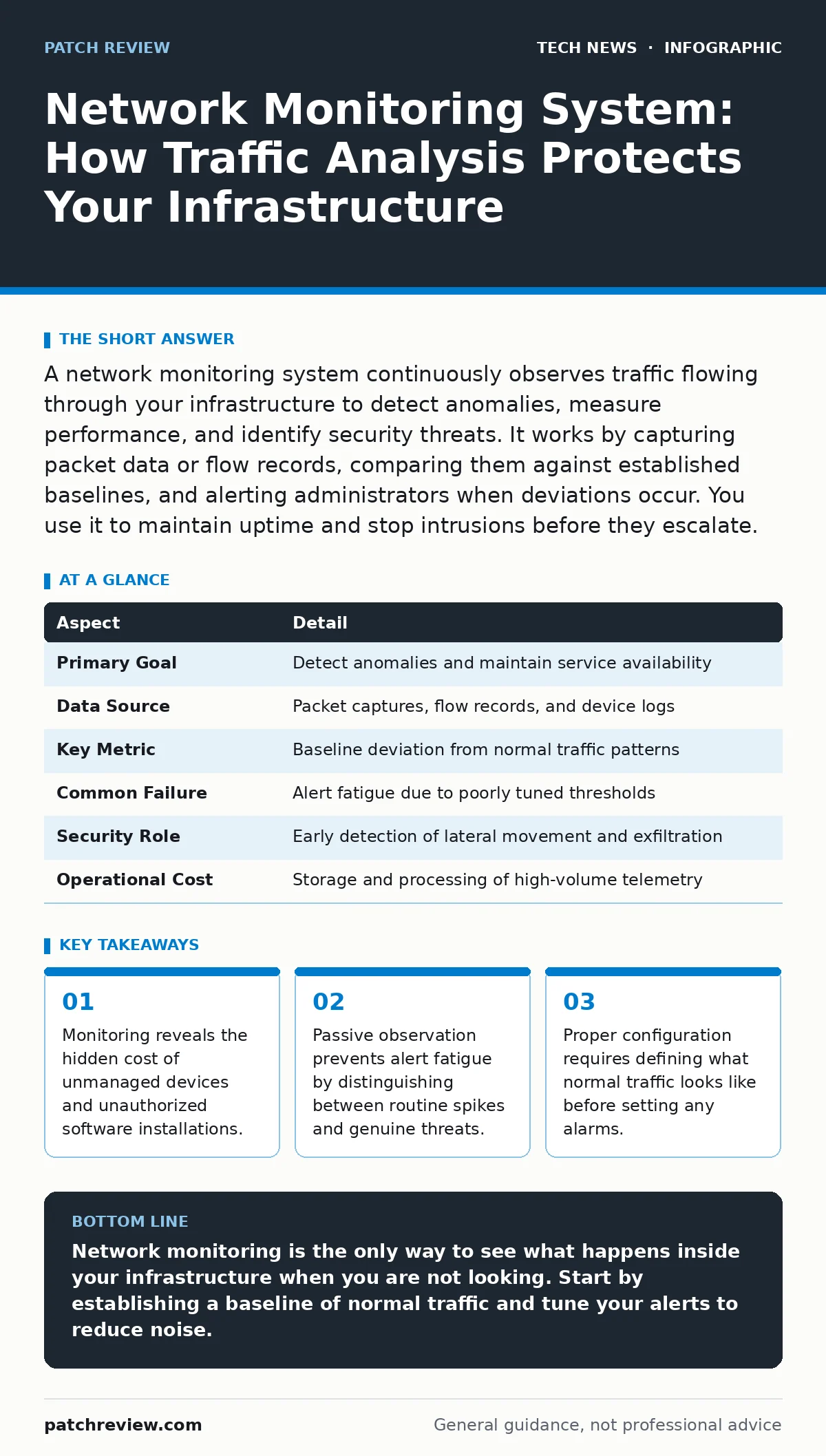
A network monitoring system continuously observes traffic flowing through your infrastructure to detect anomalies, measure performance, and identify security threats. It works by capturing packet data or flow records, comparing them against established baselines, and alerting administrators when deviations occur. You use it to maintain uptime and stop intrusions before they escalate.
The Plumbing of Your Digital Infrastructure
Imagine a city’s water supply network. Sensors measure pressure, flow rate, and purity at every junction. If a pipe bursts, the pressure drops instantly, and the system alerts maintenance crews. A network monitoring system functions as these sensors for your digital infrastructure. It observes the flow of data packets across routers, switches, and servers. Without these sensors, you cannot know if a pipe has burst until the water floods the basement.
Network monitoring is not merely a security tool. It is an operational necessity. It ensures that applications remain responsive and that data moves efficiently. When a service slows down, the monitoring system identifies whether the bottleneck lies in the hardware, the network configuration, or an external attack. This distinction saves hours of troubleshooting.
| Aspect | Detail |
|---|---|
| Primary Goal | Detect anomalies and maintain service availability |
| Data Source | Packet captures, flow records, and device logs |
| Key Metric | Baseline deviation from normal traffic patterns |
| Common Failure | Alert fatigue due to poorly tuned thresholds |
| Security Role | Early detection of lateral movement and exfiltration |
| Operational Cost | Storage and processing of high-volume telemetry |
How a Network Monitoring System Works
A network monitoring system operates through three distinct phases: collection, analysis, and alerting. The collection phase involves capturing data. This can happen through passive listening, where a sensor copies traffic passing a specific point, or active polling, where the system queries devices for their status. Passive listening provides deeper visibility into application-layer protocols. Active polling is lighter on resources but offers less detail about content.
The analysis phase compares new data against a historical baseline. The system learns what normal traffic looks like for your specific environment. If a server typically sends 100 requests per minute and suddenly sends 10,000, the system flags this deviation. The alerting phase notifies administrators. Effective systems filter noise, ensuring that only significant deviations trigger human intervention. This reduces alert fatigue, which is the primary cause of missed incidents.
Who Network Monitoring Actually Affects
Network monitoring impacts every role within an organization that relies on digital services. Security teams use it to detect intrusions. They look for unusual connections that suggest an attacker has moved laterally within the network. Operations teams use it to ensure reliability. They watch for packet loss or latency spikes that degrade user experience. Developers benefit indirectly. When monitoring identifies performance bottlenecks, developers can optimize their code or infrastructure.
Consider the impact on remote workers. If the monitoring system detects a drop in throughput, the IT team can diagnose whether the issue lies with the user’s home connection or the corporate network. This clarity prevents blame-shifting and accelerates resolution. The system also affects compliance officers. Many regulations require proof of continuous monitoring. The logs generated by the system serve as evidence that the organization actively protects its data.
What People Usually Get Wrong
Most organizations treat network monitoring as a set-and-forget solution. They install sensors and configure alerts, then never revisit the settings. This approach fails because network environments change. New applications introduce new traffic patterns. New servers add new endpoints. If the baseline is not updated, the system generates false positives. False positives lead to alert fatigue. When alerts become noise, operators ignore them. This blindness allows real threats to pass unnoticed.
Another common mistake is focusing solely on security. Organizations often buy monitoring tools to catch hackers, ignoring performance issues. This is a narrow view. A slow network is often a precursor to a security incident. Attackers exploit slow connections to hide their activities. By monitoring for performance degradation, you catch both usability issues and stealthy attacks. You must tune the system to balance security visibility with operational clarity.
Integrating Monitoring With Other Controls
Network monitoring does not operate in a vacuum. It must integrate with other security controls to be effective. For instance, open port management relies on monitoring to detect unauthorized services. If a server opens a port that should be closed, the monitoring system alerts the administrator. This allows for rapid remediation. Similarly, bring your own device policies are enforced more effectively when monitoring identifies unauthorized devices connecting to the network.
Monitoring also complements reverse proxies. A reverse proxy sits between clients and servers, handling requests and protecting the backend. Monitoring the traffic between the proxy and the server reveals application-layer attacks that might bypass perimeter defenses. This layered approach ensures that if one control fails, another detects the breach. You should also review your password policies regularly. Monitoring can detect brute-force attempts, but strong passwords reduce the likelihood of success.
See also: How Ransomware Works: The Step-by-Step Infection Cycle · DDoS Protection Checklist: Mitigation Strategies and Architecture
The Hidden Cost of Data Retention
One non-obvious consequence of network monitoring is storage cost. Capturing full packet data generates massive volumes of information. Storing this data for long periods is expensive. Many organizations try to save money by deleting data quickly. This is a dangerous trade-off. Forensic investigations often require historical data to reconstruct an incident. If you delete the data, you lose the ability to understand how an attack occurred.
A better approach is to store full packet captures for a short period and flow records for a longer period. Flow records summarize traffic without storing every packet. They are smaller and cheaper to store. They provide enough detail for most security investigations. You must decide how much visibility you need versus how much you can afford. This decision should be documented and reviewed annually.
Tuning for Signal Over Noise
The most difficult part of network monitoring is tuning. You must configure the system to ignore routine changes and highlight genuine threats. Start by establishing a baseline over several weeks. Observe traffic patterns during different times of the day and days of the week. Identify normal peaks and troughs. Then, set thresholds that trigger alerts only when traffic deviates significantly from this baseline.
Regularly review alerts. Ask yourself why each alert was generated. If an alert was a false positive, adjust the threshold. If it was a true positive, document the incident and update your response procedures. This iterative process improves the system’s accuracy over time. It transforms the monitoring system from a noise generator into a reliable early warning system. You must commit to this tuning process continuously.
Key takeaways
- Monitoring reveals the hidden cost of unmanaged devices and unauthorized software installations.
- Passive observation prevents alert fatigue by distinguishing between routine spikes and genuine threats.
- Proper configuration requires defining what normal traffic looks like before setting any alarms.
Network monitoring is the only way to see what happens inside your infrastructure when you are not looking. Start by establishing a baseline of normal traffic and tune your alerts to reduce noise.
Frequently asked questions
What is the difference between network monitoring and intrusion detection?
Network monitoring observes all traffic for performance and anomalies, while intrusion detection focuses specifically on known attack signatures. Monitoring is broader and often catches threats that signature-based tools miss.
How do I choose between packet capture and flow analysis?
Use packet capture for deep inspection of specific incidents and flow analysis for continuous, high-volume monitoring. Flow analysis is cheaper and scales better for long-term retention.
Can network monitoring protect against insider threats?
Yes, by detecting unusual data transfers or access patterns that deviate from an employee’s normal behavior. It provides visibility into actions that endpoint security might miss.
Is cloud-based network monitoring as effective as on-premise?
Cloud-based monitoring offers scalability and ease of management, but on-premise solutions provide greater control over data privacy. Choose based on your regulatory requirements and infrastructure complexity.
How this guide was produced: written by the Patch Review editorial team with AI assistance, checked against the public references listed below, and reviewed when the facts change. See our editorial policy or report an error.