
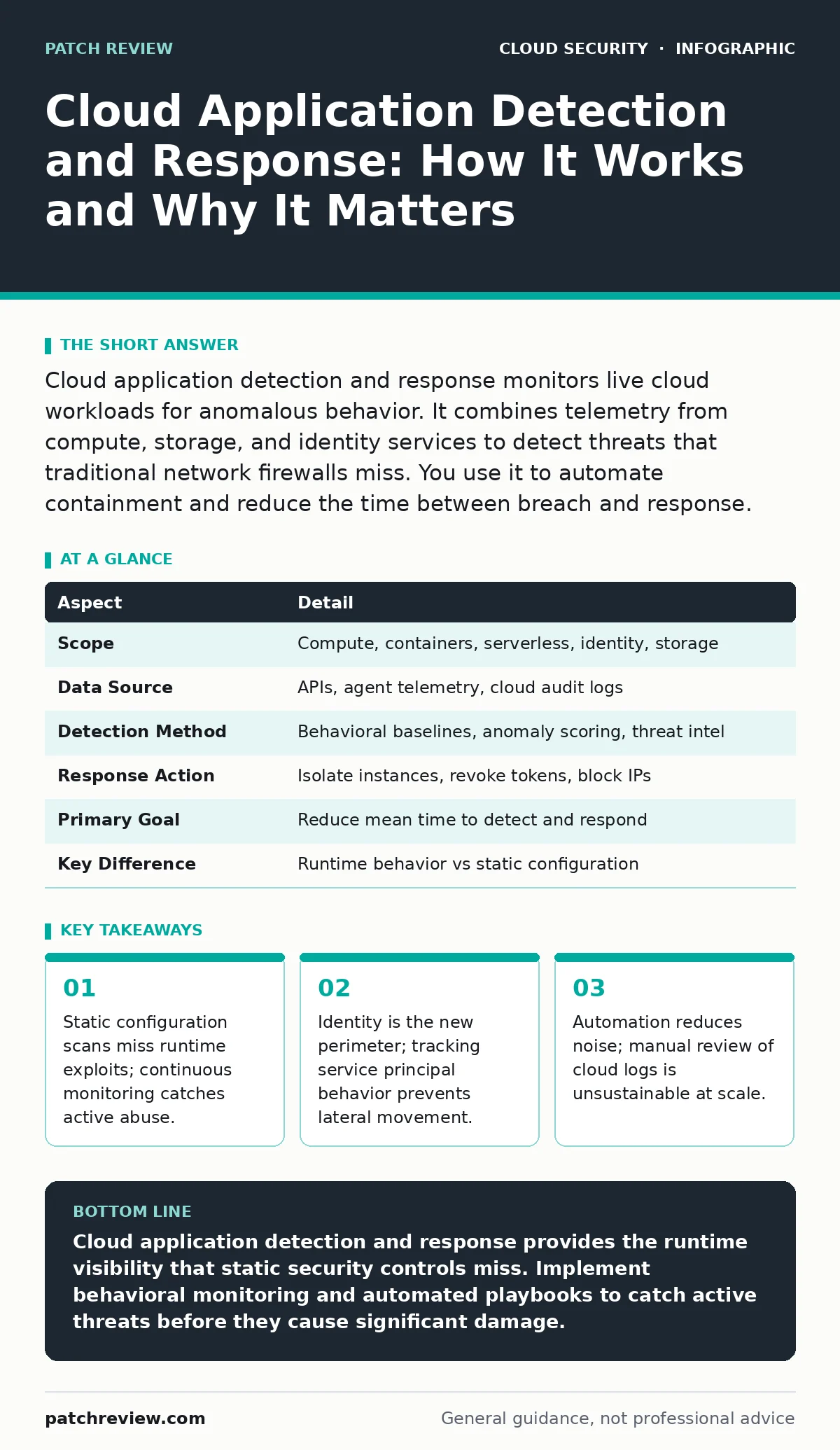
Cloud application detection and response monitors live cloud workloads for anomalous behavior. It combines telemetry from compute, storage, and identity services to detect threats that traditional network firewalls miss. You use it to automate containment and reduce the time between breach and response.
The Shift from Perimeter to Runtime
Imagine a bank that secures its vault with heavy doors but ignores the tellers who handle cash inside. Traditional network security focuses on the outer wall. Cloud application detection and response focuses on what happens after the wall is breached. This approach recognizes that in cloud environments, the perimeter is porous and identities move freely.
Cloud application detection and response is a continuous monitoring and automated reaction system for cloud workloads. It observes compute instances, containers, serverless functions, and identity credentials in real time. Unlike periodic scans that check for misconfigurations, this system watches for active threats. It answers the question of what is happening right now, not just what was wrong yesterday.
| Aspect | Detail |
|---|---|
| Scope | Compute, containers, serverless, identity, storage |
| Data Source | APIs, agent telemetry, cloud audit logs |
| Detection Method | Behavioral baselines, anomaly scoring, threat intel |
| Response Action | Isolate instances, revoke tokens, block IPs |
| Primary Goal | Reduce mean time to detect and respond |
| Key Difference | Runtime behavior vs static configuration |
How Cloud Application Detection and Response Works
The system relies on three layers: data collection, analysis, and automation. First, it gathers telemetry from cloud providers. This includes audit logs, network flow data, and host-level metrics. Agents installed on virtual machines or containers send detailed process information. Without agents, you rely on cloud provider APIs, which offer less granularity but broader coverage.
Next, the platform establishes a baseline of normal behavior. It learns how your applications typically use resources. A web server that suddenly starts downloading large files or connecting to unknown external IPs triggers an alert. The system correlates these events across services. A login from a new location combined with an unusual API call is more suspicious than either event alone.
Finally, the system executes predefined playbooks. These are automated responses triggered by specific detection rules. Actions might include isolating a compromised container, revoking an active session token, or blocking a malicious IP address. Automation ensures that response happens instantly, without waiting for human intervention. This speed is critical when attackers move quickly through cloud environments.
Who Is Affected by Runtime Threats
Every organization using cloud services faces these risks. The impact varies by architecture. Teams using serverless functions face different challenges than those running virtual machines. Serverless environments are ephemeral; they start and stop in seconds. Traditional endpoint security cannot keep up with this pace. You need detection that works without persistent agents.
Organizations with complex microservices architectures are particularly vulnerable. These systems rely on many internal service-to-service communications. An attacker who compromises one service can pivot to others. If your security team only monitors external traffic, they miss internal lateral movement. This is where cloud privilege escalation often begins. An attacker gains low-level access and uses it to take over higher-privileged services.
Developers also face pressure. They want speed and flexibility. Security controls that slow down deployments are often bypassed. Cloud application detection and response must integrate into the development lifecycle without adding friction. If the tool generates too many false positives, developers will ignore alerts. This leads to alert fatigue and missed threats.
What People Usually Get Wrong
Many teams assume that configuring cloud security groups is enough. Security groups act as virtual firewalls. They control inbound and outbound traffic. However, they do not monitor what happens inside the instance. An attacker can use allowed ports to exploit a vulnerability within the application. You need visibility beyond the network layer.
Another common error is relying solely on cloud provider logs. These logs are valuable but incomplete. They record API calls, not process execution. If malware runs inside a container, it may not generate API calls. You miss the threat entirely. This is why many organizations combine cloud logs with host-based agents. The agents provide the missing context about processes and files.
Teams often neglect identity monitoring. They focus on infrastructure and forget that credentials are the keys to the kingdom. Leaked cloud access keys remain a top threat. Attackers use stolen keys to impersonate legitimate users. If you do not monitor identity behavior, you cannot detect this impersonation. You must treat identity as a primary security surface.
Integrating with Existing Security Tools
Cloud application detection and response does not replace other tools. It complements them. You should integrate it with your security information and event management platform. This centralizes alerts and allows for correlation. An alert from your web application firewall can be linked to a suspicious process in the cloud.
Secrets managers play a key role in preventing credential theft. They store and rotate credentials automatically. Integrating detection tools with secrets managers allows you to revoke compromised keys instantly. This reduces the window of exposure. Without this integration, manual revocation takes too long.
Service mesh security adds another layer. Service meshes manage traffic between microservices. They can enforce policies at the network level. Combining service mesh data with runtime detection gives you a complete view. You see both the network traffic and the application behavior. This dual perspective improves detection accuracy.
See also: Detect Leaked Cloud Access Keys Before Attackers Do · How to Implement SASE: A Step-by-Step Network Architecture Guide
Building a Detection Strategy
Start by defining your critical assets. Not all workloads are equal. Identify the systems that hold sensitive data or provide core functionality. Focus your monitoring efforts on these high-value targets. This prioritization reduces noise and ensures you catch the most dangerous threats.
Next, establish baselines for normal behavior. This takes time. You must collect data over several weeks to understand typical patterns. Avoid setting alerts too early. You will generate false positives and lose trust. Use machine learning models that adapt to changes in your environment. Static rules become outdated quickly.
Finally, test your response playbooks. Simulate attacks to verify that automation works. Do not rely on theoretical configurations. Real-world attacks behave differently than simulations. Regular testing ensures that your system responds correctly when it matters. This practice is similar to fire drills for physical buildings.
The Role of Visibility and Logging
Effective detection requires complete visibility. Cloud logging gaps can hide attackers. If you do not enable logging for all services, you create blind spots. Attackers exploit these gaps to hide their activities. Ensure that logging is enabled by default for all new resources.
Centralize your logs. Storing logs in multiple locations makes analysis difficult. Use a single platform to ingest and analyze data. This simplifies correlation and speeds up investigation. Retain logs for a sufficient period. You may need to look back in time to understand the full scope of an attack.
Monitor for cloud metadata service attacks. These attacks target the metadata service that provides instance information. Attackers use this data to steal credentials. Detecting unusual access to metadata endpoints is a key indicator of compromise. Configure alerts for any access from unexpected sources.
Moving Beyond Reactive Security
Cloud application detection and response is not just about reacting to breaches. It is about improving your security posture continuously. Use the data to identify weaknesses. If you see frequent failed login attempts, strengthen your authentication. If you see unusual network traffic, review your segmentation.
Share insights with your development team. Security is a shared responsibility. Developers need to understand the risks they introduce. Provide feedback on secure coding practices. Integrate security checks into your deployment pipeline. This shifts security left and prevents issues before they reach production.
Review and update your detection rules regularly. Threats evolve. New tactics emerge. Your rules must adapt. Stay informed about the latest cloud security trends. Engage with the security community. Learn from others' experiences. This continuous improvement mindset is the key to long-term success.
Key takeaways
- Static configuration scans miss runtime exploits; continuous monitoring catches active abuse.
- Identity is the new perimeter; tracking service principal behavior prevents lateral movement.
- Automation reduces noise; manual review of cloud logs is unsustainable at scale.
Cloud application detection and response provides the runtime visibility that static security controls miss. Implement behavioral monitoring and automated playbooks to catch active threats before they cause significant damage.
Frequently asked questions
How does this differ from traditional endpoint detection?
Traditional endpoint detection focuses on individual devices. Cloud detection monitors ephemeral workloads and identity flows across distributed services, which standard agents often miss.
Do I need agents on every server?
Agents provide deeper visibility into processes and files. However, they add overhead. You can use agentless methods for basic monitoring, but critical assets benefit from agent-based telemetry.
Can this replace my firewall?
No. Firewalls control network traffic. This system monitors behavior and identity. They serve different purposes and should be used together for layered defense.
How do I reduce false positives?
Start with a narrow scope and establish clear baselines. Use machine learning to adapt to normal changes. Regularly tune your rules based on feedback from your security team.
How this guide was produced: written by the Patch Review editorial team with AI assistance, checked against the public references listed below, and reviewed when the facts change. See our editorial policy or report an error.