
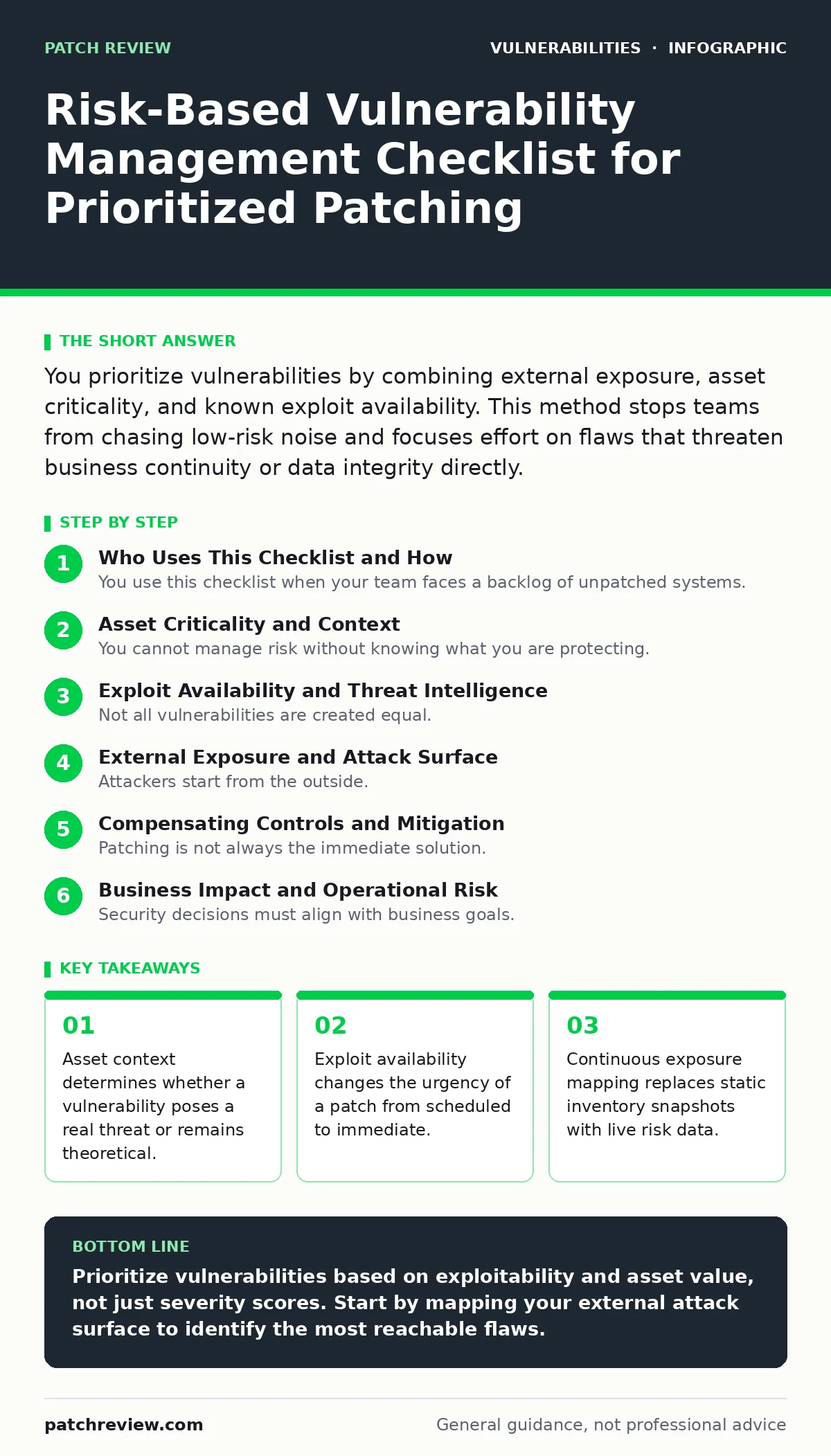
You prioritize vulnerabilities by combining external exposure, asset criticality, and known exploit availability. This method stops teams from chasing low-risk noise and focuses effort on flaws that threaten business continuity or data integrity directly.
Who Uses This Checklist and How
You use this checklist when your team faces a backlog of unpatched systems. The goal is not to fix every flaw immediately. The goal is to fix the right flaws first. This approach prevents alert fatigue and ensures security resources protect the most valuable assets.
Imagine a server with a critical flaw that no one can reach. Fixing it consumes time that could secure a public-facing application with a moderate flaw. This checklist helps you make that calculation objectively.
Asset Criticality and Context
You cannot manage risk without knowing what you are protecting. Start by classifying assets based on their role in your organization. A development laptop carries different risk than a production database server.
- Identify data sensitivity levels: High-value data requires stricter patching timelines than public marketing content.
- Map application dependencies: A flaw in a shared library affects every service that imports it.
- Define user access boundaries: Internal-only systems face fewer attack vectors than internet-exposed endpoints.
Context matters more than severity scores. A high-severity flaw on an isolated system may pose less risk than a low-severity flaw on a gateway. You must understand the path an attacker would take. This understanding informs the rest of your prioritization strategy.
Exploit Availability and Threat Intelligence
Not all vulnerabilities are created equal. Some exist only in theory. Others have active exploit code circulating in the wild. You must distinguish between these two states.
- Check for known exploit code: Publicly available exploits increase the likelihood of successful attacks.
- Monitor threat actor activity: Groups targeting your industry may prioritize specific software versions.
- Verify vendor patch status: Unpatched flaws with no fix available require compensating controls.
Exploit availability acts as a force multiplier. A moderate flaw with a ready-made exploit becomes a critical risk. You should integrate threat intelligence feeds into your workflow. This keeps your prioritization dynamic rather than static.
See our guide on emergency patching for procedures when exploit code appears unexpectedly.
External Exposure and Attack Surface
Attackers start from the outside. They scan for open ports and exposed services. Your external attack surface determines which vulnerabilities are reachable.
- Audit open ports and services: Closed ports reduce the number of entry points for attackers.
- Review firewall rules: Misconfigured rules may expose internal systems to direct internet traffic.
- Assess API endpoints: Unauthenticated APIs often bypass traditional perimeter defenses.
Exposure management provides a clearer picture of risk than vulnerability scanning alone. You need to know what is visible to the internet. This visibility dictates which flaws require immediate attention.
Refer to exposure management techniques for continuous monitoring of your external footprint.
Compensating Controls and Mitigation
Patching is not always the immediate solution. Sometimes, you cannot patch due to compatibility issues or maintenance windows. In these cases, you need other layers of defense.
- Implement network segmentation: Isolating systems limits lateral movement after a breach.
- Apply web application firewalls: WAFs can block exploit attempts before they reach the server.
- Enforce least privilege access: Restricting user rights reduces the impact of a successful compromise.
Compensating controls buy time. They do not eliminate the vulnerability. They reduce the probability of exploitation. You must document these controls and review them regularly. They are temporary measures, not permanent fixes.
This approach aligns with secure code review practices that identify weaknesses early in development.
See also: OWASP Top 10 FAQ: Clarifying Misconceptions and Real-World Impact · Emergency Patching: How to Fix Critical Flaws Without Breaking Systems
Business Impact and Operational Risk
Security decisions must align with business goals. Shutting down a system to patch it may cause more harm than leaving it vulnerable temporarily. You must weigh security risk against operational impact.
- Estimate downtime costs: Scheduled maintenance during off-hours reduces business disruption.
- Assess regulatory requirements: Certain industries mandate specific patching timelines for compliance.
- Review insurance implications: Cyber insurance policies may require specific security postures.
Business impact analysis ensures security supports the organization. It prevents security teams from becoming bottlenecks. You should involve operations and finance teams in this assessment. Their input provides a complete view of risk.
Maintenance and Continuous Improvement
Risk-based vulnerability management is not a one-time task. Threats evolve. Your environment changes. Your prioritization logic must adapt.
- Schedule regular reviews: Re-evaluate risk scores quarterly to account for new threats.
- Update asset inventories: New systems must be classified and integrated into the workflow.
- Measure patch latency: Track time from detection to remediation to identify bottlenecks.
Continuous improvement keeps your program effective. You should measure success by reduced risk, not just reduced vulnerability counts. This shift in metric drives better outcomes.
See OWASP Top 10 for common web application risks to include in your review.
Integrating with Development Lifecycles
Shifting left reduces the cost of fixing vulnerabilities. Addressing flaws in code is cheaper than patching production systems.
- Automate static analysis: Catch coding errors before they reach deployment.
- Include security training: Developers who understand clickjacking and other flaws write safer code.
- Establish feedback loops: Share vulnerability data with development teams to prevent recurrence.
Integration reduces the volume of vulnerabilities reaching production. It changes the culture from reactive to proactive. You should treat security as a shared responsibility.
Refer to bug bounty programs for external validation of your security posture.
Key takeaways
- Asset context determines whether a vulnerability poses a real threat or remains theoretical.
- Exploit availability changes the urgency of a patch from scheduled to immediate.
- Continuous exposure mapping replaces static inventory snapshots with live risk data.
Prioritize vulnerabilities based on exploitability and asset value, not just severity scores. Start by mapping your external attack surface to identify the most reachable flaws.
Frequently asked questions
How often should I update my risk-based vulnerability management checklist?
Review and update the checklist quarterly or whenever your infrastructure undergoes significant changes.
Can I automate risk-based vulnerability management?
Yes, tools can calculate risk scores automatically, but human judgment remains necessary for context.
What if a critical asset has no patch available?
Implement compensating controls like network segmentation and monitoring until a patch is released.
How do I handle zero-day vulnerabilities?
Treat zero-days as high-risk immediately, applying emergency controls and monitoring for exploit activity.
How this guide was produced: written by the Patch Review editorial team with AI assistance, checked against the public references listed below, and reviewed when the facts change. See our editorial policy or report an error.