
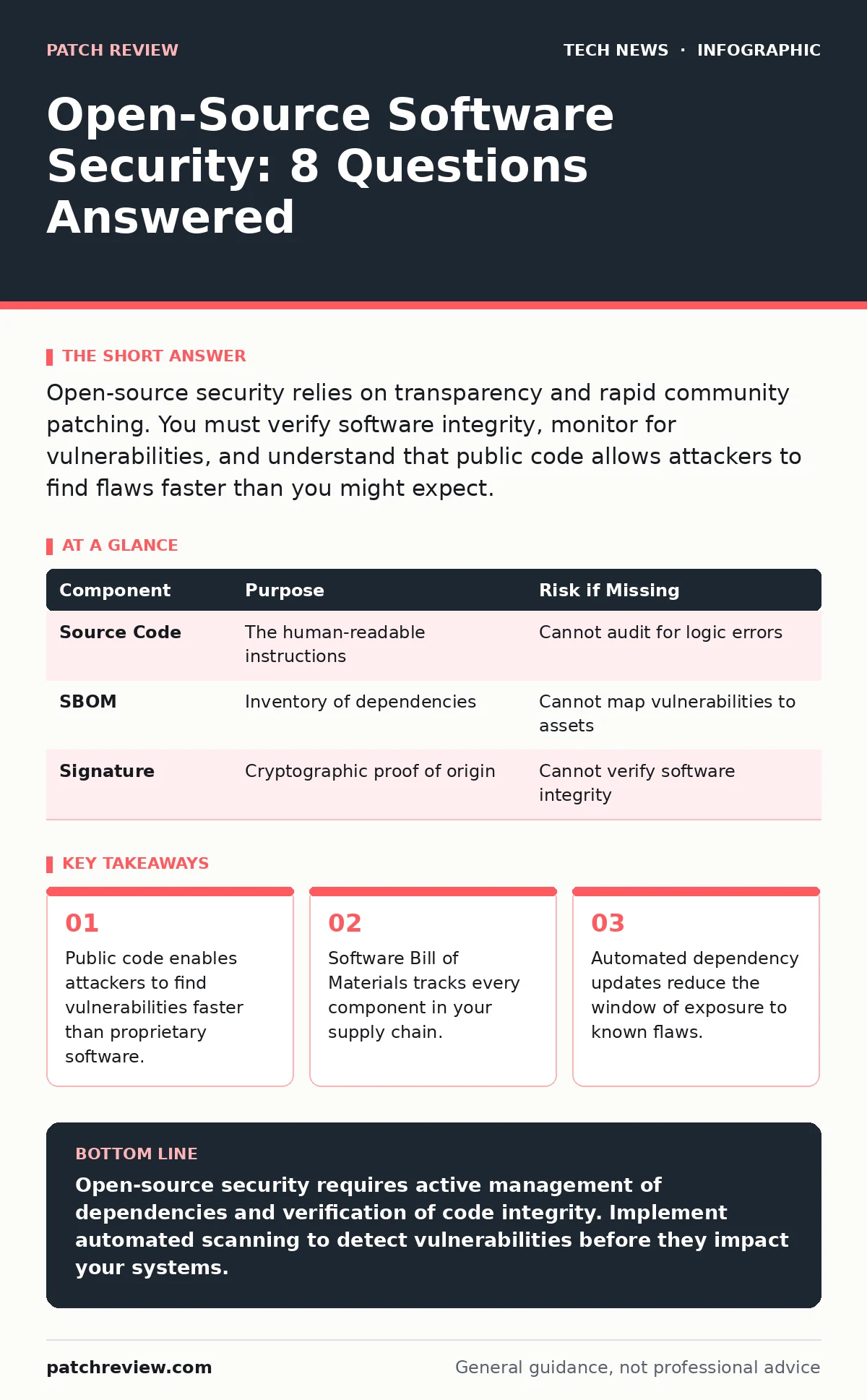
Open-source security relies on transparency and rapid community patching. You must verify software integrity, monitor for vulnerabilities, and understand that public code allows attackers to find flaws faster than you might expect.
Why is open-source code considered more secure than proprietary software?
The visibility of the source code allows many independent reviewers to find and fix errors, a concept known as "many eyes." This transparency means that security flaws are often discovered and patched by the community before they are exploited in the wild. However, this assumes that someone is actually looking at the code, which is not guaranteed for every project.
How do attackers exploit open-source vulnerabilities?
Attackers scan public repositories for unpatched flaws in popular libraries, then create exploits that target systems using those specific versions. They often wait for a critical update to be released, knowing that many organizations will delay installation due to fear of breaking their systems. This delay creates a window of opportunity where the exploit is known but not yet mitigated.
What is a Software Bill of Materials (SBOM)?
An SBOM is a structured list of all the components, libraries, and modules used in a software product. It acts like an ingredient label, telling you exactly what is inside your application and where each part came from. Without an SBOM, you cannot quickly determine if a newly discovered vulnerability affects your specific deployment.
| Component | Purpose | Risk if Missing |
|---|---|---|
| Source Code | The human-readable instructions | Cannot audit for logic errors |
| SBOM | Inventory of dependencies | Cannot map vulnerabilities to assets |
| Signature | Cryptographic proof of origin | Cannot verify software integrity |
How do I verify the authenticity of open-source software?
You must check cryptographic signatures provided by the maintainers to ensure the code has not been tampered with during distribution. These signatures prove that the package you downloaded matches the original code published by the author. If a signature is missing or invalid, you are installing software from an untrusted source.
What is the "left-pad" problem in dependency management?
This term refers to the risk of relying on tiny, single-purpose modules that have few maintainers and low visibility. If such a module is abandoned or compromised, it can break thousands of applications that depend on it. The fragility lies in the complexity of the supply chain, where a single weak link can collapse the entire structure.
See also: Domain Name System vs Domain Name Server: The Exact Difference · AI Data Centers Explained: Infrastructure, Power, and Cooling Basics
How do automated updates improve security?
Automated systems can detect new vulnerabilities in dependencies and apply patches without human intervention. This reduces the time between a flaw being discovered and your system being protected. Manual processes often lag behind, leaving systems exposed to known exploits for weeks or months.
What is the difference between a vulnerability and an exploit?
A vulnerability is a flaw or weakness in the software code that could be abused. An exploit is the specific code or technique used to take advantage of that weakness. You can have a vulnerability without an exploit existing publicly, but the risk remains until the code is patched.
How does open-source security affect web applications?
Web applications often rely on dozens of open-source libraries for common functions like authentication or data parsing. If one of these libraries has a flaw, your entire application becomes vulnerable, regardless of how well you wrote your own code. This interconnectedness means you must monitor the security status of every third-party component you use.
Can I trust code from anonymous contributors?
Contributions from anonymous or new accounts pose a higher risk because their history and reputation are unverified. Malicious actors can create throwaway accounts to inject subtle backdoors into popular projects. Reviewing the commit history and understanding the contributor's past behavior helps mitigate this risk.
How do I manage security for open-source in production?
You must implement a process for regularly scanning your dependencies against known vulnerability databases. This involves integrating security checks into your development pipeline so that new flaws are caught before they reach production. Consistent monitoring ensures that you are aware of risks as soon as they are identified.
Key takeaways
- Public code enables attackers to find vulnerabilities faster than proprietary software.
- Software Bill of Materials tracks every component in your supply chain.
- Automated dependency updates reduce the window of exposure to known flaws.
Open-source security requires active management of dependencies and verification of code integrity. Implement automated scanning to detect vulnerabilities before they impact your systems.
Frequently asked questions
Is Linux more secure than Windows?
Security depends on configuration and patching speed, not the operating system itself. Both have open-source components and proprietary elements that require careful management.
How often should I update open-source libraries?
You should update them as soon as security patches are released, ideally through an automated process to minimize delay.
How this guide was produced: written by the Patch Review editorial team with AI assistance, checked against the public references listed below, and reviewed when the facts change. See our editorial policy or report an error.