
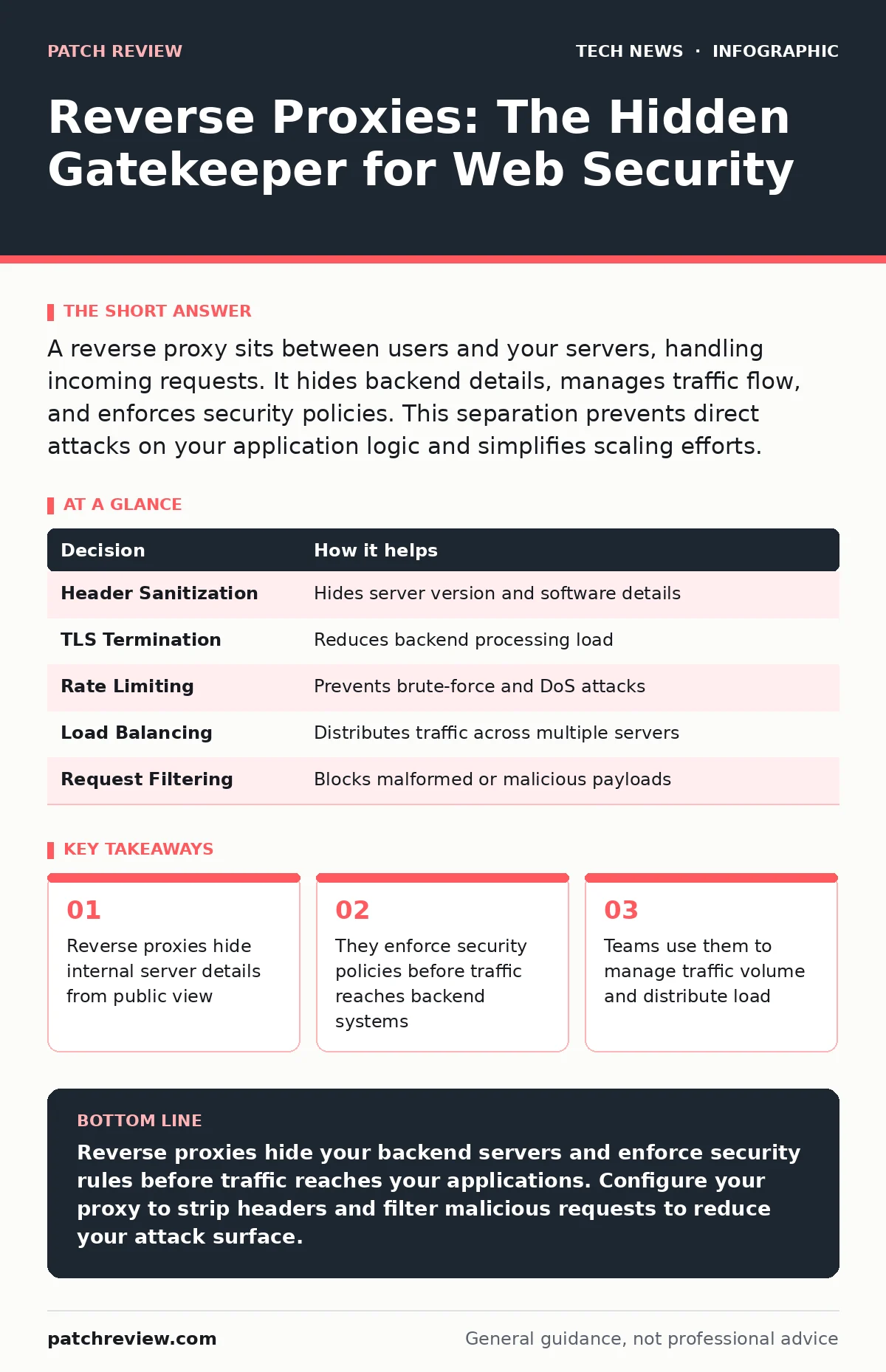
A reverse proxy sits between users and your servers, handling incoming requests. It hides backend details, manages traffic flow, and enforces security policies. This separation prevents direct attacks on your application logic and simplifies scaling efforts.
The Architecture of Indirection
You place a reverse proxy in front of your web servers to handle incoming requests. This server acts as a middleman, receiving traffic from clients and forwarding it to the appropriate backend application. The client believes it is communicating directly with your application, but the proxy intercepts and processes the connection first. This indirection creates a buffer zone between the public internet and your private infrastructure.
The proxy terminates the TLS connection, decrypting the traffic before sending it to your internal servers. This allows your backend applications to focus on processing data rather than managing encryption keys. It also means you can update certificates on the proxy without touching every individual server. This separation of duties reduces the complexity of your internal network configuration.
Hiding the Backend Identity
Direct exposure of your web servers reveals technical details to anyone who looks. HTTP headers often contain server version numbers, software types, and other metadata. Attackers use this information to find known vulnerabilities in specific software versions. A reverse proxy strips these headers or replaces them with generic values. This process, known as header sanitization, prevents attackers from fingerprinting your technology stack.
Imagine an attacker scanning your domain for open ports and service banners. Without a proxy, they see the exact version of your web server software. With a proxy, they see a generic response that provides no actionable intelligence. This obscurity is not a substitute for patching, but it raises the cost of reconnaissance. Attackers must guess your software configuration rather than confirming it instantly.
Traffic Management and Load Distribution
Your application may need to handle thousands of simultaneous connections. A single server often lacks the resources to process this volume efficiently. A reverse proxy distributes incoming requests across multiple backend servers. This load balancing ensures no single server becomes overwhelmed while others remain idle. The proxy monitors the health of each backend server and removes failed nodes from the rotation.
This distribution also allows you to scale your infrastructure horizontally. You can add more servers to handle increased demand without changing your public-facing IP address. Clients continue to connect to the same proxy endpoint. This stability simplifies DNS management and reduces the risk of service disruption during maintenance.
Enforcing Security Policies
You can define strict rules for what traffic is allowed to reach your backend. The proxy validates requests before they consume backend resources. It can block requests with malformed headers, unusual payload sizes, or suspicious patterns. This filtering prevents many common web attacks, such as SQL injection and cross-site scripting, from ever reaching your application code.
The proxy can also enforce rate limiting. This restricts the number of requests a single client can make within a specific time window. It mitigates brute-force attacks against login pages and prevents denial-of-service conditions. By absorbing excessive traffic at the edge, you protect your internal systems from resource exhaustion. This approach is more effective than trying to rate-limit within the application itself.
| Decision | How it helps |
|---|---|
| Header Sanitization | Hides server version and software details |
| TLS Termination | Reduces backend processing load |
| Rate Limiting | Prevents brute-force and DoS attacks |
| Load Balancing | Distributes traffic across multiple servers |
| Request Filtering | Blocks malformed or malicious payloads |
The Cost of Complexity
Adding a reverse proxy introduces a new point of failure. If the proxy crashes, your entire service becomes unreachable. You must ensure the proxy itself is highly available and properly monitored. This requires additional infrastructure and operational effort. You also need to configure the proxy correctly to avoid blocking legitimate traffic.
Misconfiguration can lead to security gaps. If the proxy does not properly validate requests, it may forward malicious traffic to your backend. You must regularly review proxy rules and update them as threats evolve. This ongoing maintenance is a hidden cost of using reverse proxies. Teams often underestimate the time required to keep these rules accurate.
See also: Stop Path Traversal Attacks: Defense Strategies That Actually Work · Web Skimming: How Formjacking Steals Payment Data
Integration with Broader Security
A reverse proxy works best when combined with other security measures. It does not replace the need for secure coding practices or regular vulnerability assessments. It adds a layer of defense that complements your existing controls. You should integrate the proxy with your logging and monitoring systems. This allows you to detect and respond to attacks in real time.
Consider how the proxy interacts with your identity management systems. It can enforce authentication and authorization checks before forwarding requests. This reduces the burden on your application to manage user sessions. It also centralizes access control policies, making them easier to audit and update. This integration enhances the overall security posture of your web services.
Making the Right Choice
Deciding to use a reverse proxy requires evaluating your specific needs. Small applications with low traffic may not benefit from the added complexity. However, any service exposed to the public internet gains significant protection from this indirection. You must weigh the operational costs against the security benefits. For most teams, the protection against direct attacks justifies the investment.
You should also consider the impact on performance. The proxy adds latency to each request, though this is often negligible. Modern proxies are highly optimized and can handle massive throughput. The key is to monitor performance metrics and adjust your configuration as needed. This ensures you get the security benefits without sacrificing user experience.
Final Considerations for Implementation
Implementing a reverse proxy is a strategic decision. It changes how your network handles incoming traffic. You must plan for failover scenarios and ensure redundancy. Test your configuration thoroughly to avoid unintended consequences. This preparation ensures that your proxy enhances security without disrupting service.
You should also document your proxy configuration. This documentation helps new team members understand the security controls in place. It also aids in troubleshooting issues when they arise. Clear records of your configuration decisions support long-term maintenance and compliance efforts. This discipline strengthens your overall security program.
Key takeaways
- Reverse proxies hide internal server details from public view
- They enforce security policies before traffic reaches backend systems
- Teams use them to manage traffic volume and distribute load
Reverse proxies hide your backend servers and enforce security rules before traffic reaches your applications. Configure your proxy to strip headers and filter malicious requests to reduce your attack surface.
Frequently asked questions
Does a reverse proxy replace a firewall?
No, a reverse proxy operates at the application layer, while a firewall typically operates at the network layer. They serve different purposes and should be used together for defense in depth.
Can a reverse proxy prevent all web attacks?
No, it mitigates many common attacks by filtering traffic. However, it cannot prevent vulnerabilities within your application code. Secure coding practices remain necessary.
How does a reverse proxy differ from a forward proxy?
A forward proxy sits between a client and the internet, representing the client. A reverse proxy sits between the internet and a server, representing the server to the client.
Do I need a reverse proxy for internal applications?
It is less critical for internal-only apps, but still beneficial for centralized logging, authentication, and traffic management. It adds an extra layer of control over internal access.
How this guide was produced: written by the Patch Review editorial team with AI assistance, checked against the public references listed below, and reviewed when the facts change. See our editorial policy or report an error.