
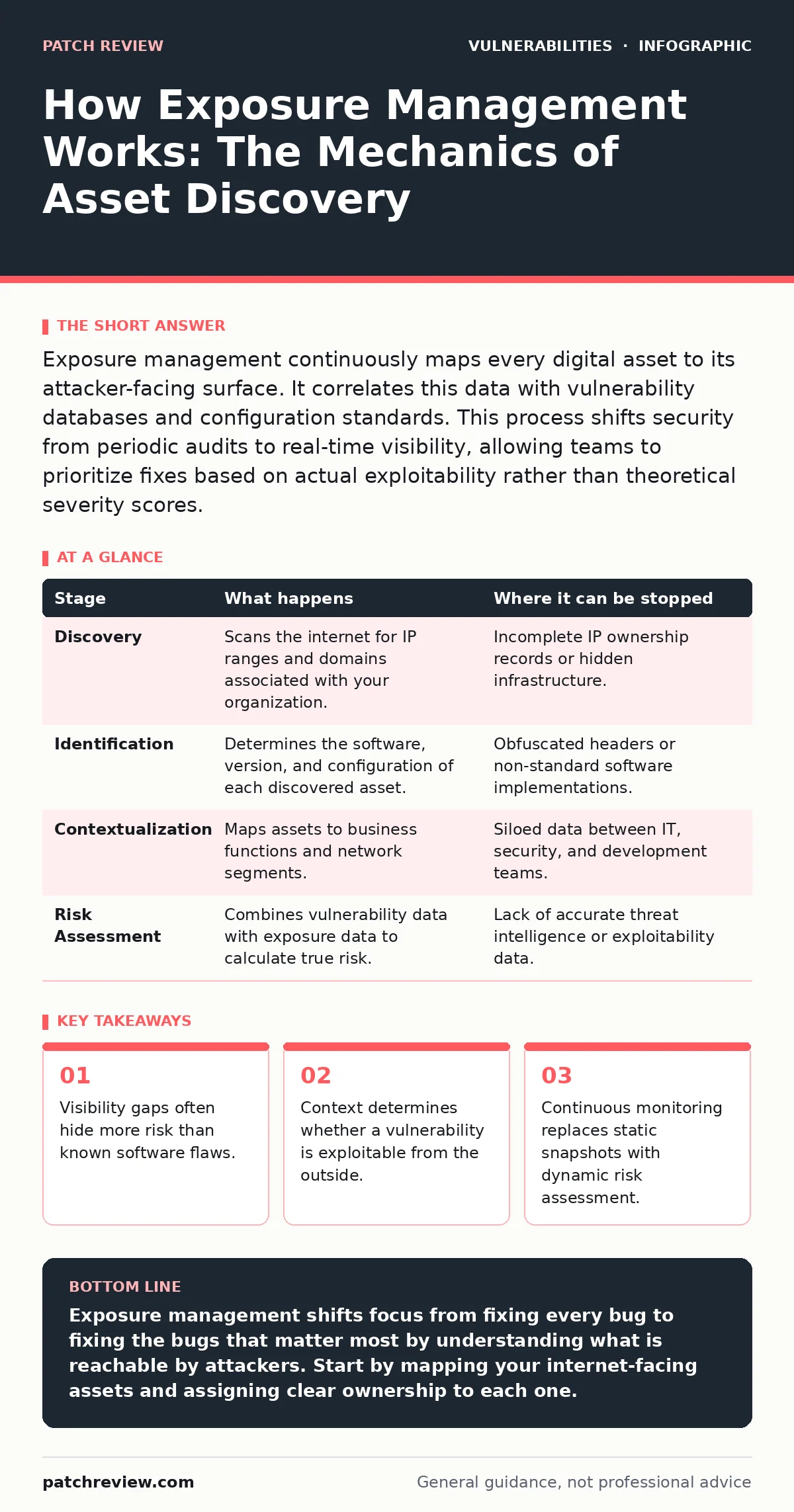
Exposure management continuously maps every digital asset to its attacker-facing surface. It correlates this data with vulnerability databases and configuration standards. This process shifts security from periodic audits to real-time visibility, allowing teams to prioritize fixes based on actual exploitability rather than theoretical severity scores.
The Visibility Gap
Most organizations believe they know what they own. They maintain inventory lists of servers, applications, and cloud instances. These lists are often incomplete. Attackers do not care about your internal inventory. They care about what is accessible from the internet. This difference between what you manage and what is reachable is the core problem exposure management solves.
Traditional vulnerability scanning assumes you have a complete list of targets. If an asset is missing from that list, it remains unscanned. It remains unprotected. Exposure management starts by finding everything that could be targeted, regardless of whether it is on your official roster. This includes forgotten development environments, misconfigured storage buckets, and legacy systems that were never decommissioned.
The Attack Surface Definition
You must define the boundary between your internal network and the public internet. This boundary is the attack surface. It consists of any interface, port, or protocol that accepts traffic from outside your control. This includes web applications, APIs, and remote access services.
Identifying this surface requires active discovery. Passive monitoring waits for traffic to arrive. Active discovery probes the perimeter to find open doors. This process reveals assets that are not communicating but are still listening. It also identifies assets that are communicating but not authorized. For example, a test server might be exposed by mistake. The discovery engine flags this as an anomaly because it falls outside the defined policy.
Asset Correlation and Context
Finding an asset is only the first step. You need to understand what that asset is. Is it a web server? A database? A personal computer used for work? This identification process is called asset correlation. It matches the discovered IP address or domain to known services and software versions.
This step adds context. A vulnerability in a database is different from a vulnerability in a web server. The database might be internal, meaning it is not directly reachable by an attacker. The web server is external. Exposure management tools tag assets with this context. They distinguish between internet-facing assets and internal-only assets. This distinction prevents teams from wasting time fixing low-risk internal issues while ignoring high-risk external ones.
Vulnerability Matching
Once the asset is identified, the system checks it against known weaknesses. This is where n-day vulnerabilities become relevant. These are flaws for which a patch exists but has not yet been applied. Exposure management does not just list these flaws. It checks if the flaw is actually exploitable from the internet.
A critical flaw in an internal application that never speaks to the outside world is low risk. A moderate flaw in an internet-facing login page is high risk. The system calculates this risk by combining the severity of the flaw with the exposure of the asset. This prevents alert fatigue. You focus on the few issues that matter most.
Risk Prioritization
Not all vulnerabilities are equal. Some require user interaction. Some require authentication. Some can be exploited remotely without any interaction. Exposure management analyzes the exploit path. It determines if an attacker can reach the vulnerable component.
Imagine a server with a known flaw in its web server software. However, the web server is behind a firewall that blocks all traffic except to a specific application port. The vulnerability in the web server is not exploitable because the firewall stops the attack vector. Exposure management recognizes this. It lowers the priority of that flaw. This saves resources. You do not patch everything. You patch what is reachable.
| Stage | What happens | Where it can be stopped |
|---|---|---|
| Discovery | Scans the internet for IP ranges and domains associated with your organization. | Incomplete IP ownership records or hidden infrastructure. |
| Identification | Determines the software, version, and configuration of each discovered asset. | Obfuscated headers or non-standard software implementations. |
| Contextualization | Maps assets to business functions and network segments. | Siloed data between IT, security, and development teams. |
| Risk Assessment | Combines vulnerability data with exposure data to calculate true risk. | Lack of accurate threat intelligence or exploitability data. |
See also: How to Prevent Clickjacking: Frame Busting and Header Defense
Continuous Monitoring
The internet changes every second. New assets appear. Old ones disappear. Configurations drift. A one-time scan is useless after a few days. Exposure management runs continuously. It watches for changes in the attack surface.
If a new server is launched, the system detects it immediately. It checks for misconfigurations. It alerts the team if the server is exposed without proper security controls. This continuous loop ensures that new risks are caught before they are exploited. It also helps with emergency patching by identifying which assets need immediate attention when a new critical vulnerability is disclosed.
Limits of Automation
Exposure management is powerful, but it is not perfect. It relies on accurate data. If the discovery phase misses an asset, the rest of the process fails. Some assets are hard to find. They might be behind complex network address translation or use non-standard ports.
Also, understanding the business context is difficult for automated tools. A tool might flag a service as unnecessary. But that service might be critical for a specific business function. Human judgment is still required to interpret the results. The tool provides the data. You provide the meaning.
Integration with Security Practices
Exposure management works best when integrated with other security practices. It feeds data into vulnerability management programs. It informs incident response by providing a map of the environment. It supports Content Security Policy implementation by identifying all web assets that need policies.
It also helps prevent directory listing exposure by identifying servers that allow directory browsing. This is a common misconfiguration that reveals sensitive files. By continuously monitoring for these issues, you reduce the chance of accidental data leaks. The goal is to shrink the attack surface. Every asset removed from the internet reduces your risk.
The Human Element
Technology cannot fix culture. Exposure management reveals the truth about your environment. That truth can be uncomfortable. It shows neglected assets and poor configurations. Teams must be willing to act on this information.
You must assign ownership for every asset. If an asset is found, someone must be responsible for it. If no one claims it, it should be decommissioned. This requires coordination across the organization. Security teams cannot do this alone. They need support from operations, development, and management.
Key takeaways
- Visibility gaps often hide more risk than known software flaws.
- Context determines whether a vulnerability is exploitable from the outside.
- Continuous monitoring replaces static snapshots with dynamic risk assessment.
Exposure management shifts focus from fixing every bug to fixing the bugs that matter most by understanding what is reachable by attackers. Start by mapping your internet-facing assets and assigning clear ownership to each one.
Frequently asked questions
How is exposure management different from vulnerability scanning?
Vulnerability scanning checks known assets for flaws. Exposure management first discovers all assets, especially unknown ones, and then evaluates their risk based on internet exposure and context.
Can exposure management find hidden or internal assets?
It primarily focuses on internet-facing assets. While it can discover some internal assets through network mapping, its strength lies in identifying what is visible to external attackers.
How often should exposure management scans run?
They should run continuously or near-real-time. The attack surface changes frequently, so periodic scans leave gaps where new risks can emerge undetected.
Does exposure management replace the need for firewalls?
No. Firewalls are a control that restricts access. Exposure management is a visibility tool that tells you if your firewall rules are working as intended and if any assets are exposed despite them.
How this guide was produced: written by the Patch Review editorial team with AI assistance, checked against the public references listed below, and reviewed when the facts change. See our editorial policy or report an error.