
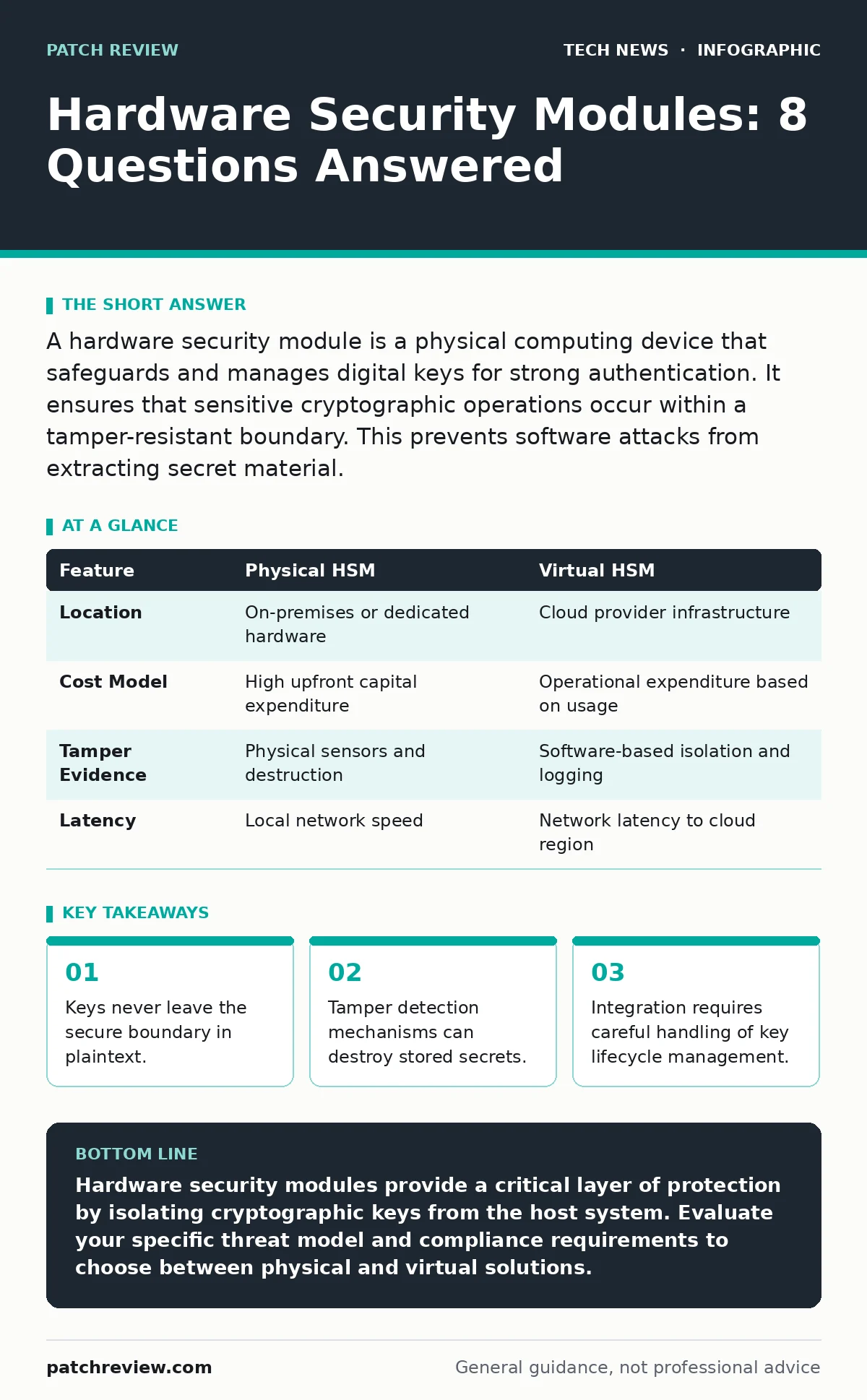
A hardware security module is a physical computing device that safeguards and manages digital keys for strong authentication. It ensures that sensitive cryptographic operations occur within a tamper-resistant boundary. This prevents software attacks from extracting secret material.
What exactly is a hardware security module?
A hardware security module is a dedicated physical device that performs cryptographic operations and protects private keys. It isolates these sensitive functions from the general computing environment. The device uses specialized hardware to enforce access controls that software alone cannot match. This isolation prevents malicious code running on the host system from intercepting keys.
How does it differ from a software key store?
Software key stores rely on the operating system and application code to protect secrets. If the system is compromised, an attacker can often extract keys from memory. A hardware security module provides a isolated execution environment that is inaccessible to the host OS. The private key never leaves the module in an unencrypted form, even during use.
What happens if someone physically attacks the device?
The device employs tamper-detection sensors to monitor for physical intrusion. These sensors detect changes in voltage, temperature, light, or physical casing integrity. If a breach is detected, the module immediately zeroes out all stored secrets. This ensures that an attacker cannot recover keys by disassembling the hardware.
Can I use it for cloud-based applications?
Yes, cloud providers offer virtual hardware security modules that emulate the secure boundary. These virtual instances run on isolated hardware partitions with strict access controls. They provide the same cryptographic guarantees as physical devices for cloud-native workloads. You manage keys centrally while applications interact via standard APIs.
| Feature | Physical HSM | Virtual HSM |
|---|---|---|
| Location | On-premises or dedicated hardware | Cloud provider infrastructure |
| Cost Model | High upfront capital expenditure | Operational expenditure based on usage |
| Tamper Evidence | Physical sensors and destruction | Software-based isolation and logging |
| Latency | Local network speed | Network latency to cloud region |
How do applications talk to the module?
Applications communicate with the module using standardized cryptographic APIs. Common standards include PKCS#11 and KMIP, which define how to generate, store, and use keys. Your application sends a request to perform an operation, such as signing a document. The module executes the operation internally and returns only the result.
See also: Should I Turn On Advanced Data Encryption: The Real Trade-Offs · How AES Encryption Works: Internal Mechanics and Attack Vectors
What is the performance impact on my systems?
Cryptographic operations are computationally intensive, so offloading them to a dedicated device improves overall system performance. The hardware module is optimized for these specific tasks, often using specialized accelerators. Network latency may introduce slight delays if the module is remote. However, the security benefit outweighs the minimal performance cost for most use cases.
How do I manage keys throughout their lifecycle?
Key management involves generating, storing, rotating, and retiring keys securely. The module provides tools to automate rotation and enforce policies on key usage. You must define clear procedures for emergency recovery and key archival. Poor management practices can undermine the security provided by the hardware itself.
What are the common integration mistakes?
Developers often wrap keys in application-level encryption before sending them to the module. This adds unnecessary complexity and potential points of failure. Another error is storing backup keys in insecure locations, defeating the purpose of the secure module. Always follow the principle of least privilege when granting access to the module.
Is it suitable for small organizations?
Small organizations can benefit from virtual hardware security modules offered by cloud providers. These services lower the barrier to entry by removing upfront hardware costs. They provide enterprise-grade security features without the need for dedicated infrastructure. Start with cloud-based solutions and scale to physical devices as requirements grow.
How do I verify the security of the module?
Look for certifications from recognized bodies that validate the design and implementation. These certifications ensure the module meets strict security standards. Regular audits and penetration testing of the integration code are also necessary. The hardware is only as secure as the processes surrounding its use.
Key takeaways
- Keys never leave the secure boundary in plaintext.
- Tamper detection mechanisms can destroy stored secrets.
- Integration requires careful handling of key lifecycle management.
Hardware security modules provide a critical layer of protection by isolating cryptographic keys from the host system. Evaluate your specific threat model and compliance requirements to choose between physical and virtual solutions.
Frequently asked questions
Can I migrate keys from one HSM to another?
Yes, but you must use secure key transport mechanisms or re-encrypt the keys under a new master key. Direct export of private keys is generally prohibited by security policies.
Do hardware security modules protect against all types of attacks?
No, they protect against unauthorized access to keys and tampering. They do not protect against social engineering, flawed application logic, or compromised user credentials.
What is the difference between an HSM and a smart card?
Smart cards are portable and have limited processing power, suitable for individual authentication. Hardware security modules are stationary, high-performance devices designed for server-side cryptographic operations.
Can I use a hardware security module for blockchain applications?
Yes, many blockchain platforms integrate with hardware security modules to secure wallet keys and sign transactions. This ensures that private keys remain protected even if the node software is compromised.
How this guide was produced: written by the Patch Review editorial team with AI assistance, checked against the public references listed below, and reviewed when the facts change. See our editorial policy or report an error.