
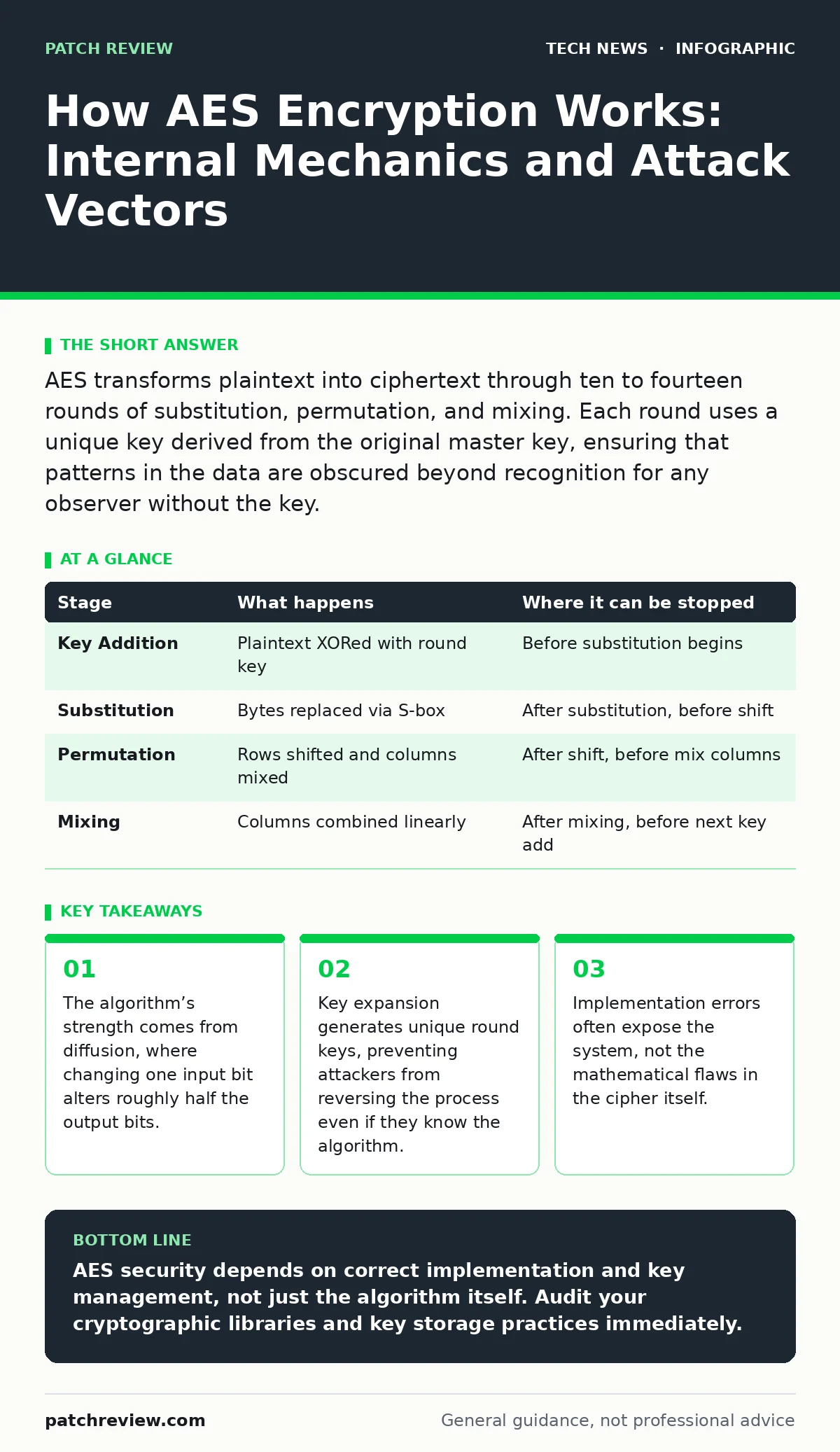
AES transforms plaintext into ciphertext through ten to fourteen rounds of substitution, permutation, and mixing. Each round uses a unique key derived from the original master key, ensuring that patterns in the data are obscured beyond recognition for any observer without the key.
The Core Mechanism of Substitution-Permutation Networks
AES operates as a substitution-permutation network. This means it repeatedly applies two types of transformations to your data. Substitution replaces input values with different output values based on a fixed lookup table. Permutation rearranges those values to spread their influence across the entire block.
This structure ensures that no single bit of input determines a single bit of output. Instead, every bit affects many others. This property is called diffusion. Diffusion hides the statistical relationship between the plaintext and the ciphertext. Without it, an attacker could analyze patterns to guess the original message.
Imagine you are shuffling a deck of cards. Substitution is like replacing every card with a different one. Permutation is like cutting and shuffling the deck. Doing both repeatedly makes it impossible to trace a card back to its original position.
Key Expansion and Round Keys
The master key you provide is never used directly to encrypt the data. Instead, the algorithm expands it into a series of round keys. Each round of encryption uses a different key from this chain. This process is called key expansion.
Key expansion adds complexity to the attack surface. If an attacker compromises one round key, they do not automatically have the master key. They must reverse the expansion process, which is designed to be difficult. The number of round keys depends on the key length. Longer keys produce more rounds and more keys.
This separation is critical for key management. You can store the master key securely while the system uses derived keys for active processing. It also allows for efficient hardware implementation, as the keys are pre-calculated before encryption begins.
Stage 1: Initial Key Addition
The first step mixes the plaintext with the first round key. This is a simple bitwise XOR operation. XOR stands for exclusive OR. It outputs true only when the inputs differ. This step ensures that the plaintext never enters the complex substitution steps in its raw form.
This stage is reversible. Applying the same key again returns the original data. This symmetry is useful for decryption, which runs the same steps in reverse order. It also means that if the key is weak, the data is only as secure as that first mix.
| Stage | What happens | Where it can be stopped |
|---|---|---|
| Key Addition | Plaintext XORed with round key | Before substitution begins |
| Substitution | Bytes replaced via S-box | After substitution, before shift |
| Permutation | Rows shifted and columns mixed | After shift, before mix columns |
| Mixing | Columns combined linearly | After mixing, before next key add |
Stage 2: Byte Substitution
The algorithm processes the data as a grid of bytes. Each byte is replaced by another byte using a mathematical function. This function is non-linear. Non-linear means the output does not change in a straight line relative to the input. This prevents linear cryptanalysis, a method that tries to approximate the cipher with linear equations.
The lookup table for this step is called an S-box. S-box stands for substitution box. It is a fixed table defined by the standard. You cannot change it. Changing it would break compatibility and likely weaken the security. The S-box is designed to maximize the difference between inputs and outputs.
Stage 3: Row Shifting
The grid of bytes is now shifted. The first row stays in place. The second row shifts left by one position. The third row shifts left by two positions. The fourth row shifts left by three positions. This step is called ShiftRows.
ShiftRows adds confusion between the columns. Without it, each column would be processed independently. An attacker could analyze each column separately. By shifting rows, the algorithm mixes data from different columns together. This forces any analysis to consider the entire block, not just parts of it.
This step is purely positional. It does not change the values of the bytes. It only changes where they are located in the grid. This makes it computationally cheap to implement, which is why it is suitable for both software and hardware.
See also: Hardware Security Modules: 8 Questions Answered · Third-Party Data Breach Response: Steps to Contain and Recover
Stage 4: Column Mixing
The algorithm now mixes the bytes within each column. Each byte in a column is combined with the other bytes in that column using a mathematical operation. This operation is linear over a specific finite field. Finite fields are mathematical structures with a limited number of elements.
This step is called MixColumns. It ensures that changes in one byte affect all bytes in the same column. Combined with ShiftRows, this creates full diffusion across the entire block. After a few rounds, every bit of the output depends on every bit of the input.
This step is omitted in the final round. The final round only performs substitution, shifting, and key addition. This omission saves processing time without reducing security. The diffusion from previous rounds is sufficient to protect the final output.
Stage 5: Final Key Addition and Decryption
The last stage adds the final round key to the state. This produces the ciphertext. The process is symmetric. Decryption runs the same steps in reverse order. It starts with the last round key and ends with the first.
You do not need a separate decryption algorithm. The same code path works for both. This reduces the attack surface. Fewer code paths mean fewer opportunities for bugs. It also simplifies hardware design, as the same circuit can handle both directions.
Implementation Context and Related Standards
Understanding AES is only part of the security picture. How you use it matters more than the algorithm itself. For instance, when securing home router security, you must ensure the device uses AES in a mode that provides authentication, not just confidentiality. Simple encryption can be tampered with if the data integrity is not verified.
Similarly, video conferencing security relies on AES to protect media streams. The speed of AES allows for real-time encryption without noticeable lag. However, the key exchange must be secure. If the keys are compromised, the encryption is pointless. This is why protocols like TLS are used to negotiate keys before AES encryption begins.
In edge computing security, devices often have limited resources. AES is efficient enough to run on small microcontrollers. This allows data to be encrypted at the source, before it leaves the device. This prevents interception on local networks.
The Hidden Cost of Key Management
The biggest risk in AES is not the cipher. It is key management. If you lose the key, the data is gone forever. If you share the key insecurely, the data is exposed. The algorithm is public and well-understood. The key is the only secret.
You must protect the key at rest and in transit. This often requires hardware security modules or secure enclaves. These are specialized chips that store keys and perform cryptographic operations. They prevent software from accessing the raw key values.
Why AES Remains the Standard
AES has resisted all practical attacks for decades. Its design is elegant and efficient. It works well on both 32-bit and 64-bit processors. It is supported by hardware instructions in most modern CPUs. This makes it fast and secure.
You do not need to understand the math to use it correctly. You need to understand the modes of operation and key management. Choose a mode that provides both confidentiality and integrity. Use a strong, random key. And trust the implementation, not your own code.
The OSI model places encryption at the presentation or session layer. Understanding where AES fits in this stack helps you design secure architectures. It is a building block, not a complete solution. Combine it with other security measures for a defense-in-depth strategy.
Key takeaways
- The algorithm’s strength comes from diffusion, where changing one input bit alters roughly half the output bits.
- Key expansion generates unique round keys, preventing attackers from reversing the process even if they know the algorithm.
- Implementation errors often expose the system, not the mathematical flaws in the cipher itself.
AES security depends on correct implementation and key management, not just the algorithm itself. Audit your cryptographic libraries and key storage practices immediately.
Frequently asked questions
Can AES be cracked by quantum computers?
Quantum computers could theoretically speed up brute-force attacks, but doubling the key size mitigates this risk. AES-256 is considered quantum-resistant.
Is AES faster on mobile devices?
Yes, modern mobile processors include hardware acceleration for AES. This makes it efficient for battery-powered devices.
Do I need to implement padding?
It depends on the mode. Block modes like CBC require padding to fit data into fixed-size blocks. Stream modes like CTR do not.
How long should an AES key be?
Use 256-bit keys for long-term security. 128-bit keys are still secure for most current applications but offer less margin against future advances.
How this guide was produced: written by the Patch Review editorial team with AI assistance, checked against the public references listed below, and reviewed when the facts change. See our editorial policy or report an error.