
Kubernetes security relies on layering network segmentation, least-privilege service accounts, and image scanning. You must secure the control plane, restrict pod capabilities, and enforce runtime detection to prevent lateral movement within your cluster.
What is the primary security risk in a Kubernetes cluster?
The primary risk is the misconfiguration of the control plane, specifically the API server, which acts as the front end for the cluster. If an attacker gains access to the API server, they can create, delete, or modify any resource within the cluster. This includes creating new pods with elevated privileges or exfiltrating secrets stored in the etcd database. Many administrators focus on securing individual workloads while neglecting the central management interface.
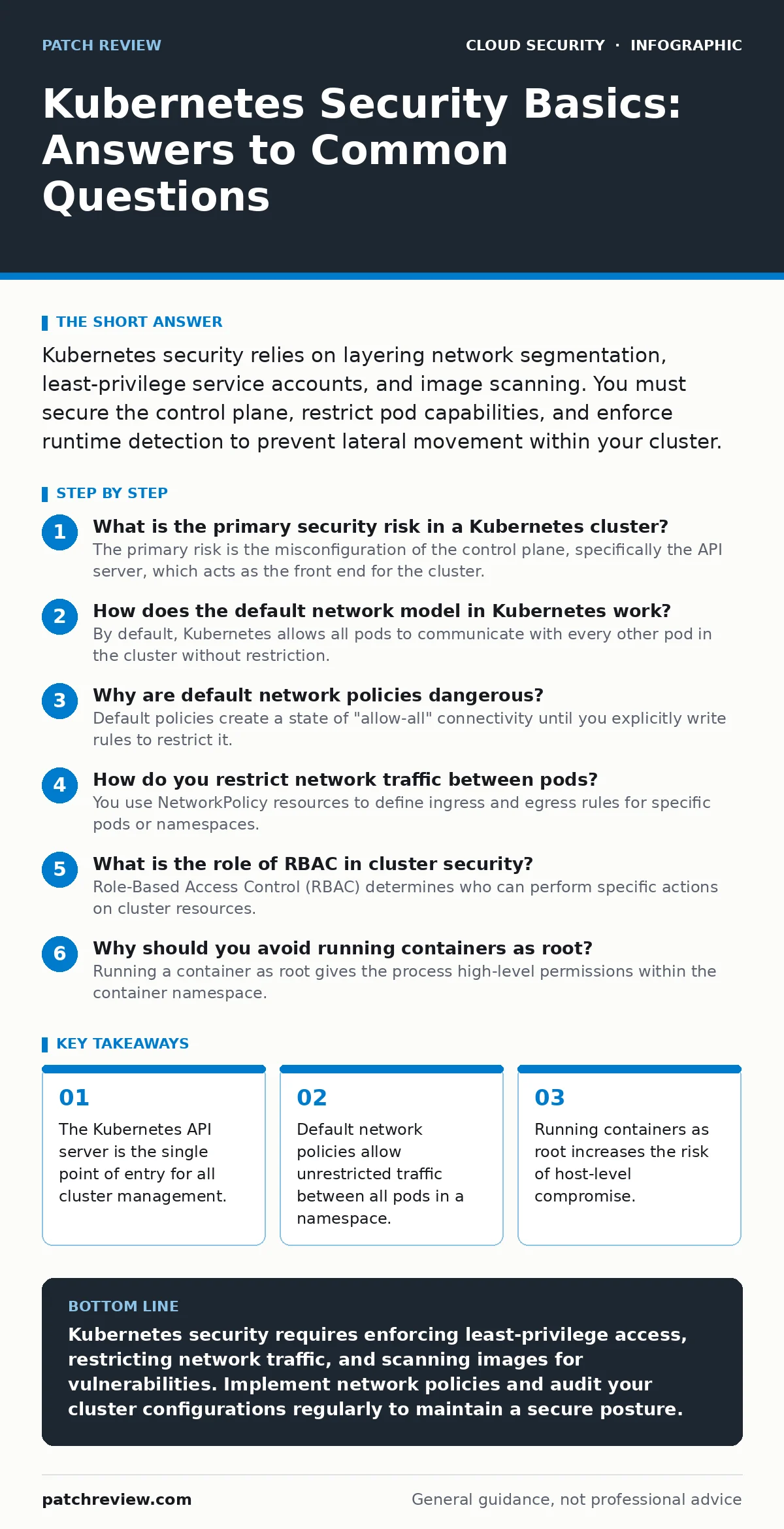
How does the default network model in Kubernetes work?
By default, Kubernetes allows all pods to communicate with every other pod in the cluster without restriction. This flat network model is convenient for development but dangerous for production environments. An attacker who compromises a single low-privilege application can scan and interact with all other services. You must implement network policies to explicitly define which traffic is allowed and which is denied.
Why are default network policies dangerous?
Default policies create a state of "allow-all" connectivity until you explicitly write rules to restrict it. This means that even if your application only needs to talk to one database, it currently has access to every other service in the namespace. This lack of segmentation facilitates lateral movement, where an attacker moves from a compromised edge service to critical internal systems. Refer to our guide on Kubernetes misconfigurations to understand how common these oversight errors are.
How do you restrict network traffic between pods?
You use NetworkPolicy resources to define ingress and egress rules for specific pods or namespaces. These policies act as a firewall inside the cluster, blocking traffic that does not match your defined criteria. You specify which source pods are allowed to send data to a target pod based on labels or namespace selectors. Without these policies, the underlying container network interface allows unrestricted flow.
What is the role of RBAC in cluster security?
Role-Based Access Control (RBAC) determines who can perform specific actions on cluster resources. It assigns permissions to users or service accounts through Roles and ClusterRoles. You should never grant cluster-admin privileges to application service accounts. Instead, create minimal roles that only allow the specific verbs and resources required for the application to function. This limits the damage if a service account token is stolen.
See also: Cloud Ransomware Response: Containment and Recovery Steps · Spot Shadow IT: Warning Signs and Response Steps
Why should you avoid running containers as root?
Running a container as root gives the process high-level permissions within the container namespace. If the container runtime has a vulnerability, an attacker can escape the container and gain root access to the host node. This breaks the isolation boundary between the application and the underlying infrastructure. You should configure security contexts to run processes as non-root users with specific user IDs.
How do you manage secrets securely in Kubernetes?
Kubernetes stores secrets in etcd, the cluster's key-value store, by default in plain text. Anyone with read access to etcd can view these sensitive credentials. You should enable encryption at rest for etcd to protect secrets from disk theft. Additionally, consider using external secret management systems that inject credentials at runtime rather than storing them in the cluster.
| Secret Management Method | Storage Location | Encryption at Rest | Runtime Injection |
|---|---|---|---|
| Native Kubernetes Secrets | etcd | Optional | No |
| External Secret Operators | External Vault | Yes | Yes |
| Environment Variables | Pod Spec | No | No |
What is the impact of privileged containers?
A privileged container has full access to the host's devices and kernel capabilities. It bypasses most security restrictions imposed by the container runtime. If an application does not explicitly require low-level system access, you should disable privileged mode. Allowing privileged containers is a common cause of host compromise and is often flagged in security audits.
How do you secure the Kubernetes API server?
Securing the API server involves restricting external access, enforcing authentication, and enabling audit logging. You should bind the API server to internal interfaces only and use mutual TLS for communication. Authentication ensures that only verified users or service accounts can interact with the cluster. Audit logging provides a record of all requests, which is vital for detecting suspicious activity and responding to incidents.
What is the difference between pod security standards and admission controllers?
Pod Security Standards define baseline levels of security for pod configurations, such as disallowing privilege escalation. Admission controllers enforce these standards by rejecting requests that violate the defined policies. While standards provide the rules, admission controllers are the gatekeepers that apply them. You should configure admission controllers to automatically reject non-compliant pod definitions before they are created.
How do image vulnerabilities affect cluster security?
Using container images with known vulnerabilities introduces known attack vectors into your environment. If an image contains a vulnerable library, an attacker can exploit it to gain control of the container. You should scan images for vulnerabilities before deploying them to production. Automate this scanning in your CI/CD pipeline to prevent vulnerable images from reaching the cluster.
What is the role of runtime security in Kubernetes?
Runtime security monitors the behavior of processes within containers after they are deployed. It detects anomalies such as unexpected network connections, file modifications, or privilege escalations. Static analysis tools cannot detect attacks that exploit runtime behaviors or zero-day vulnerabilities. Integrating runtime security tools provides an additional layer of defense against active threats.
Key takeaways
- The Kubernetes API server is the single point of entry for all cluster management.
- Default network policies allow unrestricted traffic between all pods in a namespace.
- Running containers as root increases the risk of host-level compromise.
Kubernetes security requires enforcing least-privilege access, restricting network traffic, and scanning images for vulnerabilities. Implement network policies and audit your cluster configurations regularly to maintain a secure posture.
Frequently asked questions
Can Kubernetes replace a traditional firewall?
No, Kubernetes network policies operate at the pod level within the cluster. They do not replace perimeter firewalls that protect the cluster from external internet traffic.
How do I prevent privilege escalation in pods?
Set the security context to disallow privilege escalation and run containers as non-root users. This ensures that even if a process is compromised, it cannot gain higher privileges.
What is the difference between a Role and a ClusterRole?
A Role applies to a specific namespace, while a ClusterRole applies to the entire cluster. Use Roles for namespace-scoped resources and ClusterRoles for cluster-wide resources.
Should I disable the Kubernetes dashboard?
Yes, the dashboard often requires high-level privileges and is a common target for attackers. Use the command-line interface or API for management unless the dashboard is strictly necessary and heavily secured.
How this guide was produced: written by the Patch Review editorial team with AI assistance, checked against the public references listed below, and reviewed when the facts change. See our editorial policy or report an error.