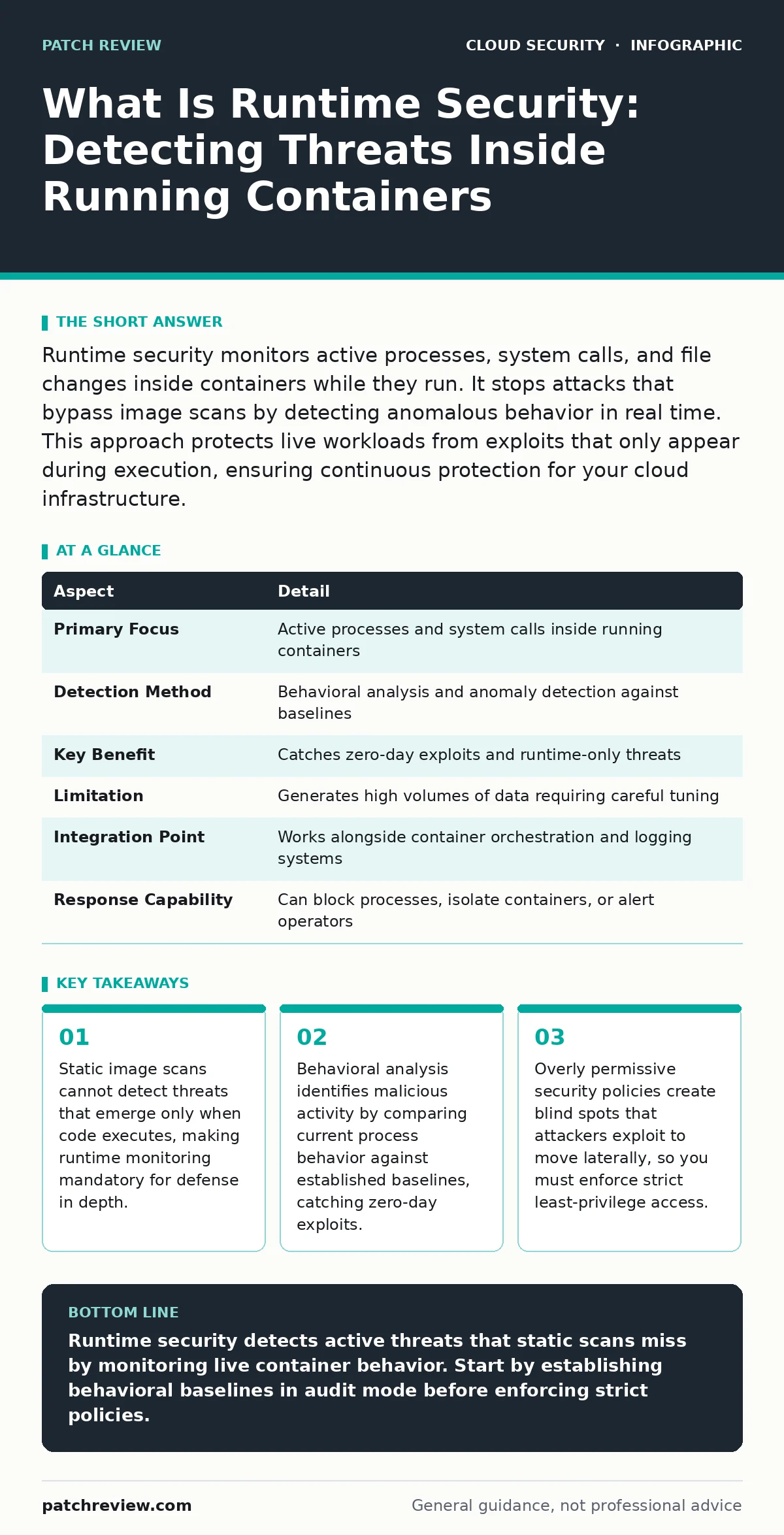
Runtime security monitors active processes, system calls, and file changes inside containers while they run. It stops attacks that bypass image scans by detecting anomalous behavior in real time. This approach protects live workloads from exploits that only appear during execution, ensuring continuous protection for your cloud infrastructure.
The Living System Analogy
Imagine building a house with perfect blueprints and high-quality materials. A static inspection checks the wood for rot before construction begins. However, once people move in, a thief might pick the lock or a pipe might burst. Runtime security acts as the security guard inside the living house. It watches what happens after the doors are closed. It does not just check the building materials.
It observes the behavior of everyone inside. It notices when someone breaks a window at midnight or moves furniture in a strange way. This distinction matters because many modern attacks do not leave traces in the code itself. They exploit how the code interacts with the operating system once it starts running. You must monitor the active environment, not just the static package.
What Is Runtime Security
Runtime security is the practice of monitoring and protecting applications while they are actively executing. It focuses on the container runtime environment, which manages the lifecycle of containers. This includes tracking system calls, file system modifications, and network connections. The goal is to detect anomalies that indicate a compromise. Static analysis tools scan container images for known vulnerabilities before deployment.
They are effective but limited. They cannot see what happens when the code runs. Runtime security fills this gap by observing live behavior. It answers the question of what is happening inside the container right now. It provides visibility into processes that static tools completely miss. This layer is critical for detecting sophisticated attacks that evade initial scrutiny.
| Aspect | Detail |
|---|---|
| Primary Focus | Active processes and system calls inside running containers |
| Detection Method | Behavioral analysis and anomaly detection against baselines |
| Key Benefit | Catches zero-day exploits and runtime-only threats |
| Limitation | Generates high volumes of data requiring careful tuning |
| Integration Point | Works alongside container orchestration and logging systems |
| Response Capability | Can block processes, isolate containers, or alert operators |
How Runtime Security Works
The mechanism relies on intercepting system calls. When a process requests an action from the operating system, such as reading a file or opening a network socket, the runtime security agent intercepts this request. It compares the request against a policy. This policy defines what is allowed. If the request matches the policy, the system allows it. If it deviates, the system flags it as an anomaly.
Some systems operate in audit mode, logging the violation without stopping it. Others operate in enforcement mode, blocking the action entirely. The agent runs inside the container or on the host node. It uses kernel-level hooks to observe activity with minimal performance impact. This deep visibility allows it to see actions that application-level logs miss.
Who Runtime Security Affects
Every organization running containers in production needs this protection. Developers benefit by gaining insight into how their code behaves in real environments. This feedback helps them write more secure code. Security teams use runtime data to reduce alert fatigue. By filtering out normal behavior, they focus on genuine threats. Operations teams rely on it to maintain service availability.
It helps identify misconfigurations that cause crashes or performance issues. The impact extends to compliance requirements. Many regulations require monitoring of active systems, not just static artifacts. Runtime security provides the audit trail needed to prove continuous compliance. It shifts security from a gatekeeping function to a continuous operation.
Common Misconceptions About Runtime Protection
Many teams believe that scanning container images is enough. This is a dangerous assumption. Images can be modified after scanning. Dependencies can introduce vulnerabilities at runtime. Another mistake is assuming that runtime security replaces static scanning. It does not. The two methods complement each other. Static scanning catches known vulnerabilities in the code.
Runtime security catches unknown behaviors in the execution. Some teams also ignore the noise problem. Without proper tuning, runtime tools generate thousands of alerts. This leads to alert fatigue and missed threats. You must define a clear baseline of normal behavior. You must update this baseline as your applications change. Failing to do so renders the tool useless.
See also: Cloud Ransomware Response: Containment and Recovery Steps · Spot Shadow IT: Warning Signs and Response Steps
Configuring Effective Policies
Start by defining what normal behavior looks like for each container. This baseline includes allowed system calls, permitted file paths, and authorized network connections. Use a learning mode to gather data over a period of time. Analyze this data to create initial policies. Then, switch to enforcement mode gradually. Start with non-critical services. Monitor the impact on application performance.
Adjust policies to reduce false positives. False positives occur when the system blocks legitimate activity. This disrupts service and erodes trust in the tool. Integrate these policies with your existing security stack. Connect runtime alerts to your incident response workflow. Ensure that your team knows how to respond to specific types of violations.
Integrating With Broader Security
Runtime security does not operate in isolation. It must work with other security controls. For instance, if runtime detection identifies a compromised container, it should trigger isolation procedures. This prevents lateral movement within the cluster. You should also consider Kubernetes misconfigurations that might allow an attacker to escape the container.
Runtime tools can detect attempts to access host resources, which often stem from poor configuration. Additionally, ensure that your logging infrastructure captures runtime events. Without proper logging, you lose the context needed for forensic analysis. Address cloud logging gaps to ensure you have a complete record of all actions.
Advanced Threat Detection
As attackers become more sophisticated, they try to evade detection. They may use techniques like living-off-the-land binaries. These are legitimate system tools used for malicious purposes. Runtime security must distinguish between legitimate use and abuse. This requires advanced behavioral analysis. Machine learning models can help identify subtle anomalies that rule-based systems miss.
However, these models require training on your specific environment. They are not plug-and-play solutions. You must invest time in tuning them. Also, consider the threat of cloud ransomware. Runtime security can detect the rapid file encryption behavior typical of ransomware. Blocking this behavior early can save your data.
Managing Operational Overhead
Running runtime security agents adds overhead to your system. This includes CPU and memory usage. You must monitor this impact carefully. Excessive overhead can degrade application performance. Choose agents that are lightweight and efficient. Optimize data collection to send only relevant information. Use sampling techniques for high-volume events. Ensure that your security team has the skills to manage these tools. They need to understand container internals and operating system behavior. Training is often overlooked. Without skilled operators, even the best tools fail. Regularly review and update your policies. As your applications evolve, so should your security posture.
Next Steps for Implementation
Begin by assessing your current container environment. Identify critical workloads that require immediate protection. Deploy runtime security agents in audit mode first. Gather data to establish baselines. Create initial policies based on this data. Test these policies in a staging environment. Verify that they do not block legitimate traffic. Gradually roll out to production. Start with non-critical services. Monitor for false positives and adjust policies. Integrate with your incident response processes. Ensure that your team can act on alerts quickly. Continuously improve your defenses. Security is an ongoing process, not a one-time project.
Key takeaways
- Static image scans cannot detect threats that emerge only when code executes, making runtime monitoring mandatory for defense in depth.
- Behavioral analysis identifies malicious activity by comparing current process behavior against established baselines, catching zero-day exploits.
- Overly permissive security policies create blind spots that attackers exploit to move laterally, so you must enforce strict least-privilege access.
Runtime security detects active threats that static scans miss by monitoring live container behavior. Start by establishing behavioral baselines in audit mode before enforcing strict policies.
Frequently asked questions
Does runtime security slow down my containers?
Lightweight agents have minimal impact, but poor configuration can cause overhead. Monitor resource usage and optimize data collection to maintain performance.
Can runtime security detect all types of attacks?
No tool detects everything. It excels at behavioral anomalies but may miss sophisticated attacks that mimic normal behavior. Combine it with static scanning and network monitoring.
How do I handle false positives?
Tune your policies based on observed legitimate behavior. Use a gradual rollout strategy to identify and adjust rules that block valid operations.
Is runtime security needed for development environments?
Yes, it helps developers understand security implications early. It provides feedback on how code behaves, fostering a culture of security from the start.
How this guide was produced: written by the Patch Review editorial team with AI assistance, checked against the public references listed below, and reviewed when the facts change. See our editorial policy or report an error.