
Callback verification requires the system to call a registered number to confirm identity. It fails when users share devices, when attackers intercept the call, or when organizations treat it as a replacement for multi-factor authentication. Proper use demands strict number registration and user training.
Misreading: Callback verification replaces multi-factor authentication
Correct reading: Callback verification is a single factor, not a complete authentication suite. It confirms that the person initiating the request controls the registered phone number. It does not verify possession of a hardware token or knowledge of a complex password. Relying solely on callbacks leaves accounts vulnerable if an attacker gains access to the victim’s phone or convinces the victim to approve a malicious call. You must combine callbacks with other methods, such as conditional access policies, to ensure that login attempts originate from trusted devices and networks. This layered approach ensures that compromising one factor does not grant full access.
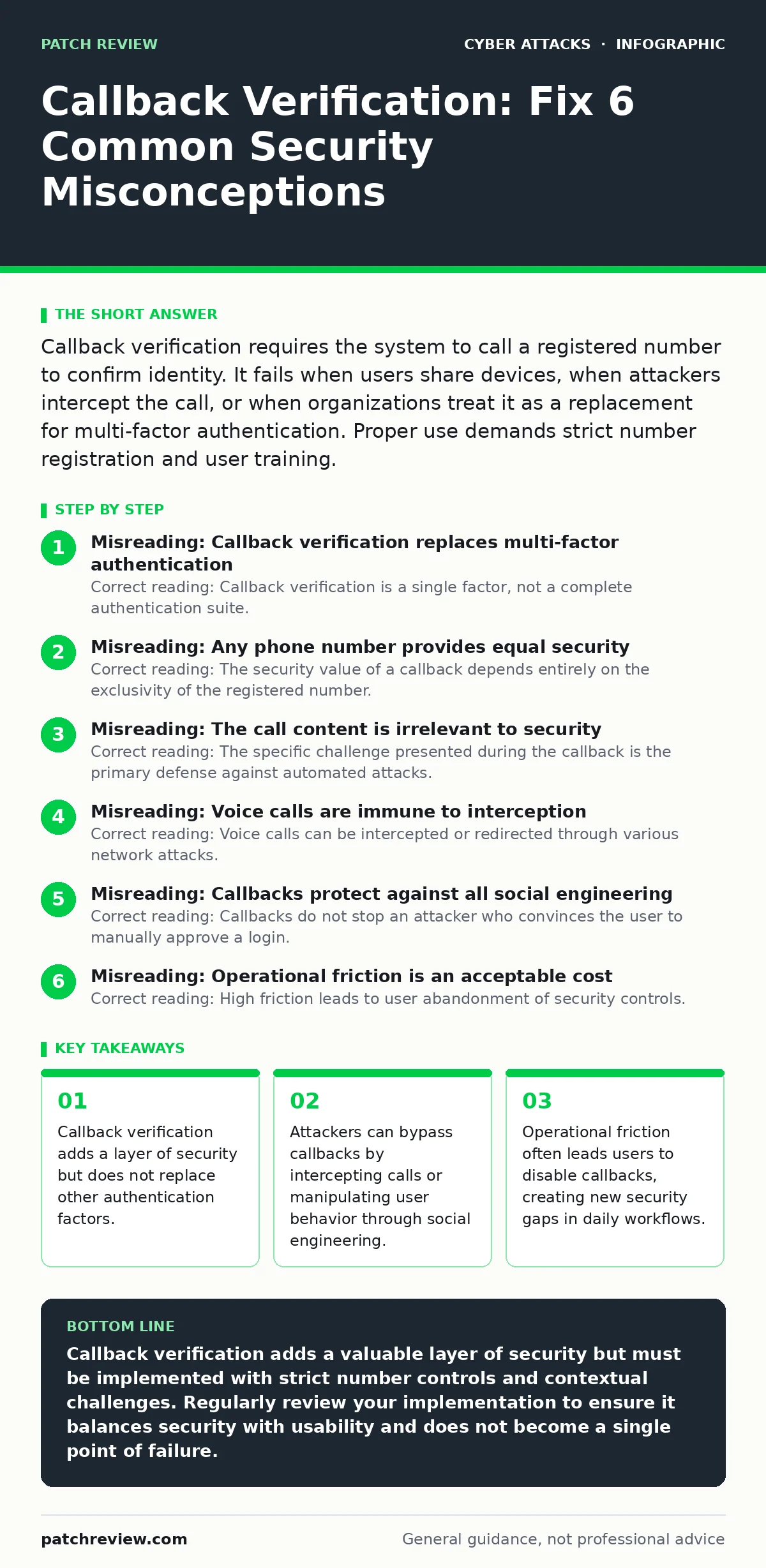
Misreading: Any phone number provides equal security
Correct reading: The security value of a callback depends entirely on the exclusivity of the registered number. Using a shared office line or a VoIP number accessible via web login drastically reduces security. An attacker who compromises the associated email account can often reset the callback number to one they control. You must enforce strict registration rules that require in-person verification or cryptographic proof of ownership before adding a number. This prevents attackers from redirecting verification calls to their own devices during an account takeover attempt.
Misreading: The call content is irrelevant to security
Correct reading: The specific challenge presented during the callback is the primary defense against automated attacks. If the system simply says "Your code is 5-4-2," it is vulnerable to social engineering. Attackers can trick users into reading out codes for malicious transactions. The system must present a context-specific challenge, such as the last 4 digits of the credit card being used or the amount of the transaction. This forces the user to verify the request details, not just their identity. Without contextual challenges, callbacks become a simple relay for attacker commands.
Misreading: Voice calls are immune to interception
Correct reading: Voice calls can be intercepted or redirected through various network attacks. Call forwarding settings on mobile devices can silently redirect verification calls to an attacker’s number. Furthermore, sophisticated attackers can use voice synthesis to mimic the system’s automated voice, confusing users who expect a specific tone or accent. While less common than SMS interception, voice channel attacks do occur. You should monitor for unusual call forwarding changes and educate users to verify the caller ID matches the expected corporate number. This awareness helps detect when an attacker has manipulated the telephony infrastructure.
Misreading: Callbacks protect against all social engineering
Correct reading: Callbacks do not stop an attacker who convinces the user to manually approve a login. In a scenario where an attacker poses as IT support, they can ask the user to initiate a callback and report the code. The system records this as a successful verification. The user becomes the weakest link, bypassing the technical control. You must train users to never initiate callbacks for unsolicited requests. Instead, users should hang up and call the official support number listed on the organization’s website. This breaks the chain of social engineering by forcing a fresh, user-initiated contact session.
See also: Scareware Tactics: How to Spot and Remove Fake Security Alerts · How Conditional Access Policies Work: The Hidden Logic
Misreading: Operational friction is an acceptable cost
Correct reading: High friction leads to user abandonment of security controls. If initiating a callback takes multiple steps or fails frequently, users will seek workarounds, such as using weak passwords or sharing credentials. This undermines the entire security posture. You must optimize the callback flow to be fast and reliable. Implementing fallback options for when the primary number is unreachable is necessary, but these fallbacks must maintain equivalent security levels. Balancing security with usability ensures that employees actually use the controls rather than circumventing them to get their work done.
Misreading: Callback verification prevents replay attacks
Correct reading: A replay attack involves an attacker capturing a valid authentication token or code and reusing it later. Callback verification codes are typically time-sensitive, but if the window is too long, replay becomes feasible. Additionally, if the system does not invalidate the code after first use, an attacker can capture the code and use it before the legitimate user. You must ensure that codes expire quickly and are single-use. This prevents attackers from harvesting verification data and using it later to gain unauthorized access. Short validity windows limit the opportunity for interception and replay.
Misreading: Callbacks are only for high-value transactions
Correct reading: Limiting callbacks to high-value transactions creates a false sense of security for routine actions. Attackers often start with low-value actions to establish a pattern of behavior or to test their access. They may also use routine logins to maintain persistence within an account. You should apply callback verification consistently across all sensitive actions, not just those involving money. This consistent application makes it harder for attackers to distinguish between high and low-value targets, increasing the risk and effort required for any unauthorized access. Consistency is key to maintaining a strong security posture.
Key takeaways
- Callback verification adds a layer of security but does not replace other authentication factors.
- Attackers can bypass callbacks by intercepting calls or manipulating user behavior through social engineering.
- Operational friction often leads users to disable callbacks, creating new security gaps in daily workflows.
Callback verification adds a valuable layer of security but must be implemented with strict number controls and contextual challenges. Regularly review your implementation to ensure it balances security with usability and does not become a single point of failure.
Frequently asked questions
How does callback verification differ from SMS verification?
Callback verification uses voice calls, which are generally harder to intercept than SMS messages. SMS can be hijacked through SIM swapping or SS7 network vulnerabilities, while voice calls require more sophisticated interception techniques. However, both methods are vulnerable to social engineering if users are not properly trained.
Can callback verification be automated for large organizations?
Yes, automated callback systems can scale to support large user bases. These systems integrate with identity providers and can trigger callbacks based on predefined risk rules. Automation reduces manual overhead and ensures consistent application of security policies across the organization. However, automation must be carefully configured to avoid false positives that disrupt user productivity.
What should I do if I receive an unexpected callback?
Treat unexpected callbacks as potential security threats. Do not provide any codes or personal information to the caller. Hang up and contact your organization’s IT support through official channels to verify if the request is legitimate. This practice helps prevent social engineering attacks and ensures that unauthorized access attempts are reported and investigated.
Does callback verification protect against credential stuffing?
Callback verification adds a layer of protection against credential stuffing by requiring additional verification beyond just a password. However, if attackers can intercept the callback or trick the user into approving it, credential stuffing can still succeed. Combining callbacks with other security measures, such as rate limiting and account lockout policies, provides stronger protection against automated attacks.
How this guide was produced: written by the Patch Review editorial team with AI assistance, checked against the public references listed below, and reviewed when the facts change. See our editorial policy or report an error.