
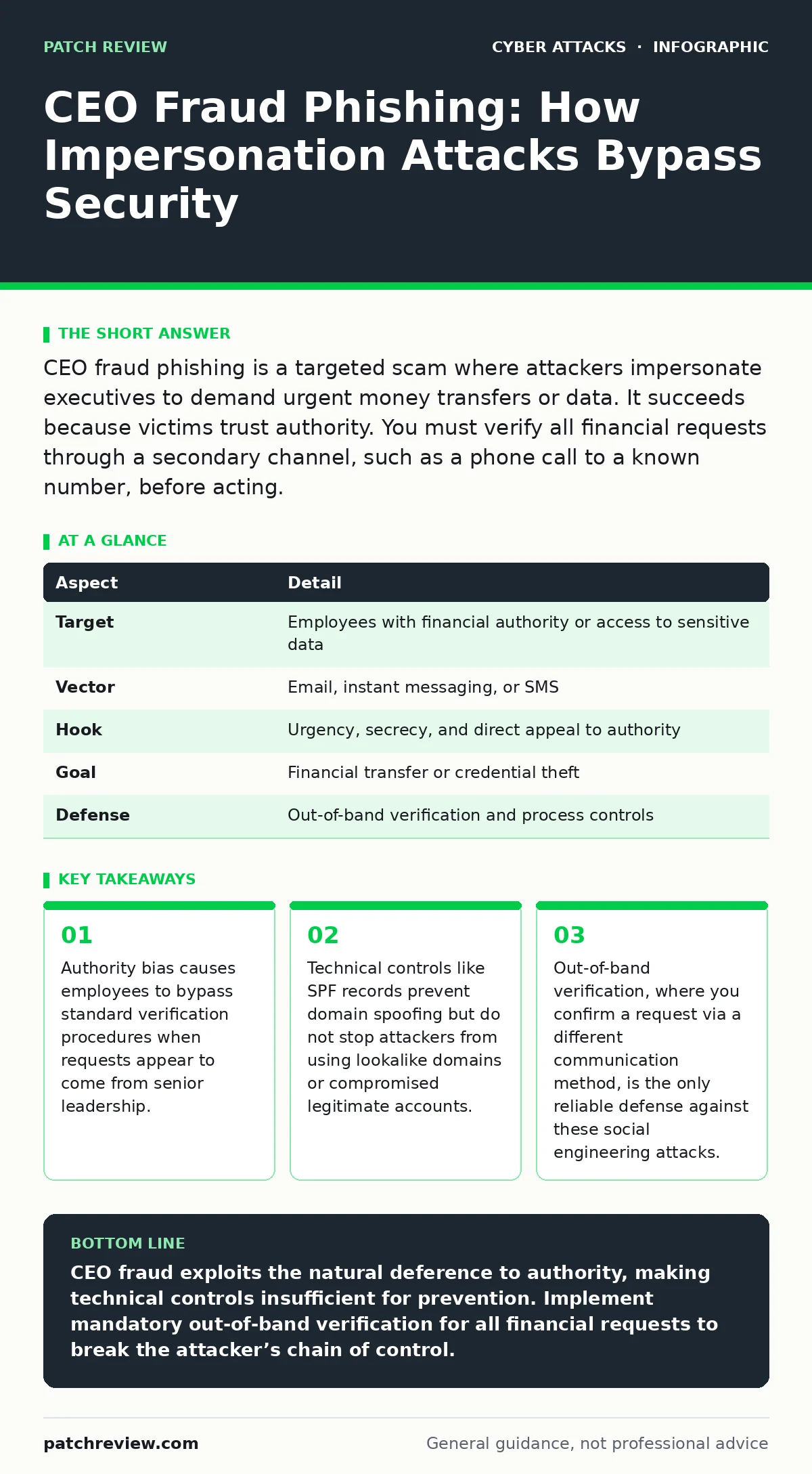
CEO fraud phishing is a targeted scam where attackers impersonate executives to demand urgent money transfers or data. It succeeds because victims trust authority. You must verify all financial requests through a secondary channel, such as a phone call to a known number, before acting.
The Psychology of Authority
Imagine a junior employee receives an email from the company president asking for immediate gift card purchases for a confidential deal. The request is urgent, the tone is commanding, and the sender’s name matches the executive perfectly. Most employees will act quickly to avoid disappointing their leader. This reaction is not a failure of training; it is a predictable human response to authority.
Attackers exploit this hierarchy. They know that subordinates are conditioned to prioritize the needs of superiors over security protocols. The attack does not rely on complex code. It relies on the natural deference you show to leadership. This dynamic creates a blind spot where technical safeguards are ignored because the perceived social cost of questioning a boss is too high.
How CEO Fraud Phishing Works
The attacker begins by researching the target organization. They gather names, roles, and reporting structures from public sources like LinkedIn or company websites. Next, they craft a message that mimics the executive’s communication style. The email often contains subtle errors or unusual formatting to create a sense of urgency. The request typically involves moving money, sharing sensitive credentials, or purchasing gift cards.
Attackers may use a domain that looks similar to the corporate domain, such as swapping letters or using a different top-level domain. In more advanced cases, they compromise a legitimate employee’s account to send the request from a real address. This method bypasses email filters because the message originates from within the trusted network. The goal is to trigger an immediate emotional response that overrides logical thinking.
| Aspect | Detail |
|---|---|
| Target | Employees with financial authority or access to sensitive data |
| Vector | Email, instant messaging, or SMS |
| Hook | Urgency, secrecy, and direct appeal to authority |
| Goal | Financial transfer or credential theft |
| Defense | Out-of-band verification and process controls |
Why Technical Controls Fail
Many organizations believe that filtering email is enough to stop these attacks. This belief is incorrect. Email authentication protocols like SPF, DKIM, and DMARC verify that an email comes from an authorized server. They do not verify the intent of the sender. If an attacker uses a legitimate account, these checks pass.
Even if the attacker uses a spoofed domain, modern filters often allow messages that look similar to legitimate ones to avoid blocking important business correspondence. You must understand that technical controls are designed to stop spam and malware, not social engineering. They cannot detect the nuance of a manipulated request. Relying solely on software creates a false sense of security. The vulnerability is not in the code; it is in the human decision-making process.
What People Usually Get Wrong
A common mistake is assuming that if the email looks correct, it is correct. Attackers invest time in making their messages appear legitimate. They may reply to an existing thread to establish context. They may use the executive’s actual photo in the signature. Another error is relying on visual cues alone. Checking the sender’s display name is insufficient. Attackers can easily change the display name to match an executive.
You must check the actual email address. Even then, a compromised account will have the correct address. The biggest error is skipping verification because the request seems small or routine. Attackers often start with small amounts to test the process. Once they confirm that verification is not required, they escalate the request. Do not assume that a small request is harmless. It is a probe for your weaknesses.
The Hidden Cost of Verification
Implementing strict verification processes can slow down business operations. Employees may feel frustrated by the extra step of calling to confirm a request. Management may worry that delays will harm client relationships. This friction is a necessary trade-off. The cost of a single successful fraud attempt far exceeds the time spent verifying requests. You must build verification into the standard operating procedure.
It should not feel like an exception. When verification becomes routine, the social pressure to skip it diminishes. Organizations that prioritize speed over security are vulnerable. The hidden cost of not verifying is not just financial; it is also reputational. Trust is difficult to rebuild after a breach. The inconvenience of a phone call is a minor price to pay for maintaining that trust.
See also: SPF Explained: How DNS Records Stop Email Spoofing · Warning Signs of Malicious Email Attachments You Can Actually See
Effective Defense Strategies
The most effective defense is out-of-band verification. This means confirming the request through a different communication channel than the one used for the request. If the request comes via email, call the executive using a known phone number. Do not use the number provided in the email. If the request comes via SMS, call the office line. This breaks the attacker’s chain of control.
They may have compromised the email account, but they are unlikely to have control over the phone system. Another strategy is to implement dual approval for financial transactions. Require two people to authorize any transfer above a certain threshold. This adds a layer of scrutiny that makes fraud more difficult. You should also train employees to recognize the signs of urgency and secrecy. These are common tactics used to bypass verification.
Related Security Concepts
Understanding CEO fraud requires a broader view of security. It is related to other attacks that exploit human trust. For instance, callback verification is a specific technique used to confirm the identity of a caller. This concept applies directly to defending against CEO fraud. You should also consider how network segmentation limits the damage if an account is compromised.
If an attacker gains access to one system, segmentation prevents them from moving laterally to financial systems. While website defacement is a visible attack, CEO fraud is silent and internal. Both require different defenses. Understanding the difference between technical attacks and social engineering helps you allocate resources effectively. Do not focus only on firewalls. Focus on processes and people.
Building a Resilient Culture
Security is not just about technology; it is about culture. You must create an environment where employees feel safe questioning authority. If an employee fears reprimand for asking for verification, the security policy is useless. Leadership must model the behavior. Executives should encourage their teams to verify requests. They should not punish employees for taking the time to confirm details.
This cultural shift takes time. It requires consistent reinforcement. When verification becomes a standard part of the workflow, the risk of CEO fraud decreases significantly. You are building a system where trust is verified, not assumed. This approach protects the organization from a wide range of social engineering attacks. It also improves overall operational discipline.
Key takeaways
- Authority bias causes employees to bypass standard verification procedures when requests appear to come from senior leadership.
- Technical controls like SPF records prevent domain spoofing but do not stop attackers from using lookalike domains or compromised legitimate accounts.
- Out-of-band verification, where you confirm a request via a different communication method, is the only reliable defense against these social engineering attacks.
CEO fraud exploits the natural deference to authority, making technical controls insufficient for prevention. Implement mandatory out-of-band verification for all financial requests to break the attacker’s chain of control.
Frequently asked questions
Can email filters stop CEO fraud?
Email filters can block obvious spam, but they cannot detect sophisticated social engineering or requests sent from compromised legitimate accounts.
What is out-of-band verification?
It is the process of confirming a request through a different communication channel, such as calling a known phone number instead of replying to an email.
Why do employees fall for these scams?
Employees are conditioned to respect authority and prioritize urgent requests from superiors, which attackers exploit to bypass standard security procedures.
How can I protect my organization?
Implement dual approval for financial transactions, train employees to recognize urgency tactics, and enforce a strict policy of verifying all requests through trusted channels.
How this guide was produced: written by the Patch Review editorial team with AI assistance, checked against the public references listed below, and reviewed when the facts change. See our editorial policy or report an error.