
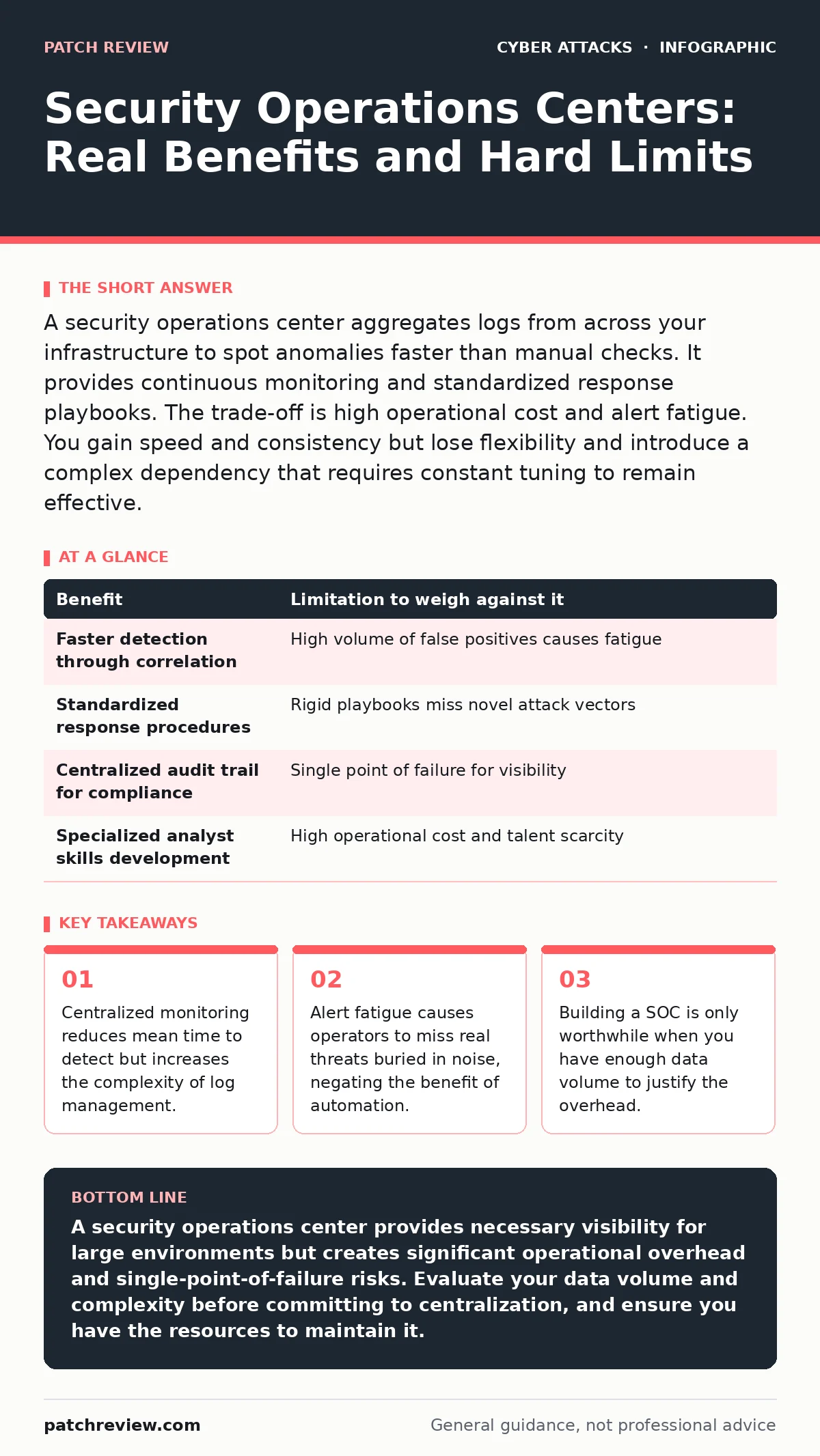
A security operations center aggregates logs from across your infrastructure to spot anomalies faster than manual checks. It provides continuous monitoring and standardized response playbooks. The trade-off is high operational cost and alert fatigue. You gain speed and consistency but lose flexibility and introduce a complex dependency that requires constant tuning to remain effective.
How Centralized Monitoring Changes Detection
A security operations center aggregates telemetry from endpoints, networks, and cloud services into a single view. This consolidation allows analysts to correlate events that appear unrelated in isolation. Imagine a failed login attempt in New York followed by a successful login from Russia minutes later. Separate systems would flag these as minor issues. A correlated view reveals a credential stuffing attack in progress.
The primary benefit is visibility. You stop relying on isolated alerts and start seeing the narrative of an attack. This context reduces the time spent investigating false positives. Analysts can distinguish between a misconfigured script and a genuine intrusion attempt. The structure forces discipline in logging. You must define what data matters before you can analyze it. This discipline often reveals gaps in your data collection strategy.
The Hidden Cost of Alert Fatigue
The centralization of data creates a flood of alerts. Most initial alerts are noise generated by normal business activity. Operators must triage thousands of signals daily to find the few that indicate compromise. This process leads to alert fatigue, a state of cognitive exhaustion where analysts stop noticing subtle indicators.
When fatigue sets in, you miss the subtle signs of advanced threats. Imagine an attacker using slow, low-volume data exfiltration that mimics normal backup traffic. An exhausted operator might dismiss this as routine. The SOC structure encourages automation to filter noise, but automated filters can also suppress novel attack patterns. You trade sensitivity for sanity. Finding the right balance requires continuous tuning of detection rules, a task that never ends.
Single Point of Failure Risks
Centralizing your security operations creates a critical dependency. If the SOC platform goes offline, your visibility drops to zero. Attackers understand this vulnerability. They often target the SOC infrastructure itself to blind defenders. A successful attack on the monitoring system allows the adversary to operate freely while you believe you are protected.
This risk extends to human factors. If you rely on a small team or a third-party provider, you face resource constraints. Staff turnover breaks institutional knowledge. Playbooks become outdated. The centralized model assumes consistent staffing and tool availability. When those assumptions fail, the SOC becomes a liability rather than an asset. You must treat the SOC as a critical infrastructure component with its own redundancy and security controls.
| Benefit | Limitation to weigh against it |
|---|---|
| Faster detection through correlation | High volume of false positives causes fatigue |
| Standardized response procedures | Rigid playbooks miss novel attack vectors |
| Centralized audit trail for compliance | Single point of failure for visibility |
| Specialized analyst skills development | High operational cost and talent scarcity |
When Centralization Adds Real Value
A security operations center makes sense when your environment generates too much data for manual review. Large networks with diverse endpoints produce logs that exceed human processing capacity. Automation becomes necessary to filter noise. In these cases, the SOC provides the only viable way to maintain visibility.
Complex compliance requirements also drive the need for centralization. Regulators often demand centralized logging and defined response times. A SOC structure provides the framework to meet these mandates consistently. If you manage multiple sites or cloud environments, a unified view prevents blind spots. You avoid the inefficiency of separate teams managing separate silos. The investment pays off when the scale of your infrastructure outpaces the capacity of individual administrators.
When Decentralization Works Better
Small organizations often suffer under the weight of a full SOC. The cost of tools, licenses, and staff exceeds the value of the protection. In these cases, decentralized monitoring is more effective. Individual system owners monitor their own assets. They understand the baseline behavior of their specific systems better than a central team ever could.
Decentralization also works when speed is more important than correlation. Imagine a website experiencing defacement. The web team can restore services immediately without waiting for a central ticket. A SOC process might introduce delays through bureaucracy. If your primary risk is localized, such as cryptomining attacks on exposed servers, local controls and automated scripts are sufficient. You do not need a central team to watch every server if you can isolate the vulnerable ones.
See also: Callback Verification: Fix 6 Common Security Misconceptions · Replay Attack Response: Containment, Recovery, and Prevention Steps
Balancing Automation and Human Insight
Automation handles the repetitive tasks of a SOC. It parses logs, applies rules, and generates initial alerts. However, automation cannot understand intent or context. Human analysts must review exceptions and refine rules. The balance between automation and human judgment determines the effectiveness of your operations.
Too much automation leads to blind spots. Rules trained on past data miss new tactics. Too much manual review leads to burnout. You must design a workflow where machines handle volume and humans handle nuance. This requires continuous feedback loops. Analysts must update detection rules based on new findings. The SOC is not a set-and-forget system. It is a living process that requires constant attention and adjustment.
Integrating with Other Security Controls
A SOC does not operate in isolation. It must integrate with other security controls to be effective. Network segmentation limits the damage of a breach, giving the SOC time to detect and respond. Without segmentation, an attacker moves laterally before detection.
Email security controls reduce the volume of malicious email attachments reaching users. This reduces the noise the SOC must process. Similarly, proper SPF configuration prevents domain spoofing, reducing phishing attempts. The SOC focuses on what these controls cannot catch. It handles zero-click attacks and sophisticated malware that bypasses perimeter defenses. The SOC is the last line of defense, not the first. It validates the effectiveness of your other controls.
Building a Sustainable SOC Culture
The technology is only part of the equation. The people and processes define success. You must foster a culture of continuous improvement. Analysts should share findings and update playbooks regularly. Cross-training ensures that knowledge is not held by a single individual.
Regular tabletop exercises test your response capabilities. These drills reveal gaps in your procedures and tooling. You must simulate realistic scenarios, such as callback phishing attempts targeting your SOC staff themselves. Understanding how attackers try to manipulate your defenders is as important as understanding how they breach your network. The SOC culture must be resilient, adaptable, and focused on learning from every incident.
Key takeaways
- Centralized monitoring reduces mean time to detect but increases the complexity of log management.
- Alert fatigue causes operators to miss real threats buried in noise, negating the benefit of automation.
- Building a SOC is only worthwhile when you have enough data volume to justify the overhead.
A security operations center provides necessary visibility for large environments but creates significant operational overhead and single-point-of-failure risks. Evaluate your data volume and complexity before committing to centralization, and ensure you have the resources to maintain it.
Frequently asked questions
How many analysts do I need for a SOC?
Staffing depends on shift coverage and alert volume. You need enough people to maintain focus without burnout. Small teams often require 24/7 coverage with rotating shifts, meaning you need multiple full-time equivalents.
Can I use a third-party SOC?
Managed detection and response services can provide expertise without hiring full-time staff. You trade control for convenience. Ensure the provider integrates well with your existing tools and shares clear reporting.
What is the difference between a SOC and a NOC?
A network operations center focuses on keeping systems online and performing. A security operations center focuses on detecting and responding to malicious activity. They often share tools but have different goals.
How do I measure SOC success?
Track mean time to detect and mean time to respond. Monitor the ratio of false positives to true positives. These metrics show whether your tools and processes are improving over time.
How this guide was produced: written by the Patch Review editorial team with AI assistance, checked against the public references listed below, and reviewed when the facts change. See our editorial policy or report an error.