
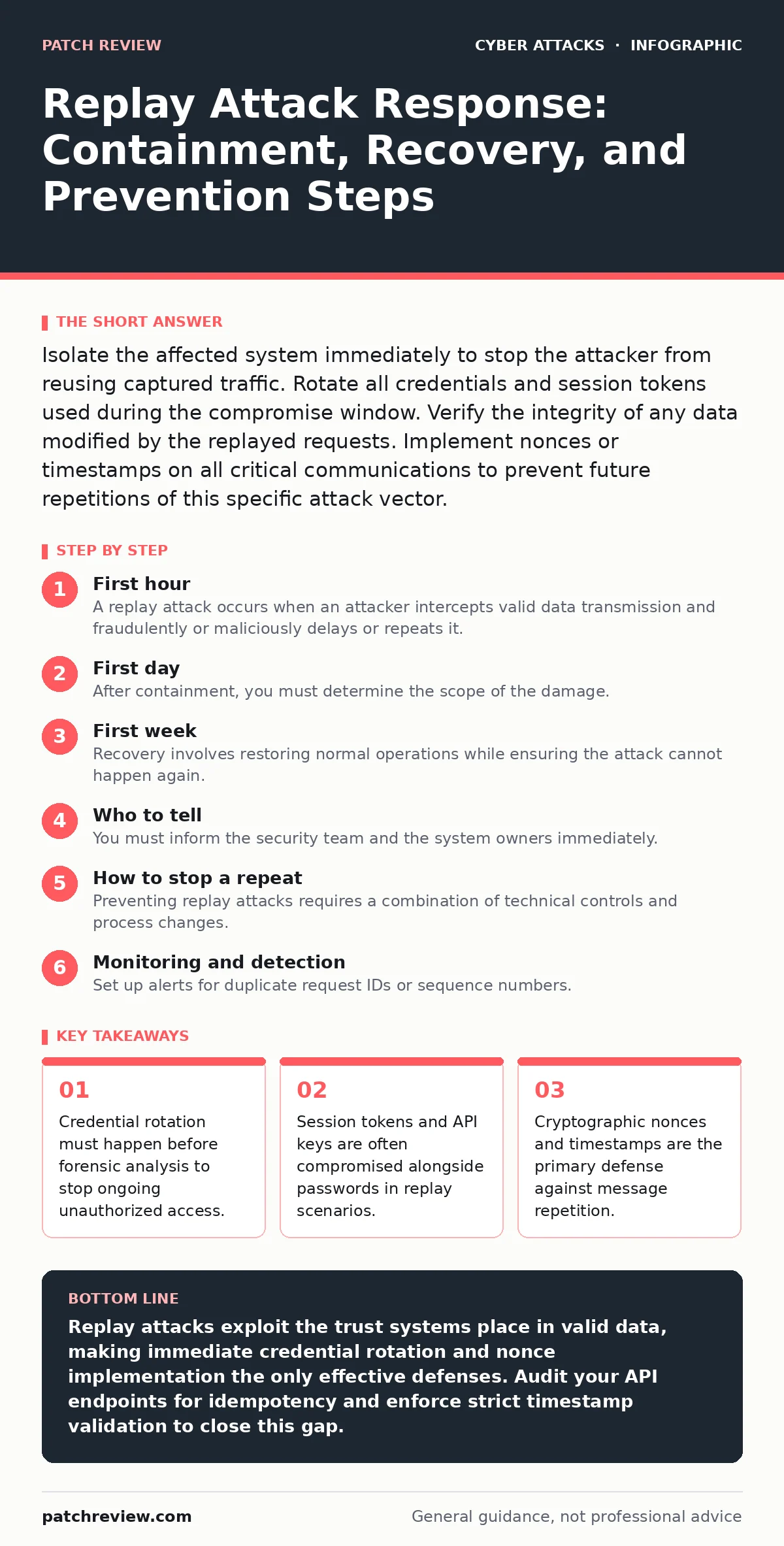
Isolate the affected system immediately to stop the attacker from reusing captured traffic. Rotate all credentials and session tokens used during the compromise window. Verify the integrity of any data modified by the replayed requests. Implement nonces or timestamps on all critical communications to prevent future repetitions of this specific attack vector.
First hour
A replay attack occurs when an attacker intercepts valid data transmission and fraudulently or maliciously delays or repeats it. The attacker does not need to decrypt the data. They only need to copy the bits and send them again. This bypasses standard encryption if the system accepts repeated messages as new requests. You must act fast because the attacker may still be active.
Immediate containment checklist
- Isolate the compromised endpoint from the network immediately.
- Disable the user account associated with the intercepted session.
- Revoke all active session tokens for that user.
- Rotate API keys if the intercepted traffic involved application programming interfaces.
- Document the exact time the anomaly was detected.
Isolating the host prevents the attacker from continuing to send the captured packet stream. Disabling the account stops the attacker from using that identity for new actions. You must revoke session tokens because many systems keep a session alive even after a password change. If the attacker has a valid session cookie, they can continue acting as the user until the cookie expires. This is why session cookie theft is often the result of a successful replay.
You must rotate API keys if the intercepted traffic involved machine-to-machine communication. Applications often use long-lived keys that do not expire quickly. If an attacker captures a request with a valid key, they can replay it indefinitely until the key is rotated. Do not assume that changing the user password is enough. The application may still trust the old key.
First day
After containment, you must determine the scope of the damage. A replay attack can change data, submit transactions, or execute commands. You need to know which requests were replayed and what they did. Review the application logs and server logs for duplicate request IDs or timestamps. Look for requests that arrive at unusual times or from unusual sources.
Investigating the impact
- Identify the specific endpoints or APIs that were targeted.
- Compare the replayed requests with the original legitimate requests.
- Determine if the replayed requests resulted in state changes.
- Check for any financial transactions or data modifications.
If the replayed request was idempotent, it may have caused no harm. An idempotent request produces the same result no matter how many times it is sent. A GET request to read a file is idempotent. However, a POST request to transfer money is not. Sending the same transfer request twice results in two transfers. You must check for these non-idempotent actions.
You should also look for signs of web skimming on the pages where the attack originated. Attackers often inject malicious scripts to steal data in real-time. If the replay attack came from a compromised web page, the attacker may have been collecting more than just the single request. They may have been harvesting credentials from other users. This requires a broader investigation of the web application code.
First week
Recovery involves restoring normal operations while ensuring the attack cannot happen again. You must change all credentials that were in use during the compromise window. This includes passwords, session tokens, and API keys. You must also review the application architecture to see why the replay was accepted.
Strengthening defenses
Implement conditional access policies that require re-authentication for sensitive actions. If a user performs a high-risk action, the system should ask for a new password or multi-factor authentication. This breaks the chain of a replay attack because the attacker cannot provide the second factor. They only have the captured traffic from the first login.
Use cryptographic nonces in your application design. A nonce is a number used once. The server generates a unique nonce for each request. The client must include this nonce in the response. The server checks that the nonce has not been used before. If the attacker replays an old request, the nonce will be invalid. This is the most effective technical control against replay attacks.
Timestamps also help. Attach a time stamp to each request. The server rejects any request that is older than a few seconds. This limits the window in which an attacker can replay the data. If the attacker captures a request at 10:00:00, they cannot replay it at 10:05:00. The server will see the old time stamp and reject it. This requires synchronized clocks on all servers and clients.
Who to tell
You must inform the security team and the system owners immediately. The security operations centers need to monitor for similar patterns in other parts of the network. They can look for duplicate packets or unusual traffic volumes. This helps them detect if the attacker is moving laterally.
Inform the users who were affected. Tell them that their credentials were compromised. Advise them to change their passwords on other systems if they reuse passwords. This is similar to the advice given after malicious email attachments compromise a device. The user’s identity is now considered untrusted until proven otherwise.
If the attack involved financial data or personal information, you may need to notify regulatory bodies. Check your local laws and industry standards. Some industries require notification within a specific timeframe. Do not delay this step. Transparency builds trust with your users and customers.
How to stop a repeat
Preventing replay attacks requires a combination of technical controls and process changes. You must ensure that every request is unique. This means using nonces, timestamps, or sequence numbers. You must also ensure that the communication channel is secure. Use Transport Layer Security (TLS) for all communications. This prevents the attacker from easily intercepting the traffic in the first place.
Review your authentication flows. Do not rely solely on static credentials. Use dynamic tokens that expire quickly. Implement callback verification for high-value actions. This adds a step that the attacker cannot replay. They cannot answer the callback because they do not have the user’s phone or email.
Train your developers to recognize replay risks. Many developers do not consider the possibility of message repetition. They assume that if the message is valid, it is new. This assumption is dangerous. Every state-changing request must be protected against replay. Include this in your code review process. Check for missing nonces or timestamps in API calls.
See also: Malware Persistence Mechanisms: How Code Outlives Reboots · Cloud Ransomware Response: Containment and Recovery Steps
Monitoring and detection
Set up alerts for duplicate request IDs or sequence numbers. Your logging system should flag any request that has the same ID as a previous request. This allows you to detect replay attacks in real-time. You can then block the attacker and investigate the impact.
Monitor for unusual traffic patterns. A replay attack may cause a spike in traffic to a specific endpoint. It may also cause errors in the application if the replayed request conflicts with the current state. These anomalies can be early indicators of an attack.
Regularly review your security controls. Ensure that your nonces are truly random and unique. Ensure that your timestamps are accurate and synchronized. Test your systems with simulated replay attacks to verify that they are rejected. This is part of a regular security testing program.
Key takeaways
- Credential rotation must happen before forensic analysis to stop ongoing unauthorized access.
- Session tokens and API keys are often compromised alongside passwords in replay scenarios.
- Cryptographic nonces and timestamps are the primary defense against message repetition.
Replay attacks exploit the trust systems place in valid data, making immediate credential rotation and nonce implementation the only effective defenses. Audit your API endpoints for idempotency and enforce strict timestamp validation to close this gap.
Frequently asked questions
How do I know if I am under a replay attack?
Look for duplicate request IDs, unusual transaction volumes, or state changes that do not match user activity logs.
Does encryption stop replay attacks?
Encryption protects the data content, but it does not prevent an attacker from copying and resending the encrypted packet.
What is a nonce in cybersecurity?
A nonce is a random number used only once in a cryptographic communication to ensure that old messages cannot be reused.
Can firewalls detect replay attacks?
Standard firewalls cannot detect replay attacks unless they are configured to inspect application-layer data for duplicate identifiers.
How this guide was produced: written by the Patch Review editorial team with AI assistance, checked against the public references listed below, and reviewed when the facts change. See our editorial policy or report an error.