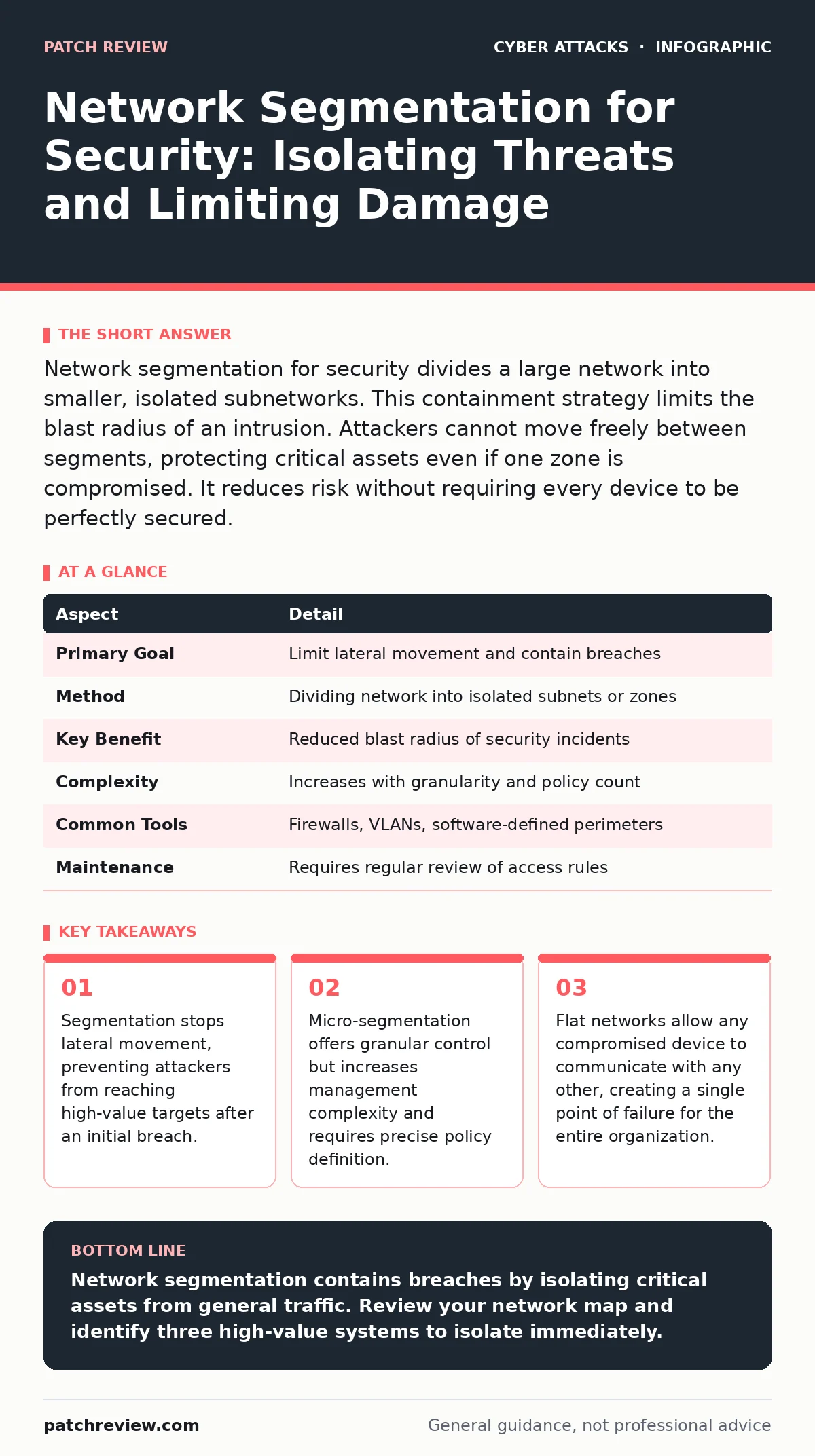
Network segmentation for security divides a large network into smaller, isolated subnetworks. This containment strategy limits the blast radius of an intrusion. Attackers cannot move freely between segments, protecting critical assets even if one zone is compromised. It reduces risk without requiring every device to be perfectly secured.
The Water Main Analogy
Imagine a city water supply with a single, massive pipe running through every neighborhood. If that pipe bursts, the entire city loses pressure and suffers contamination. Now imagine separate pipes for residential, commercial, and industrial zones. A break in one zone affects only that area. Network segmentation works the same way. It isolates parts of your infrastructure so that a failure or intrusion in one area does not cascade into the rest. This physical separation logic applies to digital traffic flows.
What Is Network Segmentation for Security?
Network segmentation for security is the practice of dividing a computer network into smaller, distinct subnetworks. Each segment operates with its own security policies and access controls. This isolation ensures that devices in one segment cannot freely communicate with devices in another unless explicitly permitted. The goal is to limit the attack surface. If an adversary compromises one device, they remain trapped within that specific segment. This containment strategy protects sensitive data and critical systems from widespread exposure.
| Aspect | Detail |
|---|---|
| Primary Goal | Limit lateral movement and contain breaches |
| Method | Dividing network into isolated subnets or zones |
| Key Benefit | Reduced blast radius of security incidents |
| Complexity | Increases with granularity and policy count |
| Common Tools | Firewalls, VLANs, software-defined perimeters |
| Maintenance | Requires regular review of access rules |
How Segmentation Limits Attack Surface
Attackers rarely target your most secure system directly. They find an entry point with weaker defenses, such as a guest Wi-Fi network or an Internet of Things device. Once inside, they look for paths to more valuable targets. In a flat network, every device can talk to every other device. The attacker moves freely, scanning for vulnerabilities and escalating privileges. Segmentation breaks these paths. You define strict rules for which segments can communicate. An IoT device in the guest segment cannot reach the finance database in the corporate segment. This forces the attacker to find a new entry point for each target.
The Hidden Cost of Complexity
Segmentation is not a set-it-and-forget-it control. It introduces operational overhead. Every new application or service requires a review of network paths. You must define exactly which ports and protocols are allowed between segments. This process slows down deployment cycles. Developers may complain that the network team is blocking legitimate traffic. You must balance security with usability. Over-segmentation can create a maze of rules that is impossible to audit. Under-segmentation leaves gaps that attackers exploit. The hidden cost is the time spent maintaining accurate network diagrams and access control lists.
Common Mistakes in Implementation
Many organizations treat segmentation as a one-time project. They draw lines on a diagram and then stop. Networks change constantly. Devices move, applications update, and remote workers join. Static segments become outdated quickly. Rules that were necessary six months ago may now be obsolete. These stale rules create confusion and potential backdoors. Another common error is relying solely on perimeter firewalls. Internal segmentation requires internal controls. You must assume the perimeter is already breached. This mindset shift is difficult but necessary for effective defense.
People also misunderstand the role of VLANs. Virtual Local Area Networks provide Layer 2 isolation, which is useful for broadcast domains. However, VLANs do not provide security on their own. Without a firewall or access control list between VLANs, traffic can still flow freely. You must enforce security policies at the boundaries. Simply placing devices in different VLANs is not enough. You must verify that traffic between them is explicitly denied by default.
See also: Open Port Management: Why Closing Unnecessary Ports Reduces Attack Surface · Edge Computing FAQs: Security Risks, Architecture, and Real-World Answers
Integrating with Other Controls
Segmentation works best when combined with other security measures. It reduces the risk of replay attacks by limiting the paths an attacker can traverse to capture and reuse credentials. It also mitigates the impact of ARP spoofing by containing the spoofed traffic within a small segment. When you implement conditional access policies, segmentation ensures that even if a user’s credentials are stolen, the attacker cannot reach resources outside their assigned zone. This layered approach creates multiple barriers.
Consider the risk of CEO fraud. An attacker may trick an employee into transferring funds. If the financial systems are segmented and require specific authentication, the attacker cannot easily manipulate the payment gateway from a compromised work station. Segmentation does not prevent the social engineering attack, but it limits the damage. You should also review your security operations centers procedures. Analysts need visibility into segmented traffic to detect anomalies. If you cannot see the traffic, you cannot protect it.
Planning Your Segmentation Strategy
Start by identifying your crown jewels. These are the systems that hold sensitive data or critical business functions. Place these systems in the most restrictive segments. Then identify the systems that interact with them. Define the minimum necessary communication paths. Deny all other traffic by default. This principle of least privilege applies to network traffic as well as user accounts.
Review your guest network. It should be completely isolated from the corporate network. Guests should not be able to scan or ping internal devices. This prevents an attacker with a compromised guest device from mapping your internal infrastructure. Use micro-segmentation for high-risk workloads. This allows you to control traffic at the workload level, not just the network level. It provides finer granularity but requires more management.
Maintaining Segmentation Over Time
Networks evolve. You must review your segmentation strategy regularly. Quarterly reviews are a good baseline. Check for new applications, new devices, and changes in business processes. Remove rules that are no longer needed. This reduces the attack surface and simplifies troubleshooting. Automation can help manage this complexity. Use tools that can enforce policies consistently across the network.
Training is also important. Staff members need to understand why segmentation exists. They may request exceptions for convenience. You must explain the trade-offs. Convenience often comes at the cost of security. Establish a clear process for requesting and approving exceptions. Every exception should have an expiration date. This ensures that temporary access does not become permanent.
Key takeaways
- Segmentation stops lateral movement, preventing attackers from reaching high-value targets after an initial breach.
- Micro-segmentation offers granular control but increases management complexity and requires precise policy definition.
- Flat networks allow any compromised device to communicate with any other, creating a single point of failure for the entire organization.
Network segmentation contains breaches by isolating critical assets from general traffic. Review your network map and identify three high-value systems to isolate immediately.
Frequently asked questions
Does network segmentation slow down network performance?
Segmentation can introduce slight latency due to additional routing and inspection. Modern hardware handles this efficiently. The security benefits outweigh the minimal performance impact.
Can segmentation stop ransomware?
Segmentation limits the spread of ransomware. It prevents the malware from encrypting all files at once. It does not prevent the initial infection, but it reduces the total damage.
How do I segment a cloud environment?
Cloud segmentation uses virtual networks and security groups. You define rules for each instance. The logic is the same as on-premises segmentation, but the implementation uses cloud-native tools.
Is micro-segmentation necessary for small businesses?
Micro-segmentation is beneficial for any size. Small businesses can use basic VLANs and firewall rules. You do not need expensive tools to start. Focus on isolating critical assets first.
How this guide was produced: written by the Patch Review editorial team with AI assistance, checked against the public references listed below, and reviewed when the facts change. See our editorial policy or report an error.