
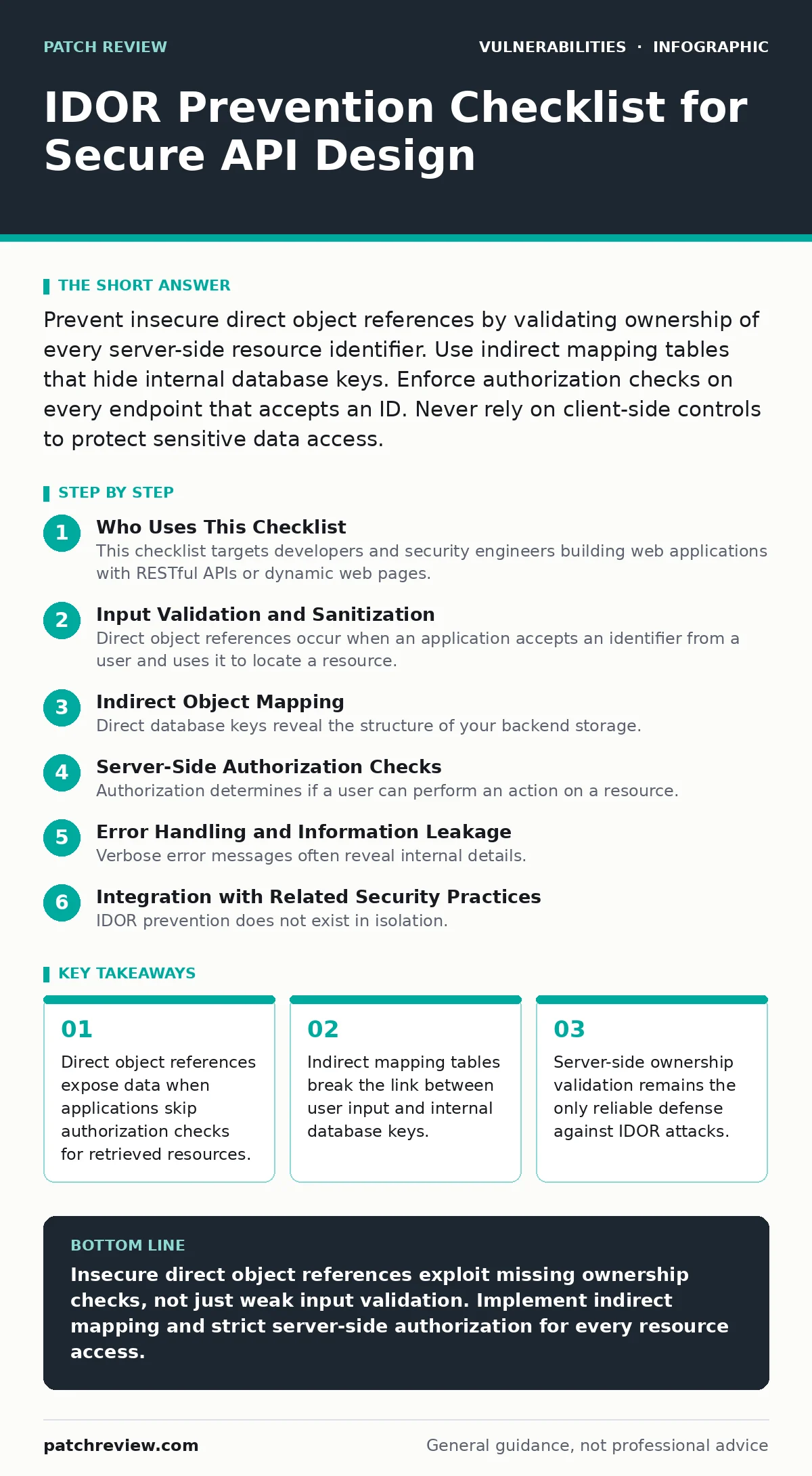
Prevent insecure direct object references by validating ownership of every server-side resource identifier. Use indirect mapping tables that hide internal database keys. Enforce authorization checks on every endpoint that accepts an ID. Never rely on client-side controls to protect sensitive data access.
Who Uses This Checklist
This checklist targets developers and security engineers building web applications with RESTful APIs or dynamic web pages. You use it during code review phases to verify that resource access controls function correctly. Each item addresses a specific failure mode in authorization logic. Check these items before deploying new features or refactoring existing data access layers.
Input Validation and Sanitization
Direct object references occur when an application accepts an identifier from a user and uses it to locate a resource. Attackers modify these identifiers to access data belonging to other users. You must validate that the identifier format matches expectations.
- Reject non-integer IDs when the system expects numeric primary keys: prevents injection attempts that bypass type checks.
- Enforce strict length limits on identifier parameters: stops buffer overflow attempts and reduces search space for attackers.
- Validate UUIDs against a known format before processing: ensures malformed identifiers fail fast without reaching the database.
- Strip whitespace and special characters from ID parameters: prevents parsing errors that might bypass authorization logic.
Input validation alone does not prevent IDOR. An attacker can provide a valid integer that belongs to another user. Validation reduces the attack surface but does not verify ownership. You must combine these checks with authorization logic.
Indirect Object Mapping
Direct database keys reveal the structure of your backend storage. If users see sequential integers like 1, 2, 3, they can guess valid IDs. Indirect mapping breaks this visibility. You create a server-side table that maps public tokens to internal keys.
- Replace sequential database keys with random tokens in API responses: hides the total number of records and prevents enumeration.
- Store the mapping between public tokens and internal keys in a separate table: decouples public exposure from internal data structure.
- Rotate mapping tokens periodically for long-lived resources: limits the window of exposure if a token is leaked.
- Ensure the mapping table does not expose ownership relationships: prevents attackers from inferring data associations through token analysis.
Indirect mapping adds complexity to your data layer. You must maintain the mapping table and handle token generation. The trade-off is reduced risk of enumeration. Attackers cannot guess valid IDs because the tokens are random and opaque. This approach complements, but does not replace, ownership checks.
Server-Side Authorization Checks
Authorization determines if a user can perform an action on a resource. Authentication verifies who the user is. IDOR occurs when authorization is missing or flawed. You must check ownership on the server for every request that accesses a resource.
- Verify the resource owner matches the authenticated user session: ensures users can only access their own data.
- Deny access by default when ownership cannot be verified: follows the principle of least privilege and fails securely.
- Include authorization checks in all CRUD operations: prevents bypasses through update or delete endpoints that might skip checks.
- Log denied access attempts for audit purposes: provides visibility into potential attacks and helps refine detection rules.
Client-side controls like hiding buttons or removing links do not prevent IDOR. Attackers craft their own requests. Server-side checks are mandatory. You cannot rely on JavaScript validation or API gateway rules alone. The application logic must enforce ownership before returning data.
Error Handling and Information Leakage
Verbose error messages often reveal internal details. If an IDOR attempt triggers a "Record Not Found" vs "Access Denied" distinction, attackers gain information. You must standardize error responses to prevent information leakage.
- Return generic error messages for both missing and unauthorized resources: prevents attackers from distinguishing between valid and invalid IDs.
- Avoid stack traces or database error details in production responses: stops attackers from learning schema structure or query logic.
- Rate-limit failed access attempts on sensitive endpoints: slows down automated enumeration attacks and reduces noise.
- Monitor for unusual patterns in ID access attempts: helps detect active IDOR exploitation before data exfiltration occurs.
Information leakage turns a failed attack into a reconnaissance tool. Attackers use error differences to map valid resources. Consistent error handling removes this signal. You must balance usability with security. Users need to know if a request failed, but they do not need to know why it failed at a technical level.
Integration with Related Security Practices
IDOR prevention does not exist in isolation. It interacts with other security controls. For example, proper exposure management helps you identify which endpoints accept direct object references. You should also consider risk-based vulnerability management to prioritize fixing IDOR issues in high-value data flows.
- Align IDOR checks with session management policies: ensures that session expiration also invalidates cached resource access tokens.
- Review clickjacking protections alongside IDOR controls: prevents attackers from forcing users to submit malicious ID values via UI overlays.
- Coordinate with bug bounty programs to test IDOR scenarios: external testers often find edge cases in authorization logic that internal reviews miss.
- Ensure end-of-life software is removed from the stack: outdated frameworks may lack modern authorization helpers or contain known IDOR flaws.
Integrating these practices creates a defense-in-depth strategy. No single control stops all IDOR attacks. You combine indirect mapping, strict authorization, and careful error handling. This layered approach reduces the likelihood of successful exploitation.
Maintenance and Continuous Testing
Security controls degrade over time. New features often bypass existing checks. You must retest authorization logic after changes. Automated tests should verify that users cannot access resources they do not own.
- Include IDOR test cases in your CI/CD pipeline: catches regressions before code reaches production.
- Perform periodic manual testing of complex workflows: automated tests may miss context-dependent authorization failures.
- Review authorization logic during major refactoring efforts: ensures that new architectures maintain ownership checks.
- Update threat models to include IDOR scenarios for new data types: keeps security design aligned with evolving business logic.
Continuous testing ensures that your defenses remain effective. You cannot assume that once-fixed IDOR issues stay fixed. Code changes introduce new risks. Regular review and testing maintain the integrity of your authorization controls.
Key takeaways
- Direct object references expose data when applications skip authorization checks for retrieved resources.
- Indirect mapping tables break the link between user input and internal database keys.
- Server-side ownership validation remains the only reliable defense against IDOR attacks.
Insecure direct object references exploit missing ownership checks, not just weak input validation. Implement indirect mapping and strict server-side authorization for every resource access.
Frequently asked questions
Does using UUIDs prevent IDOR attacks?
No, UUIDs only make guessing harder. Attackers can still access valid UUIDs if the application does not verify that the user owns the resource.
Can API gateways stop IDOR vulnerabilities?
API gateways can enforce rate limiting and basic auth, but they cannot verify resource ownership. Application-level authorization checks remain necessary.
Should I hide database IDs from users entirely?
Yes, hiding internal IDs reduces the attack surface. Use indirect tokens instead of exposing primary keys in URLs or API responses.
How do I test for IDOR in my application?
Attempt to access resources belonging to other users by modifying ID parameters in your requests. Verify that the server denies access.
How this guide was produced: written by the Patch Review editorial team with AI assistance, checked against the public references listed below, and reviewed when the facts change. See our editorial policy or report an error.