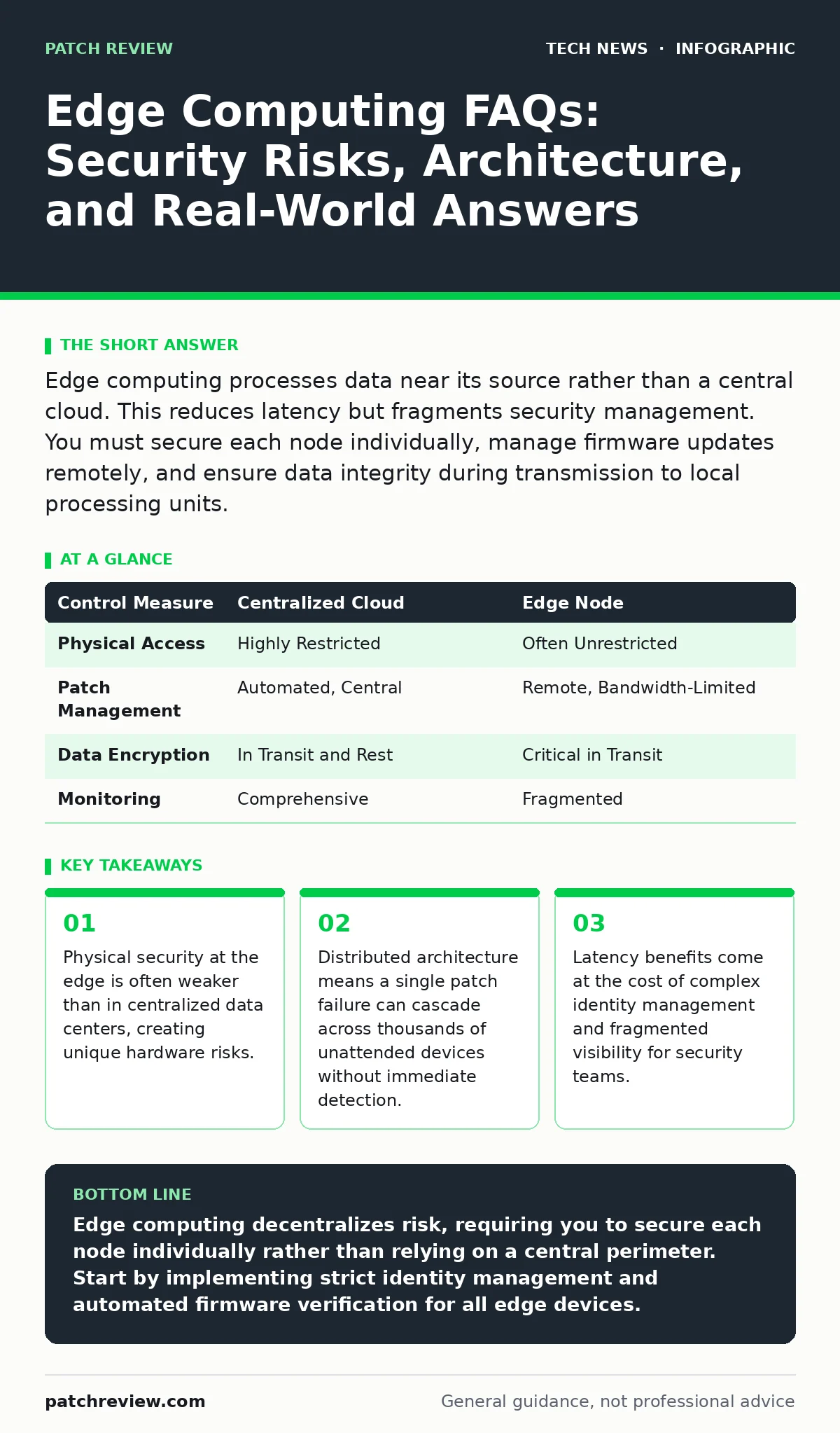
Edge computing processes data near its source rather than a central cloud. This reduces latency but fragments security management. You must secure each node individually, manage firmware updates remotely, and ensure data integrity during transmission to local processing units.
What defines edge computing?
Edge computing is the practice of processing data closer to where it is generated, rather than sending it to a central cloud server. This architecture reduces the distance data travels, which lowers latency and saves bandwidth. You deploy compute resources at the "edge" of the network, often on devices like sensors, cameras, or local servers.
Why does edge computing increase security risk?
Distributing compute resources expands your attack surface because each node is a potential entry point. Centralized data centers have strict physical security, but edge devices often sit in unsecured locations. An attacker only needs physical access to one node to potentially compromise the local network or exfiltrate data.
How do you secure physical edge devices?
You must assume that any edge device can be physically tampered with. Use hardware security modules (HSMs) to store cryptographic keys securely within the device. Enable tamper-evident seals and sensors that trigger alerts if the device casing is opened. Regular physical audits are necessary, though difficult to scale across thousands of locations.
What is the impact on network visibility?
Edge architectures obscure traditional network monitoring because traffic flows locally before reaching the core. You lose the single pane of glass that centralized logging provides. Each edge node must generate and forward logs securely, which consumes bandwidth and processing power. Without proper log aggregation, you cannot detect lateral movement between edge nodes.
How do you manage identity at the scale of the edge?
Traditional username and password combinations fail at scale due to management overhead and weak user behavior. Implement mutual TLS, where both the client and server verify each other's identity using digital certificates. This ensures that only authorized devices can communicate with the central system. Certificate rotation must be automated to prevent expired credentials from causing outages.
| Control Measure | Centralized Cloud | Edge Node |
|---|---|---|
| Physical Access | Highly Restricted | Often Unrestricted |
| Patch Management | Automated, Central | Remote, Bandwidth-Limited |
| Data Encryption | In Transit and Rest | Critical in Transit |
| Monitoring | Comprehensive | Fragmented |
See also: How Ransomware Works: The Step-by-Step Infection Cycle · DDoS Protection Checklist: Mitigation Strategies and Architecture
Why is firmware management harder at the edge?
Edge devices often have limited storage and processing power, making large updates difficult to download and install. You must sign firmware updates cryptographically to prevent malicious code from executing on the device. Verify the signature before applying any update to ensure it comes from a trusted source. Failed updates can brick devices that are physically inaccessible for repair.
How does edge computing affect data privacy?
Processing data locally can improve privacy by keeping sensitive information off central servers. However, it also means data resides on devices with weaker security controls. You must encrypt data at rest on the edge device using strong algorithms. If the device is stolen, the encrypted data remains unreadable without the decryption keys.
What are the common misconceptions about edge security?
Many believe that edge computing is inherently more secure because data does not travel far. This is false because local networks are often less monitored and less hardened. Another myth is that edge devices are too small to be valuable targets. Attackers often use edge nodes as stepping stones to reach more critical central systems.
How do you detect anomalies at the edge?
Traditional signature-based detection struggles with edge devices due to resource constraints and unique traffic patterns. Use behavioral analysis to identify deviations from normal operation, such as unexpected data volumes or connection attempts. Deploy lightweight agents that report only anomalies to save bandwidth. Correlate these alerts with central logs to distinguish between local noise and coordinated attacks.
What is the role of zero trust in edge architectures?
Zero trust assumes no user or device is trusted by default, regardless of location. This model is ideal for edge computing because it eliminates reliance on perimeter defenses. Every request must be authenticated and authorized before access is granted. Implement micro-segmentation to isolate edge nodes from each other and from the central network.
How does edge computing relate to remote work security?
Edge computing supports remote work by processing data locally for employees in distributed locations. This reduces dependency on central office infrastructure and improves performance for latency-sensitive applications. However, it also introduces the same security challenges as IoT edge devices. You must apply the same strict access controls and monitoring to remote edge nodes as you would to office-based systems.
What are the implications for DevOps security?
Deploying code to edge devices requires rigorous testing and automated security checks. You cannot manually verify each device, so your CI/CD pipeline must include security scanning. Ensure that container images used on edge nodes are minimal and free of vulnerabilities. Automate rollback procedures to quickly revert faulty deployments that could lock you out of remote devices.
How do you ensure compliance with data regulations?
Data sovereignty laws often require data to remain within specific geographic boundaries. Edge computing helps comply with these laws by processing data locally. However, you must ensure that logs and backups do not violate these restrictions. Map data flows carefully to understand where information travels and who has access to it. Regular audits are necessary to prove compliance.
What is the future of edge security?
As edge devices become more powerful, they will handle more sensitive tasks. This will increase the value of each node to attackers. Security will shift from reactive detection to proactive prevention using AI and machine learning. These technologies can predict and block attacks before they execute. You must stay informed about emerging threats and adapt your security posture accordingly.
Key takeaways
- Physical security at the edge is often weaker than in centralized data centers, creating unique hardware risks.
- Distributed architecture means a single patch failure can cascade across thousands of unattended devices without immediate detection.
- Latency benefits come at the cost of complex identity management and fragmented visibility for security teams.
Edge computing decentralizes risk, requiring you to secure each node individually rather than relying on a central perimeter. Start by implementing strict identity management and automated firmware verification for all edge devices.
Frequently asked questions
Can I use standard firewalls to protect edge devices?
Standard firewalls are insufficient because they do not protect against physical access or local network attacks. You need a combination of network segmentation, hardware security, and endpoint detection.
How do I update thousands of edge devices simultaneously?
Use an over-the-air update system with cryptographic verification. Roll out updates in stages to monitor for failures and ensure you can rollback if issues arise.
Is edge computing safe for sensitive financial data?
It can be safe if you encrypt data at rest and in transit, and use hardware security modules. However, the risk of physical theft is higher, so you must mitigate this through strong encryption and access controls.
What is the biggest mistake in edge security planning?
Underestimating the physical security risks. Many organizations focus on network security but ignore the fact that attackers can physically access and tamper with edge devices.
How this guide was produced: written by the Patch Review editorial team with AI assistance, checked against the public references listed below, and reviewed when the facts change. See our editorial policy or report an error.