
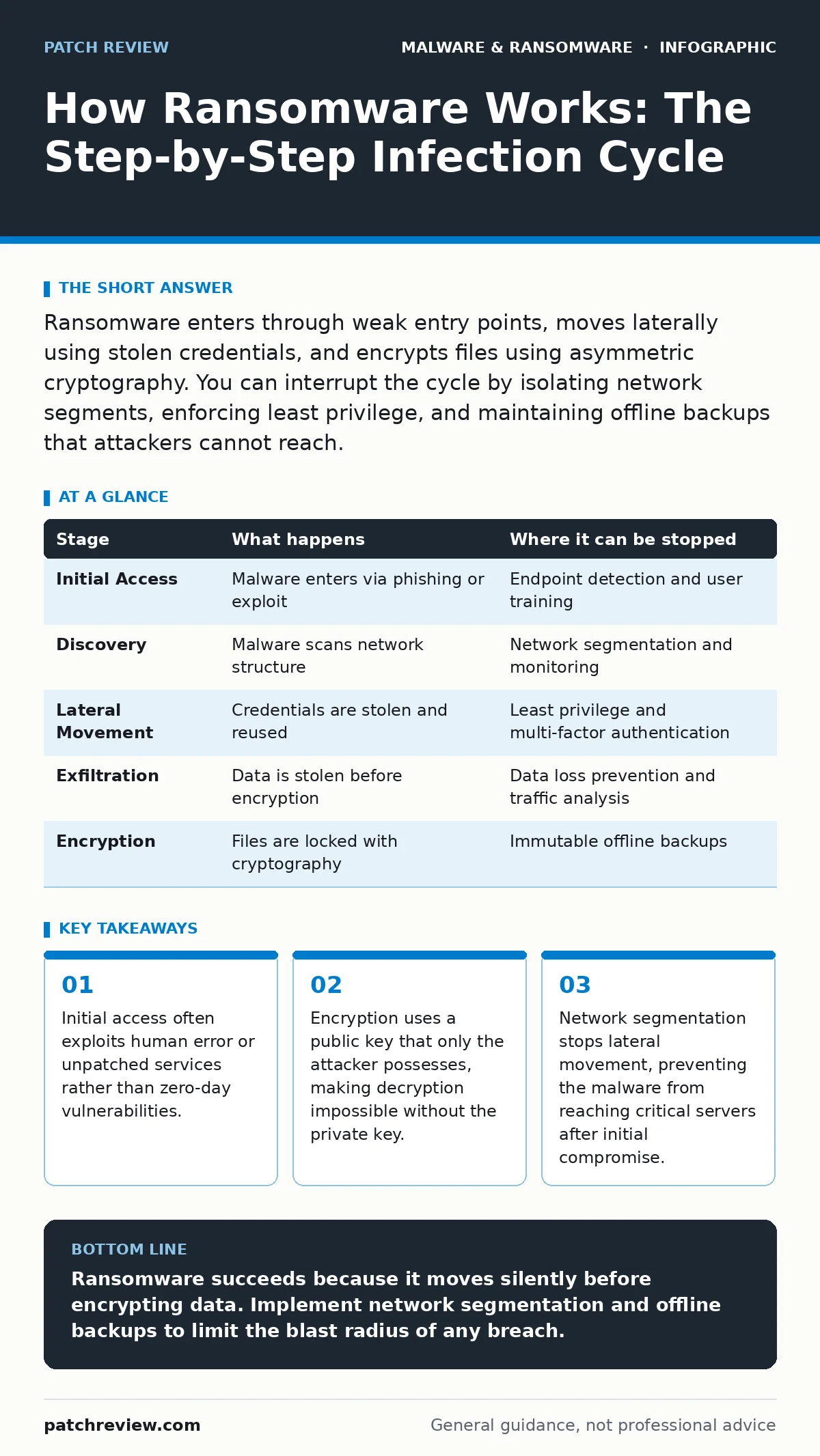
Ransomware enters through weak entry points, moves laterally using stolen credentials, and encrypts files using asymmetric cryptography. You can interrupt the cycle by isolating network segments, enforcing least privilege, and maintaining offline backups that attackers cannot reach.
The Anatomy of a Ransomware Attack
Understanding ransomware requires looking past the encryption screen. The visible destruction is merely the final result of a process that may have been running silently for weeks. Attackers prioritize stealth during the early phases to maximize the value of their eventual leverage.
Most operators follow a predictable pattern derived from ransomware-as-a-service frameworks. These commercial structures allow less skilled criminals to rent sophisticated tools, meaning the underlying mechanics remain consistent regardless of the specific variant. You must understand each phase to identify where your defenses can intervene.
Stage 1: Initial Access and Entry
The attack begins with gaining a foothold in your environment. This rarely involves hacking firewalls directly. Instead, attackers look for open doors left by users or administrators. Phishing emails with malicious attachments are common, but compromised remote access tools and exposed database ports are equally frequent entry points.
The flaw exploited here is often a lack of verification. If a system accepts input without strict validation, it becomes vulnerable. Attackers also rely on potentially unwanted programs that users install willingly, which may contain vulnerabilities or backdoors. The goal is to execute code that runs with the privileges of the logged-in user.
Stage 2: Discovery and Mapping
Once inside, the malware does not immediately encrypt files. It pauses to understand what it has captured. The attacker’s tool scans the network to identify storage locations, domain controllers, and high-value data repositories. This phase relies on the victim’s network being flat or poorly segmented.
If your network allows free movement between departments, the malware can reach critical servers in minutes. It looks for shared drives, backup servers, and cloud storage credentials. The mechanism here is often the use of built-in system commands or stolen credentials to query directory services.
This stage highlights the hidden cost of convenience. Shared network drives that ease collaboration also provide a highway for malware. Without segmentation, one compromised workstation gives the attacker visibility into the entire organization.
Stage 3: Lateral Movement and Escalation
After mapping the environment, the malware moves deeper. It seeks higher privileges to bypass security controls and access protected data. This is often achieved through malware persistence mechanisms that ensure the attacker remains present even if the initial process is terminated.
Attackers use stolen credentials to log into other machines. This is known as pass-the-hash or pass-the-ticket, where the authentication token from one machine is reused on another. The flaw relied upon is the trust relationship between computers in a domain. If one machine is trusted, its tokens are trusted everywhere.
This phase is where infostealers often operate in parallel, harvesting saved passwords and browser cookies. The combination of ransomware and credential theft creates a dual threat: data is locked, and the attacker already has the keys to your other systems.
Stage 4: Data Exfiltration and Preparation
Modern ransomware often steals data before encrypting it. This double extortion tactic increases pressure on the victim. The malware compresses and uploads sensitive files to external servers. This step relies on the victim’s outbound traffic filters being too permissive.
If your network allows large file transfers to unknown destinations, the attacker can exfiltrate gigabytes of data undetected. The mechanism often involves creating a temporary encrypted channel that blends in with normal web traffic. The goal is to secure leverage before destroying access to the primary systems.
This phase introduces a critical trade-off. Monitoring all outbound traffic for anomalies can impact performance, leading some organizations to leave gaps. Attackers exploit these gaps to move data out before the encryption phase begins.
See also: Zero-click attacks: How invisible threats bypass your defenses
Stage 5: Encryption and Execution
This is the visible stage of the attack. The malware encrypts files using strong cryptographic algorithms. Typically, it uses asymmetric encryption, where a public key encrypts the data and only the attacker’s private key can decrypt it. The private key is generated locally and sent to the attacker’s server.
The encryption process consumes significant system resources. It targets specific file extensions, such as documents, databases, and images. The mechanism is rapid and automated, designed to lock out users before IT teams can respond. The attacker may also delete shadow copies and backups to prevent recovery.
Stage 6: Ransom Demand and Negotiation
The attacker displays a ransom note on every affected screen. This note contains instructions for payment, usually in cryptocurrency to maintain anonymity. It may threaten to release stolen data if the ransom is not paid within a specific timeframe.
The demand relies on panic. The attacker knows that business continuity is at risk. They may offer to decrypt a few files as proof of capability. This stage is purely psychological, designed to bypass rational decision-making. The attacker waits for the victim to contact them through secure messaging channels.
Interrupting the Cycle
You can break this chain at multiple points. The table below summarizes where defenses are most effective.
| Stage | What happens | Where it can be stopped |
|---|---|---|
| Initial Access | Malware enters via phishing or exploit | Endpoint detection and user training |
| Discovery | Malware scans network structure | Network segmentation and monitoring |
| Lateral Movement | Credentials are stolen and reused | Least privilege and multi-factor authentication |
| Exfiltration | Data is stolen before encryption | Data loss prevention and traffic analysis |
| Encryption | Files are locked with cryptography | Immutable offline backups |
The Role of Related Threats
Ransomware rarely operates in isolation. It is often preceded by crypto-stealing malware that harvests wallet keys and session tokens. This financial theft can occur silently, draining funds before the ransom note appears.
Similarly, fileless malware techniques allow attackers to run code in memory without touching the disk. This makes detection harder because traditional antivirus scans files on storage. Understanding these adjacent threats helps you recognize the broader context of an intrusion.
Strategic Defense Considerations
Defense is not about blocking every attack; it is about limiting the damage when one gets through. Assume your perimeter will be breached. Focus on internal controls that restrict what an attacker can do once inside.
Implement least privilege principles. Users and services should only have the access necessary for their tasks. This limits the scope of lateral movement. Use multi-factor authentication to protect against stolen credentials, even if passwords are compromised.
Key takeaways
- Initial access often exploits human error or unpatched services rather than zero-day vulnerabilities.
- Encryption uses a public key that only the attacker possesses, making decryption impossible without the private key.
- Network segmentation stops lateral movement, preventing the malware from reaching critical servers after initial compromise.
Ransomware succeeds because it moves silently before encrypting data. Implement network segmentation and offline backups to limit the blast radius of any breach.
Frequently asked questions
Can ransomware spread without human interaction?
Yes, if it exploits unpatched vulnerabilities in network services like Remote Desktop Protocol or file sharing protocols, it can move automatically.
Does antivirus software stop ransomware?
Traditional antivirus may detect known variants, but it often fails against new or customized malware. Behavioral analysis is more effective for stopping unknown threats.
How long does the encryption phase take?
It varies by environment size, but large networks can be fully encrypted in hours. The speed depends on network bandwidth and storage access speeds.
Is cloud storage safe from ransomware?
Cloud storage is vulnerable if the attacker gains access to your cloud credentials. They can delete or encrypt cloud data just as easily as local files.
How this guide was produced: written by the Patch Review editorial team with AI assistance, checked against the public references listed below, and reviewed when the facts change. See our editorial policy or report an error.