Protect systems by implementing rate limiting, using content delivery networks for absorption, configuring web application firewalls to filter bad requests, and testing failure modes regularly to ensure resilience against volumetric attacks.
Defining the Threat Model
You must understand that a distributed denial-of-service attack aims to exhaust resources, not necessarily to steal data. The goal is availability disruption. You face two primary categories: volumetric attacks that saturate bandwidth and application-layer attacks that exhaust processing power. Volumetric floods fill your internet pipe with noise. Application attacks mimic legitimate users but trigger expensive server operations.
Your defense strategy depends on where the attack hits. If the pipe fills, you need bandwidth buffering. If the server slows, you need request validation. Most teams focus on bandwidth and ignore processing limits. This leaves them vulnerable to low-volume attacks that crash services without triggering alarm bells.
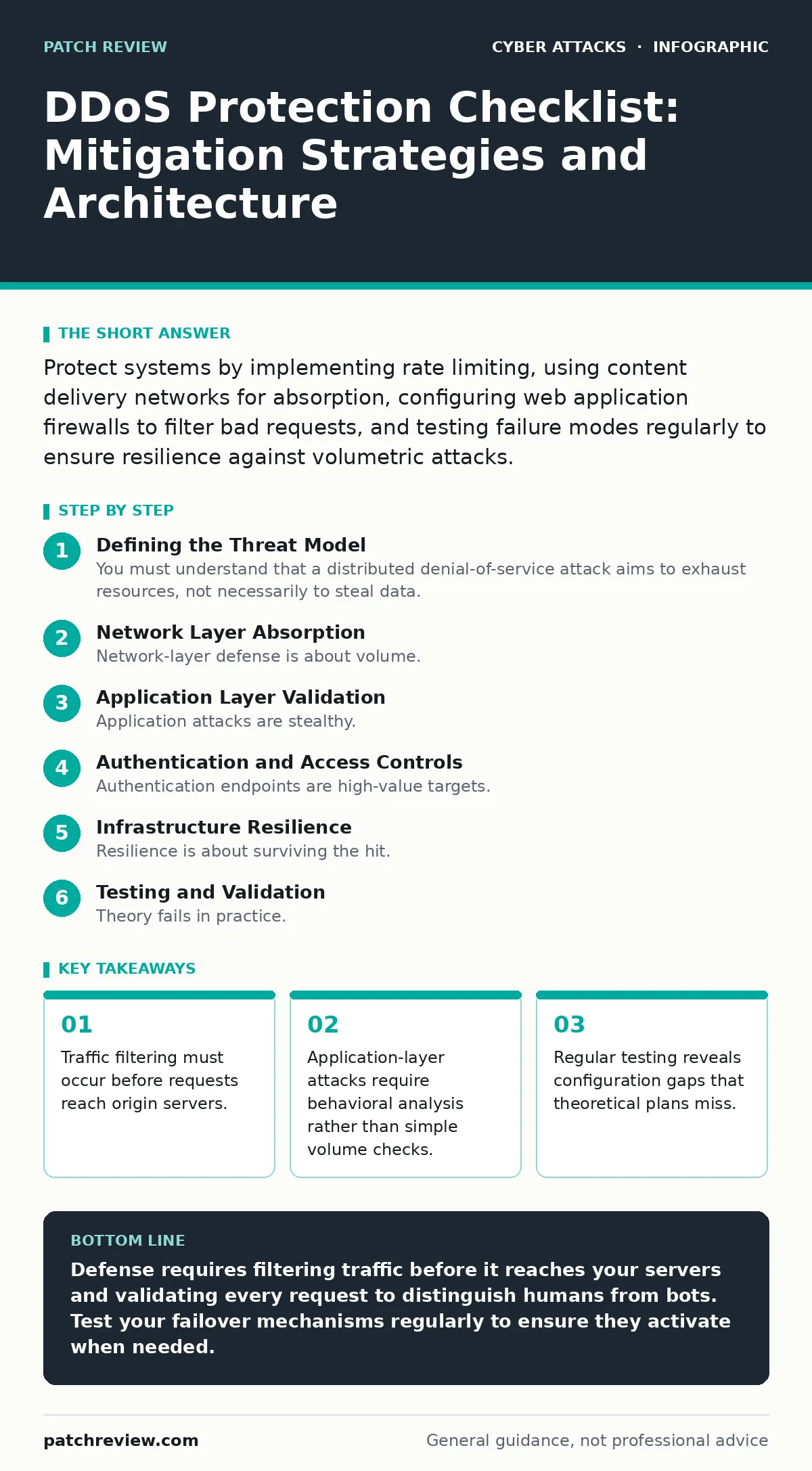
Network Layer Absorption
- Deploy a content delivery network: Distributes traffic across many servers to absorb volumetric floods before they reach your origin.
- Enable anycast routing: Directs users to the nearest data center, reducing latency and spreading load across multiple locations.
- Configure upstream scrubbing: Filters malicious traffic at the internet exchange level, preventing congestion on your own links.
- Set bandwidth thresholds: Alerts you when traffic exceeds normal baselines, allowing early detection of volumetric spikes.
Network-layer defense is about volume. You cannot stop a tsunami with a sieve. You need a larger basin. Content delivery networks act as that basin. They absorb the shock. If you rely only on your own infrastructure, your bandwidth cap becomes your breaking point. Upstream scrubbing moves the problem to a provider with more capacity. This is a trade-off. You pay for the buffer. You gain resilience.
Application Layer Validation
- Implement rate limiting: Caps the number of requests a single IP can make, preventing resource exhaustion from rapid queries.
- Use web application firewalls: Inspects HTTP headers and payloads to block malformed or malicious requests before they reach the application.
- Require JavaScript challenges: Forces browsers to execute code, filtering out simple bots that cannot render scripts.
- Validate session cookies: Ensures that each request comes from a verified, active user session, reducing the impact of session cookie theft.
Application attacks are stealthy. They look like normal traffic. A single request might seem harmless. Ten thousand requests per second from unique IPs look like a viral marketing campaign. You must distinguish between humans and machines. Rate limiting is the first filter. It stops the obvious floods. Web application firewalls add depth. They check the content of the request. If a request asks for a complex database query, the firewall can block it. JavaScript challenges add friction. Bots struggle with them. Humans do not. This slows down attackers without annoying users.
Authentication and Access Controls
- Enforce conditional access policies: Restricts login attempts based on location, device health, and risk level to reduce credential stuffing impact.
- Deploy multi-factor authentication: Adds a second verification step, making stolen credentials useless for most automated attacks.
- Monitor login alerts: Notifies administrators of unusual access patterns, enabling rapid response to coordinated brute-force attempts.
- Implement CAPTCHA selectively: Triggers human verification only when suspicious behavior is detected, balancing security and user experience.
Authentication endpoints are high-value targets. Attackers know that crashing a login page causes immediate pain. They use credential stuffing to test stolen passwords. They use brute force to guess weak ones. Conditional access policies add context. If a login comes from a new country, the system can block it. Multi-factor authentication breaks the automation. Bots cannot read SMS codes or approve push notifications. This is not just about DDoS. It is about securing the entry point. If you protect the login, you reduce the incentive for attackers to flood it.
Infrastructure Resilience
- Configure auto-scaling: Automatically adds server capacity during traffic spikes to handle legitimate load increases.
- Implement failover mechanisms: Redirects traffic to backup servers if primary systems become unresponsive or overloaded.
- Use stateless architecture: Designs services that do not store session data locally, allowing any server to handle any request.
- Test failure modes: Simulates server outages to verify that failover systems activate correctly and quickly.
Resilience is about surviving the hit. Even with filtering, some bad traffic gets through. Your infrastructure must bend, not break. Auto-scaling adds muscle. When traffic rises, more servers come online. This helps with legitimate spikes too. Failover is the parachute. If the main server dies, the backup takes over. Stateless architecture is key. If each server holds user sessions, you cannot move traffic easily. If sessions are stored centrally, any server can handle any user. This flexibility is vital during an attack.
See also: Edge Computing FAQs: Security Risks, Architecture, and Real-World Answers · How Ransomware Works: The Step-by-Step Infection Cycle
Testing and Validation
- Conduct tabletop exercises: Walk through attack scenarios with your team to identify gaps in communication and response procedures.
- Perform penetration testing: Hire experts to attempt DDoS simulations to find weaknesses in your filtering rules.
- Review attack lifecycle stages: Analyze how attackers move from reconnaissance to exploitation to ensure your defenses cover all phases.
- Update mitigation rules: Adjust filters based on new attack patterns and changes in your application infrastructure.
Theory fails in practice. You might have the right tools. You might have the right rules. But do they work together? Tabletop exercises reveal communication breakdowns. Who calls the provider? Who updates the firewall? Penetration testing finds technical gaps. Attackers evolve. They find new ways to bypass filters. You must evolve too. Reviewing the attack lifecycle helps you anticipate the next move. Updating rules is continuous work. Security is not a one-time setup. It is a cycle of improvement.
Key takeaways
- Traffic filtering must occur before requests reach origin servers.
- Application-layer attacks require behavioral analysis rather than simple volume checks.
- Regular testing reveals configuration gaps that theoretical plans miss.
Defense requires filtering traffic before it reaches your servers and validating every request to distinguish humans from bots. Test your failover mechanisms regularly to ensure they activate when needed.
Frequently asked questions
Does a content delivery network stop all DDoS attacks?
No, it primarily mitigates volumetric attacks and can help with some application-layer attacks, but sophisticated low-volume attacks may still reach your origin server.
How do I differentiate between a DDoS attack and a traffic spike?
Analyze the source diversity and request patterns; attacks often come from many unique IPs with repetitive or malformed requests, while spikes show diverse, legitimate user behavior.
Is rate limiting enough to protect my API?
Rate limiting helps but is not sufficient alone; you also need behavioral analysis, authentication checks, and web application firewalls to stop sophisticated application-layer attacks.
What is the role of DNS in DDoS protection?
DNS resolution is a common target; protecting your DNS provider and using anycast routing ensures that users can find your services even during an attack.
How this guide was produced: written by the Patch Review editorial team with AI assistance, checked against the public references listed below, and reviewed when the facts change. See our editorial policy or report an error.