Bug bounty programs are not open-ended penetration tests. They operate within strict technical scopes and legal boundaries. Participants often fail by testing out-of-scope assets, duplicating known issues, or ignoring disclosure policies. Success requires precise adherence to program rules and a focus on novel, high-impact vulnerabilities rather than volume.
Misreading: Bug bounties are free penetration testing services
Correct reading: Bug bounty programs are targeted vulnerability disclosure initiatives, not comprehensive security audits. Organizations define a specific scope of assets, such as a single web application or API endpoint, for testing. They do not invite researchers to test their entire infrastructure, including internal networks or third-party services.
Imagine you find a vulnerability in a company’s marketing blog, which is hosted on a separate platform from their main product. Even if the blog shares the same domain name, it may fall outside the bounty scope. Testing it without explicit permission is unauthorized access. The program exists to crowdsource discovery for specific, high-value targets. It does not replace the need for professional penetration testing, which requires broader authorization and different methodologies.
Researchers who treat these programs as free audit services often face legal consequences. The organization retains the right to pursue action for unauthorized testing. You must read the scope section carefully. If an asset is not listed, assume it is off-limits. This boundary protects you from liability and ensures the organization can manage the volume of reports effectively.
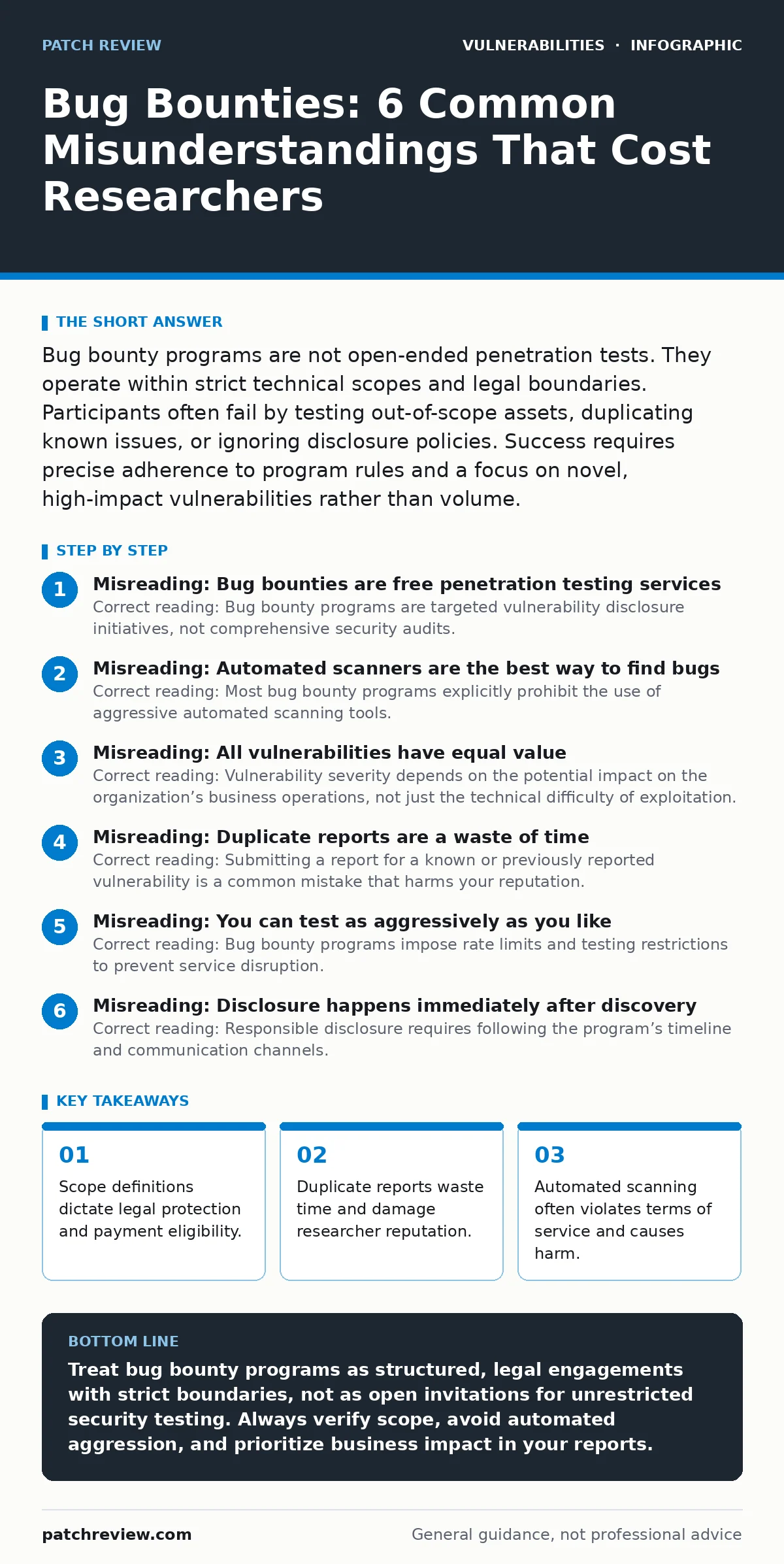
Misreading: Automated scanners are the best way to find bugs
Correct reading: Most bug bounty programs explicitly prohibit the use of aggressive automated scanning tools. These tools generate high volumes of traffic that can degrade service performance for legitimate users. They also produce noisy data, leading to many false positives that waste the time of triage teams.
Suppose you run a directory traversal scanner against a target. The scanner might find a publicly accessible file that was intentionally left open for documentation purposes. Reporting this as a vulnerability ignores the context. The organization may have assessed the risk and accepted it. Automated tools cannot distinguish between a misconfiguration and a deliberate design choice.
Manual testing allows you to understand the application’s logic. You can identify business logic flaws that scanners miss. These flaws often have higher severity because they bypass authentication or authorization checks. Focus your energy on understanding how the application processes data. Use automation only for passive reconnaissance, such as gathering subdomains, if the program rules allow it. Never run active scans that modify data or create accounts without prior approval.
Misreading: All vulnerabilities have equal value
Correct reading: Vulnerability severity depends on the potential impact on the organization’s business operations, not just the technical difficulty of exploitation. A simple information disclosure might be critical if it exposes sensitive customer data. A complex code execution flaw might be low severity if it requires physical access to a server.
Consider an insecure direct object references (IDOR) vulnerability that allows a user to view another user’s profile. If the profile contains only a username and avatar, the impact is low. If it contains financial records or personal identification numbers, the impact is high. You must assess the data sensitivity and the context of the breach.
Organizations use frameworks like CVSS to standardize ratings, but they often adjust scores based on business context. A vulnerability that allows an attacker to deface a public page is different from one that allows them to modify transaction records. When submitting a report, describe the business impact clearly. Explain what an attacker could do with the access gained. This helps the triage team assign the correct severity and prioritize the fix.
Misreading: Duplicate reports are a waste of time
Correct reading: Submitting a report for a known or previously reported vulnerability is a common mistake that harms your reputation. Most platforms use automated checks to detect duplicates. If you submit a known issue, your report is marked as duplicate, and you receive no reward. Repeated duplicates can lead to account suspension.
Imagine you discover a prototype pollution vulnerability in a JavaScript library. Before writing your report, search the platform’s public submissions and the organization’s advisory page. Check if others have reported similar issues. If a fix is already in progress, do not submit a new report. Instead, wait for the fix to be deployed and verify that it works.
This verification process can sometimes yield a new finding. The fix might introduce a regression or leave a residual vulnerability. This is a valid, novel report. Always check for existing reports first. This practice shows professionalism and respect for the triage team’s workload. It also ensures you focus your efforts on undiscovered vulnerabilities, which are more likely to earn a reward.
Misreading: You can test as aggressively as you like
Correct reading: Bug bounty programs impose rate limits and testing restrictions to prevent service disruption. You must test responsibly, avoiding actions that could harm the application’s availability or integrity. This includes avoiding denial-of-service attacks, mass account creation, and aggressive fuzzing.
Suppose you want to test for SQL injection. Instead of sending thousands of payloads in rapid succession, send a few carefully crafted requests. Observe the application’s response. If you notice errors or unusual behavior, document it. Aggressive testing can trigger automated security controls, such as IP blocking, which prevents you from testing further.
Respect the application’s rate limits. If the program specifies a maximum number of requests per minute, adhere to it strictly. Use delays between requests to simulate normal user behavior. This approach reduces the risk of disrupting service and demonstrates your commitment to responsible testing. Organizations appreciate researchers who prioritize the stability of their systems while searching for vulnerabilities.
Misreading: Disclosure happens immediately after discovery
Correct reading: Responsible disclosure requires following the program’s timeline and communication channels. You must report the vulnerability through the designated platform and wait for the organization’s response. Publicly disclosing details before the organization has had a chance to fix the issue is a violation of most program policies.
Imagine you find a critical vulnerability. You feel compelled to share your findings on social media to gain recognition. Doing so exposes the organization to immediate risk and violates the trust inherent in the program. Instead, submit a detailed report with proof of concept. Wait for the triage team to acknowledge receipt and begin the fix process.
The organization will typically provide a timeline for remediation. If they fail to respond within a reasonable period, follow the program’s escalation policy. Do not go public until the fix is deployed or the agreed-upon deadline has passed. This process ensures that users are protected and that you maintain a positive relationship with the organization. Refer to guides on risk-based vulnerability management to understand how organizations prioritize fixes.
Misreading: Scope excludes related technologies
Correct reading: The scope of a bug bounty program is strictly defined. Assets that are related but not explicitly listed are out of scope. This includes third-party integrations, content delivery networks, and open-source components used by the organization. Testing these assets without permission is unauthorized.
Suppose you identify a vulnerability in a self-hosted GitLab instance used by the organization for internal development. Even if the instance is accessible from the internet, it is likely out of scope. The organization may have separate security processes for internal tools. Testing it exposes you to legal risk and provides no reward.
Focus your efforts on the assets listed in the scope section. If you are unsure whether an asset is in scope, ask the program administrators for clarification. Do not assume that related domains or services are included. This discipline ensures you stay within legal boundaries and focus on the targets the organization wants you to test. Understanding the difference between n-day vulnerabilities and zero-day exploits is also critical for prioritizing your research.
Key takeaways
- Scope definitions dictate legal protection and payment eligibility.
- Duplicate reports waste time and damage researcher reputation.
- Automated scanning often violates terms of service and causes harm.
- Severity ratings depend on business impact, not just technical complexity.
Treat bug bounty programs as structured, legal engagements with strict boundaries, not as open invitations for unrestricted security testing. Always verify scope, avoid automated aggression, and prioritize business impact in your reports.
Frequently asked questions
Can I test mobile applications if they are not listed in the scope?
No. If the mobile application is not explicitly listed in the scope, testing it is unauthorized. Only test assets that are clearly included in the program rules.
What should I do if I find a vulnerability in a third-party service?
Do not test or report it through the bug bounty program. Contact the third-party vendor directly if they have a disclosure policy, or ignore it if it is out of scope.
How do I know if my report is a duplicate?
Search the platform’s public submissions and the organization’s advisory pages for similar issues. If a fix is already in progress, your report is likely a duplicate.
Can I use automated tools for reconnaissance?
Passive reconnaissance, such as gathering subdomains, is often allowed. Active scanning that sends requests to the target is usually prohibited. Check the specific program rules for details.
How this guide was produced: written by the Patch Review editorial team with AI assistance, checked against the public references listed below, and reviewed when the facts change. See our editorial policy or report an error.