
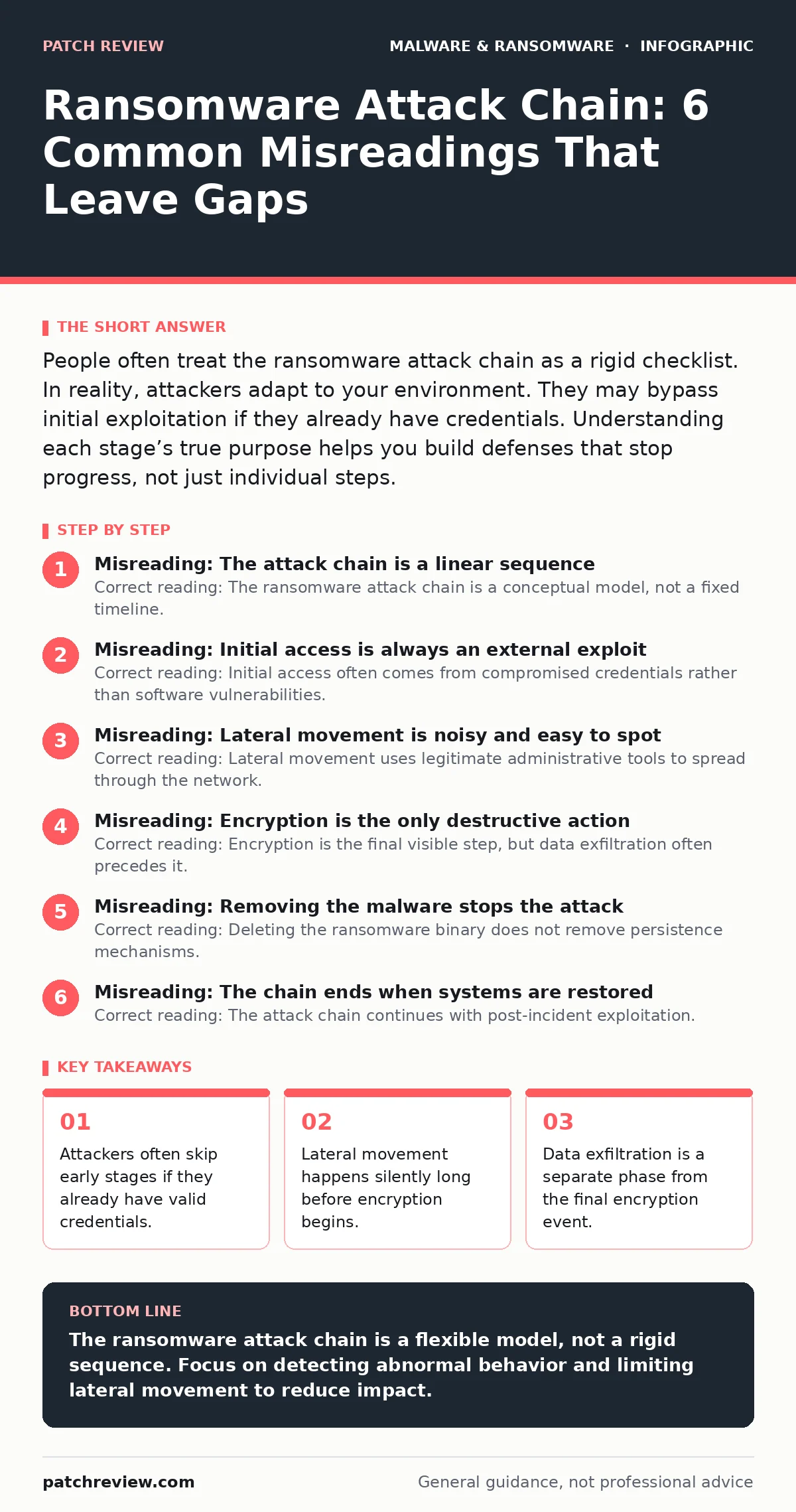
People often treat the ransomware attack chain as a rigid checklist. In reality, attackers adapt to your environment. They may bypass initial exploitation if they already have credentials. Understanding each stage’s true purpose helps you build defenses that stop progress, not just individual steps.
Misreading: The attack chain is a linear sequence
Correct reading: The ransomware attack chain is a conceptual model, not a fixed timeline. Attackers do not follow stages in a strict order. They move laterally, pause, or backtrack based on network topology and detection risk. Treating it as linear causes defenders to focus on stopping the first step, ignoring that an attacker may already be inside. You must assume breach and monitor for progression, not just entry.
Misreading: Initial access is always an external exploit
Correct reading: Initial access often comes from compromised credentials rather than software vulnerabilities. Attackers use phishing or stolen password hashes to log in legitimately. This bypasses perimeter defenses that only scan for malicious payloads. If you rely solely on patching to stop entry, you miss the human factor. Credential hygiene and multi-factor authentication address this vector. See our guide on ransomware for deeper context on entry methods.
Misreading: Lateral movement is noisy and easy to spot
Correct reading: Lateral movement uses legitimate administrative tools to spread through the network. Attackers use protocols like SMB or PowerShell to move between hosts. These actions look like normal maintenance to basic monitors. Endpoint detection and response (EDR) solutions help identify anomalous usage patterns. Without behavioral analysis, you will miss the silent spread. The attacker is already present when encryption starts.
Misreading: Encryption is the only destructive action
Correct reading: Encryption is the final visible step, but data exfiltration often precedes it. Attackers steal sensitive files to leverage double extortion. They compress and upload data before locking systems. If you only monitor for file changes, you miss the theft. Network traffic analysis detects large outbound transfers. Backups are useless if data is already in the attacker’s hands.
Misreading: Removing the malware stops the attack
Correct reading: Deleting the ransomware binary does not remove persistence mechanisms. Attackers install backdoors, create new accounts, or modify startup scripts. These ensure they can return if you restore from backup. You must hunt for all artifacts, not just the primary payload. Fileless malware techniques hide in memory, leaving no files to delete. A thorough incident response plan covers cleanup and validation.
See also: Ransomware-as-a-Service: Risks and Protection for Small Businesses
Misreading: The chain ends when systems are restored
Correct reading: The attack chain continues with post-incident exploitation. Attackers may have planted infostealers to harvest future credentials. They might have installed potentially unwanted programs that degrade performance. The environment is never fully clean until you verify every component. Rebuilding systems from trusted images is safer than cleaning. Assume the attacker has left traps for later.
Misreading: Defenses must stop every stage equally
Correct reading: Resources should focus on stages where detection is most feasible. You cannot prevent all initial access attempts, but you can limit lateral movement. Segmenting networks reduces the blast radius. Monitoring for privilege escalation stops attackers from gaining admin rights. Prioritize controls that increase attacker effort. See our guide on malware obfuscation for how attackers hide their tools.
Misreading: The attack chain applies only to ransomware
Correct reading: The same stages apply to other threats like IoT malware or scareware. Understanding the chain helps you analyze any intrusion. It provides a common language for incident response teams. You can adapt the model to fit different attack types. This flexibility makes it a valuable analytical tool.
Key takeaways
- Attackers often skip early stages if they already have valid credentials.
- Lateral movement happens silently long before encryption begins.
- Data exfiltration is a separate phase from the final encryption event.
- Defenses must focus on detecting abnormal behavior, not just known signatures.
The ransomware attack chain is a flexible model, not a rigid sequence. Focus on detecting abnormal behavior and limiting lateral movement to reduce impact.
Frequently asked questions
How do I detect lateral movement if it uses legitimate tools?
Monitor for unusual process creation, remote execution, and access to sensitive directories. Baseline normal behavior to spot deviations.
Can I stop ransomware if I already have valid credentials?
Implement least privilege access and multi-factor authentication. Monitor for impossible travel or unusual login times.
Why is data exfiltration separate from encryption?
Attackers steal data to pressure victims into paying. Encryption locks systems, but theft threatens privacy and compliance.
How do I verify my environment is clean after an attack?
Rebuild systems from trusted backups. Verify all accounts and permissions. Monitor for new indicators of compromise.
How this guide was produced: written by the Patch Review editorial team with AI assistance, checked against the public references listed below, and reviewed when the facts change. See our editorial policy or report an error.