
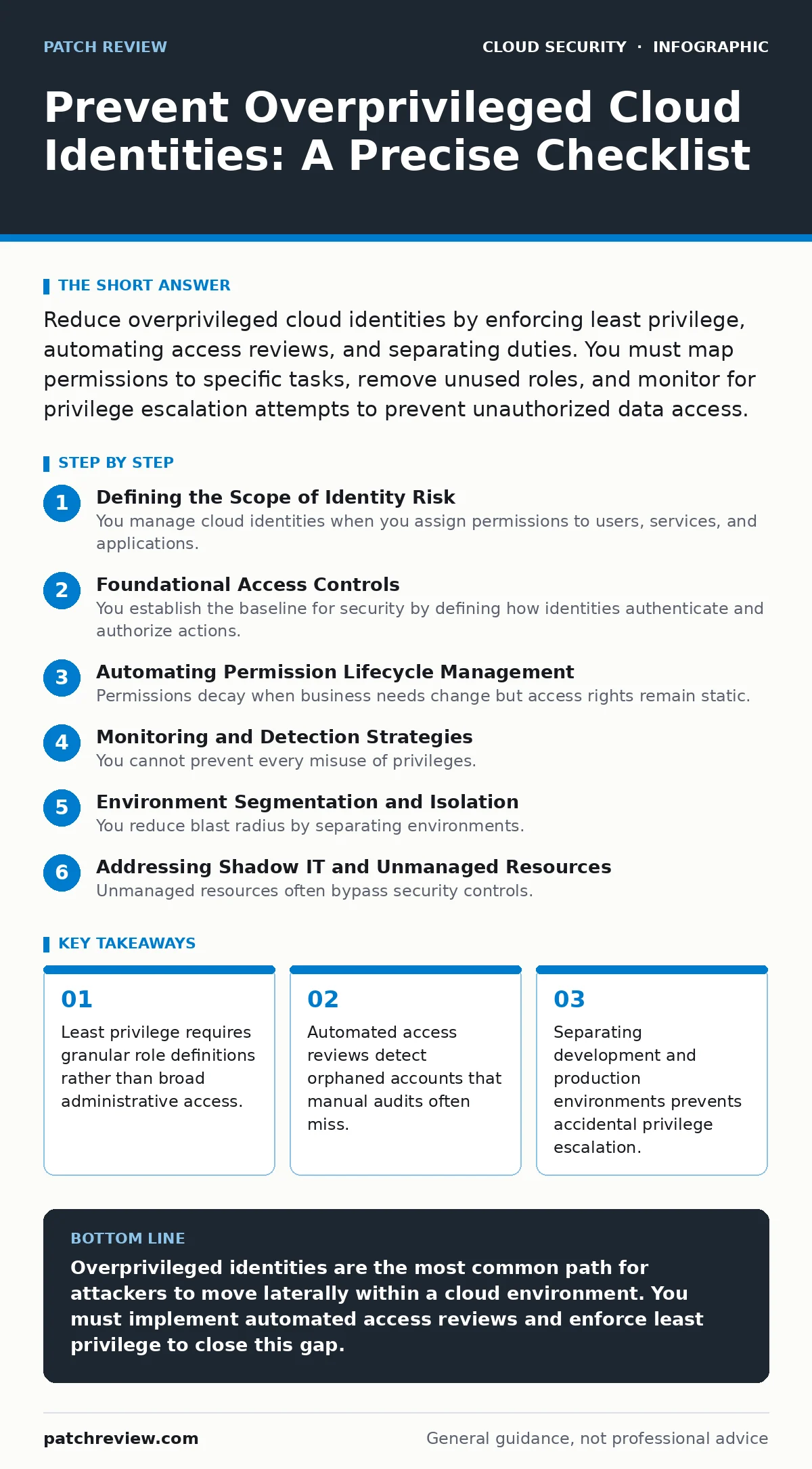
Reduce overprivileged cloud identities by enforcing least privilege, automating access reviews, and separating duties. You must map permissions to specific tasks, remove unused roles, and monitor for privilege escalation attempts to prevent unauthorized data access.
Defining the Scope of Identity Risk
You manage cloud identities when you assign permissions to users, services, and applications. Overprivileged identities occur when an account holds more access rights than necessary for its current function. This mismatch creates a hidden liability. An attacker who compromises a low-level service account with administrative rights can pivot to sensitive data immediately. You must treat every identity as a potential entry point. The checklist below helps you audit and reduce these excess permissions. You use this list to verify your current security posture against established best practices.
Foundational Access Controls
You establish the baseline for security by defining how identities authenticate and authorize actions. Weak foundations allow attackers to bypass complex controls later in the chain.
- Enforce multi-factor authentication for all human identities: This prevents credential theft from granting immediate access.
- Use short-lived credentials for service accounts: This limits the window of opportunity for stolen keys.
- Disable default root or administrator accounts: This removes the most obvious target for brute-force attacks.
- Implement role-based access control policies: This ensures users only receive permissions tied to their job function.
- Require justification for high-privilege access requests: This creates an audit trail for sensitive operations.
Automating Permission Lifecycle Management
Permissions decay when business needs change but access rights remain static. Manual tracking fails at scale. You must automate the removal of unnecessary access to maintain a clean permission surface.
- Schedule quarterly access reviews for all privileged accounts: This catches stale permissions before attackers exploit them.
- Implement just-in-time access for administrative tasks: This grants elevated rights only during specific maintenance windows.
- Automate the decommissioning of inactive accounts: This removes dormant identities that serve no business purpose.
- Tag resources with ownership metadata: This clarifies who is responsible for reviewing specific permissions.
- Integrate identity management with provisioning workflows: This ensures new hires receive only the access they need on day one.
Monitoring and Detection Strategies
You cannot prevent every misuse of privileges. You must detect anomalies quickly to limit damage. Monitoring focuses on behavior rather than static configuration.
- Log all privilege escalation events: This provides visibility into attempts to gain higher access levels.
- Alert on access from unusual locations or devices: This signals potential account compromise or insider threat.
- Monitor for cross-account access patterns: This detects lateral movement between different cloud environments.
- Review API calls for sensitive data access: This identifies unauthorized queries to protected resources.
- Implement anomaly detection for service account behavior: This spots automated abuse of privileged roles.
Environment Segmentation and Isolation
You reduce blast radius by separating environments. A compromised identity in one area should not affect another. This isolation limits the scope of any successful breach.
- Separate development, staging, and production environments: This prevents testing errors from impacting live systems.
- Use network segmentation for sensitive workloads: This restricts direct access to critical databases and services.
- Apply distinct identity policies per environment: This ensures production accounts have stricter controls than development.
- Disable direct internet access for backend services: This reduces the attack surface for cloud metadata service attacks.
- Isolate container runtimes from host systems: This prevents container escapes from compromising the underlying infrastructure.
See also: Cloud Application Detection and Response: How It Works and Why It Matters · Cloud Ransomware Response: Containment and Recovery Steps
Addressing Shadow IT and Unmanaged Resources
Unmanaged resources often bypass security controls. You must identify and secure these assets to prevent them from becoming weak links.
- Inventory all cloud resources regularly: This reveals unmanaged instances that lack proper identity controls.
- Scan for unsecured cloud databases: This identifies storage buckets exposed to the public internet.
- Review third-party application permissions: This ensures external services do not hold excessive access rights.
- Audit serverless function triggers: This verifies that event-driven code runs with minimal necessary privileges.
- Check for orphaned storage volumes: These often contain sensitive data but lack active access controls.
Reviewing Related Security Gaps
You must consider how identity issues interact with other security domains. Isolated fixes often fail when broader systemic weaknesses exist.
- Assess cloud logging gaps: Incomplete logs hide evidence of privilege abuse and make forensics difficult.
- Evaluate cloud privilege escalation paths: Understanding how attackers move up helps you block those specific routes.
- Review Kubernetes misconfigurations: Poor cluster settings can bypass identity controls within container orchestration.
- Examine container runtime security: Weak runtime isolation allows compromised containers to access host identities.
- Consider secure access service edge (SASE) integration: This helps enforce consistent identity policies across hybrid environments.
Maintaining Continuous Improvement
Security is not a one-time task. You must continuously refine your identity management processes as your environment evolves.
- Conduct regular penetration testing: This validates that your controls work against real-world attack techniques.
- Update access policies after organizational changes: Mergers, departures, and role changes require immediate permission updates.
- Train staff on least privilege principles: Awareness reduces the likelihood of users requesting unnecessary access.
- Document exception processes clearly: This ensures temporary elevated access is tracked and revoked promptly.
- Review incident response plans for identity breaches: This prepares your team to react quickly to compromised accounts.
Key takeaways
- Least privilege requires granular role definitions rather than broad administrative access.
- Automated access reviews detect orphaned accounts that manual audits often miss.
- Separating development and production environments prevents accidental privilege escalation.
Overprivileged identities are the most common path for attackers to move laterally within a cloud environment. You must implement automated access reviews and enforce least privilege to close this gap.
Frequently asked questions
How do I find overprivileged accounts in my cloud environment?
Use cloud-native identity management tools to generate reports on unused permissions and high-privilege roles. Cross-reference these with current job functions to identify mismatches.
What is the difference between least privilege and need-to-know?
Least privilege restricts actions an identity can perform, while need-to-know restricts data an identity can access. You must implement both to secure sensitive information.
Should I use group-based or individual permissions?
Group-based permissions are easier to manage and audit. You should assign users to groups that reflect their roles rather than granting individual permissions directly.
How often should I review cloud identity permissions?
You should review permissions quarterly for standard accounts and monthly for privileged accounts. Automated tools can help flag anomalies between scheduled reviews.
How this guide was produced: written by the Patch Review editorial team with AI assistance, checked against the public references listed below, and reviewed when the facts change. See our editorial policy or report an error.