
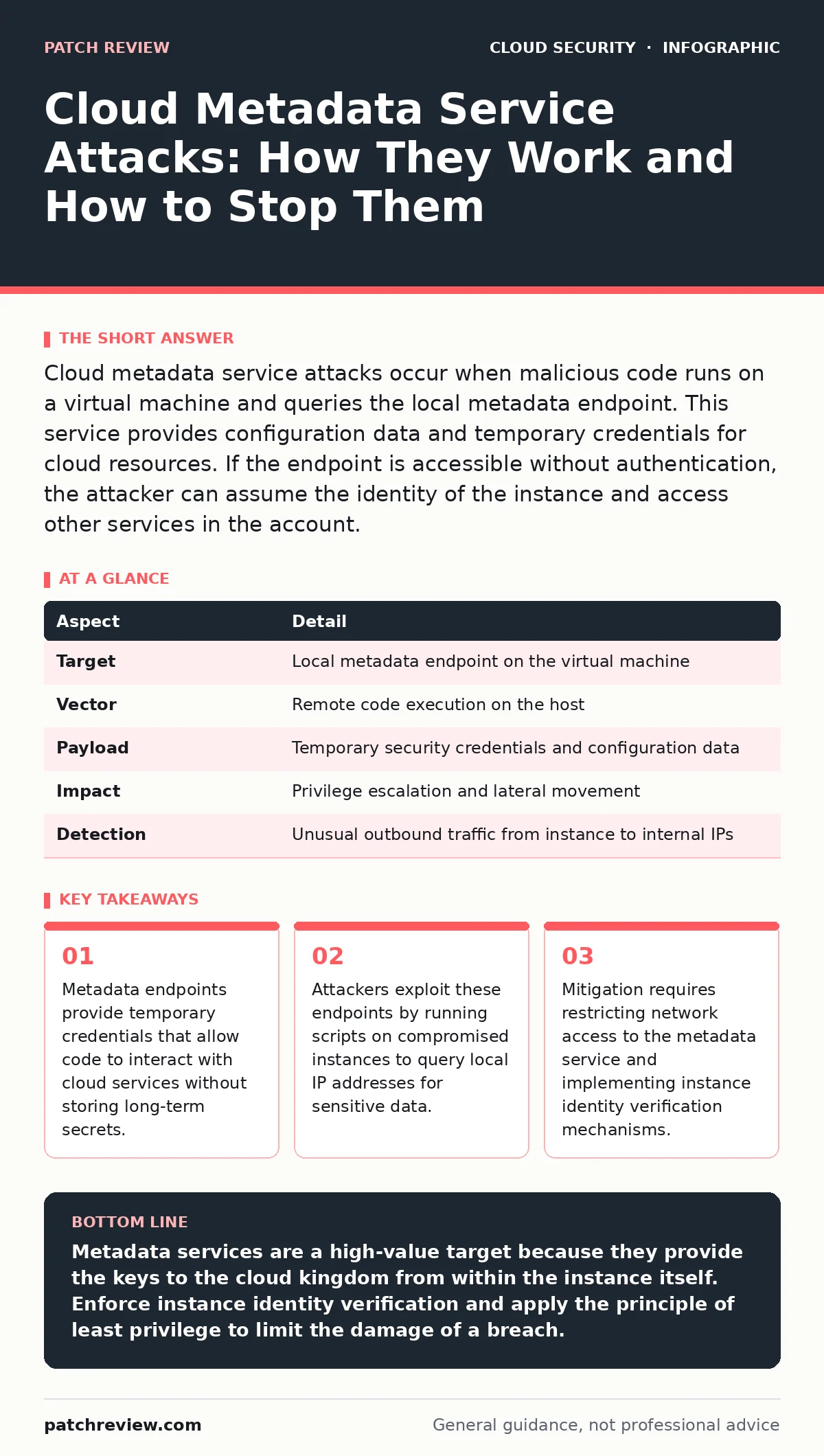
Cloud metadata service attacks occur when malicious code runs on a virtual machine and queries the local metadata endpoint. This service provides configuration data and temporary credentials for cloud resources. If the endpoint is accessible without authentication, the attacker can assume the identity of the instance and access other services in the account.
The Hidden Door in Every Virtual Machine
Imagine a hotel room where the key card not only opens your door but also grants access to the building’s electrical grid, the safe deposit box, and the manager’s office. In cloud computing, every virtual machine has a similar hidden door. It is called the metadata service. This internal service allows the operating system to retrieve configuration details, such as its own IP address, region, and security group associations. It also issues temporary credentials that allow the instance to interact with other cloud services.
This mechanism eliminates the need to store long-term access keys on the disk. Without it, managing secrets for thousands of servers would be a logistical nightmare. However, this convenience creates a high-value target. If an attacker gains execution capability on the instance, they can query this local service to steal the temporary credentials. They then use these stolen tokens to move laterally within the cloud environment.
How the Exploitation Chain Unfolds
The attack begins with the compromise of the compute instance. This might happen through a vulnerable application, a misconfigured container, or a weak password. Once the attacker has command execution, they look for the metadata endpoint. This endpoint is a specific, well-known IP address that only the instance itself can reach. It is not exposed to the public internet.
The attacker runs a simple command to fetch data from this local IP. The response includes the instance profile or role associated with the machine. This role defines what actions the instance is permitted to perform. If the role has broad permissions, the attacker can assume that identity. They effectively become the cloud account for the duration of the session. This allows them to read storage buckets, launch new instances, or modify network rules.
| Aspect | Detail |
|---|---|
| Target | Local metadata endpoint on the virtual machine |
| Vector | Remote code execution on the host |
| Payload | Temporary security credentials and configuration data |
| Impact | Privilege escalation and lateral movement |
| Detection | Unusual outbound traffic from instance to internal IPs |
Common Forms of Metadata Abuse
Attackers do not always write custom scripts to exploit this. They often use existing tools designed for cloud reconnaissance. These tools automatically detect the cloud provider and attempt to pull credentials from known endpoints. The process is often automated and silent. The attacker may exfiltrate the data to a command and control server before the victim realizes the instance is compromised.
Another common form involves the abuse of overly permissive roles. Many administrators assign broad permissions to instances to avoid debugging access issues. This practice, known as privilege creep, means that stealing the metadata credentials grants the attacker far more power than necessary. For example, a web server might have permission to write logs, but if the role also allows reading all storage buckets, the attacker gains access to proprietary data. This is why the principle of least privilege is critical in cloud architecture.
Who Is Most at Risk
Any organization using cloud infrastructure is exposed to this risk. The attack vector exists by design in modern cloud platforms. However, certain configurations increase the likelihood of success. Instances running unpatched software are easier to compromise initially. Once inside, the lack of network segmentation allows the attacker to reach the metadata endpoint freely.
Organizations that rely on default security settings are particularly vulnerable. Default configurations often allow unrestricted access to the metadata service from within the instance. Without additional controls, any process running on the machine can query the endpoint. This includes malicious scripts, compromised libraries, or even a curious junior administrator. The risk is not limited to large enterprises. Small teams with limited security oversight often overlook the need to restrict access to these internal services.
What People Usually Get Wrong
A common misconception is that securing the perimeter is enough. Many teams focus on firewall rules and external access controls. They assume that because the metadata endpoint is internal, it is safe. This view ignores the reality of insider threats and compromised workloads. If the attacker is already inside the instance, the perimeter is irrelevant. The metadata service is a local resource, not a network resource.
Another mistake is assuming that temporary credentials are low risk. Because these credentials expire quickly, some believe they are less valuable than long-term keys. This is incorrect. The temporary credentials are valid for the duration of the session. During that window, they grant full access to the permissions assigned to the instance. If those permissions are broad, the impact is severe. The expiration time does not mitigate the risk of immediate lateral movement.
See also: Spot Shadow IT: Warning Signs and Response Steps · Detect Leaked Cloud Access Keys Before Attackers Do
Reducing the Risk of Compromise
The most effective defense is to require authentication for metadata requests. Modern cloud platforms offer a feature that forces the client to provide a token before the metadata service responds. This token is obtained by making an initial request to a specific header endpoint. The token is valid for a short period, usually minutes. This prevents unauthorized scripts from simply querying the endpoint. It breaks the automatic exploitation chain.
You should also restrict the permissions of the instance roles. Assign only the minimum permissions required for the workload. If a web server only needs to write logs, do not grant it permission to read storage buckets. This limits the damage if the credentials are stolen. Additionally, consider using private endpoints for metadata services where available. This adds an extra layer of network isolation.
Integrating Defense into Your Workflow
Securing metadata services is not a one-time task. It requires ongoing monitoring and configuration management. You should audit your instance roles regularly to identify excessive permissions. Look for roles that have been granted broad access and narrow them down. This process reduces the attack surface and limits the potential impact of a breach.
Integrate these checks into your deployment pipeline. Use tools that scan for misconfigurations before code reaches production. This prevents vulnerable instances from being launched in the first place. Consider reviewing your broader cloud security posture. Understanding how cloud security groups interact with metadata services can help you build a more resilient architecture. For deeper insights, explore guides on Kubernetes misconfigurations and secrets managers to see how credential management evolves in containerized environments.
Key takeaways
- Metadata endpoints provide temporary credentials that allow code to interact with cloud services without storing long-term secrets.
- Attackers exploit these endpoints by running scripts on compromised instances to query local IP addresses for sensitive data.
- Mitigation requires restricting network access to the metadata service and implementing instance identity verification mechanisms.
Metadata services are a high-value target because they provide the keys to the cloud kingdom from within the instance itself. Enforce instance identity verification and apply the principle of least privilege to limit the damage of a breach.
Frequently asked questions
Can metadata service attacks happen in on-premise data centers?
No, this specific attack vector is unique to cloud environments where metadata services are provided by the infrastructure provider. On-premise systems use different configuration management tools.
Does using a secrets manager prevent metadata attacks?
It reduces the risk by removing credentials from the metadata service. However, if the secrets manager itself is misconfigured or the instance has broad permissions, the attacker may still access secrets through other means.
How do I know if my instances are protected?
Check your cloud provider’s documentation for instance identity verification. Ensure that this feature is enabled on all instances. You can also test by attempting to query the metadata endpoint without a token.
Are containers vulnerable to metadata service attacks?
Yes, if the container shares the host’s network namespace and has access to the metadata endpoint. This is a common issue in Kubernetes clusters. Review Kubernetes security basics to understand how to isolate workloads.
How this guide was produced: written by the Patch Review editorial team with AI assistance, checked against the public references listed below, and reviewed when the facts change. See our editorial policy or report an error.