
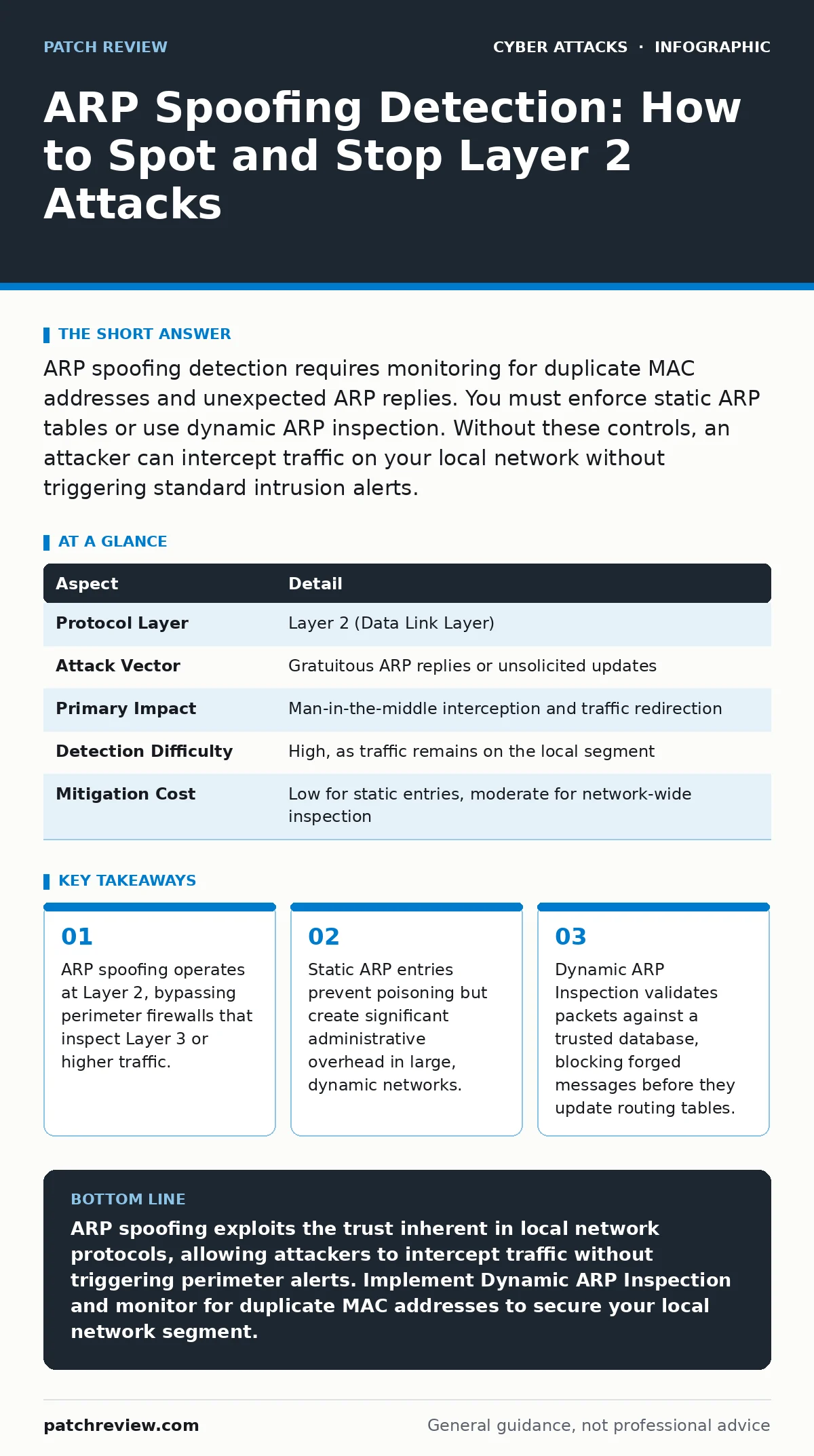
ARP spoofing detection requires monitoring for duplicate MAC addresses and unexpected ARP replies. You must enforce static ARP tables or use dynamic ARP inspection. Without these controls, an attacker can intercept traffic on your local network without triggering standard intrusion alerts.
Understanding the Address Resolution Protocol
Imagine a post office where every letter carries a name but no street address. Workers must ask a central directory to find the correct delivery route. The Address Resolution Protocol, or ARP, performs this function on local networks. It maps Internet Protocol addresses to physical hardware addresses, known as MAC addresses. Without ARP, devices on the same local network cannot communicate directly. The protocol assumes that any device claiming to own an IP address is telling the truth. This assumption is the foundation of the vulnerability. An attacker can send false ARP messages to link their hardware address to the IP address of a legitimate server or gateway.
| Aspect | Detail |
|---|---|
| Protocol Layer | Layer 2 (Data Link Layer) |
| Attack Vector | Gratuitous ARP replies or unsolicited updates |
| Primary Impact | Man-in-the-middle interception and traffic redirection |
| Detection Difficulty | High, as traffic remains on the local segment |
| Mitigation Cost | Low for static entries, moderate for network-wide inspection |
How ARP Spoofing Works in Practice
The attack begins with a simple broadcast message. The attacker sends an ARP reply stating that their MAC address corresponds to the IP address of the default gateway or a target server. The victim device updates its ARP cache, which is the local memory table that stores these mappings. Future traffic intended for the gateway now goes to the attacker’s machine.
The attacker can then forward the traffic to the real gateway to maintain connectivity while reading or modifying the data. This process is transparent to the victim. The network connection appears stable, and applications continue to function normally. The attacker sits silently between the two parties, creating a man-in-the-middle position.
Who Is Affected by Layer 2 Attacks
Any device on a shared local network segment is vulnerable. This includes laptops on corporate Wi-Fi, servers in a virtual machine cluster, and IoT devices on a home network. The attack does not require remote access. The attacker must be on the same broadcast domain as the victim. This means they are physically connected to the same switch or wireless access point.
Flat networks, where all devices share a single subnet, are the most dangerous environments. Segmentation reduces the blast radius. If a network is divided into smaller subnets, the attacker can only target devices within their own segment. Large organizations with complex routing tables are less susceptible to widespread disruption, but individual segments remain at risk.
Common Misconceptions About Network Security
Many administrators believe that firewalls protect against ARP spoofing. This is incorrect. Firewalls operate at Layer 3 and above, inspecting IP headers and application data. ARP operates at Layer 2, below the firewall’s view. The firewall sees traffic leaving the network but cannot see how the local device decided where to send it. Another common error is assuming that encryption solves the problem.
While Transport Layer Security encrypts the content of the message, it does not prevent the attacker from seeing the destination or injecting reset packets. Encryption protects data confidentiality but not availability or integrity against active interference. You must treat local network trust as a separate security domain from perimeter security.
Effective ARP Spoofing Detection Methods
Detecting ARP spoofing requires observing the behavior of the ARP protocol itself. The most reliable method is to monitor for duplicate IP-to-MAC mappings. If two different MAC addresses claim the same IP address, a conflict exists. Network monitoring tools can log these events in real time. You should also look for a high volume of ARP requests from a single host.
Legitimate devices rarely need to broadcast ARP requests frequently. A sudden spike suggests an attacker is trying to poison the caches of many devices simultaneously. Another indicator is unexpected ARP replies. Devices should only reply to ARP requests directed at them. Unsolicited replies are a strong sign of malicious activity.
See also: Network Monitoring System: How Traffic Analysis Protects Your Infrastructure · Open Port Management: Why Closing Unnecessary Ports Reduces Attack Surface
Mitigation Strategies for Local Networks
The most effective defense is Dynamic ARP Inspection, or DAI. DAI validates ARP packets against a trusted database, often built using DHCP snooping. If a packet does not match the expected binding, the switch drops it. This stops the attack at the hardware level. For smaller networks, static ARP entries provide a simple solution.
You manually configure the correct IP-to-MAC mapping on critical devices. This prevents the cache from being overwritten. However, static entries are difficult to maintain in dynamic environments where devices join and leave frequently. Port security can also limit the number of MAC addresses allowed on a single switch port. This prevents an attacker from spoofing multiple identities on one connection.
The Trade-Off Between Security and Convenience
Implementing strict ARP controls introduces management complexity. Static ARP entries require manual updates whenever hardware changes. This creates a single point of failure. If an administrator enters the wrong MAC address, the device loses network connectivity. DAI requires a robust DHCP infrastructure to build the trusted database. If the DHCP server is misconfigured, legitimate devices may be blocked.
There is also a performance cost. Inspecting every ARP packet consumes switch processing power. On high-density networks, this can introduce latency. You must balance the risk of interception against the operational burden of enforcement. For most modern networks, the cost of DAI is justified by the risk of data theft and session hijacking.
Integrating Detection into Broader Security
ARP spoofing detection is not a standalone solution. It works best when combined with other monitoring tools. Security operations centers can correlate ARP anomalies with other suspicious activity. For instance, a spike in ARP traffic followed by unusual outbound connections may indicate a compromised host. You should also consider the risk of session cookie theft.
If an attacker intercepts traffic, they can steal authentication tokens. Detecting ARP spoofing early prevents this secondary attack. Similarly, protecting against web skimming requires ensuring that traffic to payment gateways is not being redirected by a local attacker. Layer 2 security is the foundation that allows higher-layer protections to function correctly.
Key takeaways
- ARP spoofing operates at Layer 2, bypassing perimeter firewalls that inspect Layer 3 or higher traffic.
- Static ARP entries prevent poisoning but create significant administrative overhead in large, dynamic networks.
- Dynamic ARP Inspection validates packets against a trusted database, blocking forged messages before they update routing tables.
ARP spoofing exploits the trust inherent in local network protocols, allowing attackers to intercept traffic without triggering perimeter alerts. Implement Dynamic ARP Inspection and monitor for duplicate MAC addresses to secure your local network segment.
Frequently asked questions
Can ARP spoofing happen on wireless networks?
Yes, Wi-Fi networks use ARP just like wired networks. An attacker connected to the same Wi-Fi access point can send poisoned ARP replies to other clients on that network.
Does changing my IP address stop ARP spoofing?
No, changing your IP address does not stop the attack. The attacker will simply target your new IP address. The vulnerability lies in the protocol itself, not the specific address assigned to your device.
How do I check my ARP cache for signs of attack?
You can view your ARP cache using standard command-line tools. Look for duplicate IP addresses associated with different MAC addresses. If you see the same IP listed twice with different hardware addresses, your cache may be poisoned.
Is ARP spoofing detectable by antivirus software?
Traditional antivirus software focuses on file-based threats and may not detect ARP spoofing. You need network-level monitoring tools or host-based intrusion detection systems that specifically watch for network protocol anomalies.
How this guide was produced: written by the Patch Review editorial team with AI assistance, checked against the public references listed below, and reviewed when the facts change. See our editorial policy or report an error.