
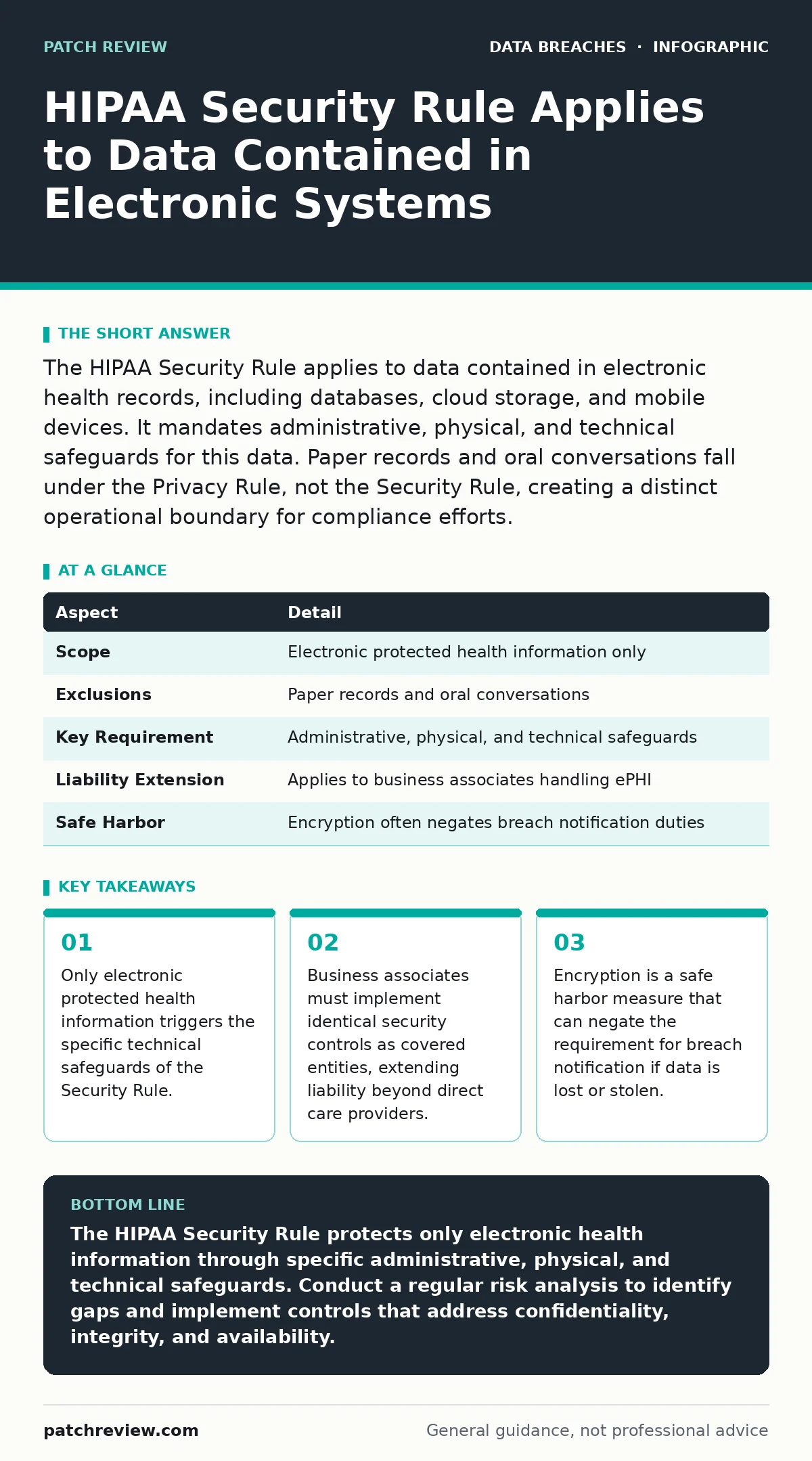
The HIPAA Security Rule applies to data contained in electronic health records, including databases, cloud storage, and mobile devices. It mandates administrative, physical, and technical safeguards for this data. Paper records and oral conversations fall under the Privacy Rule, not the Security Rule, creating a distinct operational boundary for compliance efforts.
The Scope of Electronic Protection
Imagine a hospital filing cabinet. The paper charts inside are protected by law, but the rules governing their lock are different from the rules governing the server in the basement. The HIPAA Security Rule applies to data contained in electronic systems. It specifically targets electronic protected health information, often abbreviated as ePHI. This definition excludes paper files and verbal discussions. Those formats fall under the HIPAA Privacy Rule. Understanding this distinction prevents wasted effort on securing non-electronic media with technical controls that do not apply.
The rule requires covered entities to implement administrative, physical, and technical safeguards. These safeguards protect the confidentiality, integrity, and availability of ePHI. Confidentiality means preventing unauthorized access. Integrity ensures data remains accurate and unaltered. Availability guarantees authorized users can access data when needed. You must address all three pillars to achieve compliance. Focusing on one while neglecting the others creates exploitable gaps in your security posture.
| Aspect | Detail |
|---|---|
| Scope | Electronic protected health information only |
| Exclusions | Paper records and oral conversations |
| Key Requirement | Administrative, physical, and technical safeguards |
| Liability Extension | Applies to business associates handling ePHI |
| Safe Harbor | Encryption often negates breach notification duties |
Who Must Comply With the Rule
Covered entities include health plans, healthcare clearinghouses, and healthcare providers who transmit health information electronically. If you bill an insurance company electronically, you are likely a covered entity. This includes doctors, clinics, and hospitals. The rule also extends to business associates. These are vendors or service providers who create, receive, maintain, or transmit ePHI on behalf of a covered entity. Examples include cloud storage providers, billing services, and IT consultants.
Business associates face the same security obligations as covered entities. They cannot outsource their liability. If a business associate fails to secure data, the covered entity may still be held responsible. This creates a chain of accountability. You must vet every vendor that touches your data. Conducting proper third-party data breaches risk assessments helps identify where your vendors might fail. You need contractual agreements that explicitly state their security responsibilities. Verbal assurances are insufficient for legal compliance.
Technical Safeguards for Data at Rest
Encryption is the primary technical control for data at rest. This means data stored on hard drives, USB sticks, or cloud servers. When you encrypt ePHI, you transform it into unreadable code. Only those with the correct decryption key can read it. If an attacker steals an encrypted laptop, they cannot access the patient records. This is why encryption serves as a safe harbor. If encrypted data is lost, you often do not need to report the breach.
Key management is the hidden cost of encryption. You must secure the keys that unlock the data. If you lose the key, the data is permanently inaccessible. This creates an availability risk. You must balance security with access. Implementing strong access controls ensures only authorized personnel can retrieve keys. Regularly testing your disaster recovery plans verifies that you can restore data when needed. This process requires careful planning and documented procedures.
Administrative and Physical Controls
Technical tools alone cannot secure your environment. Administrative safeguards involve policies and procedures. You must conduct a risk analysis to identify vulnerabilities. This is not a one-time task. Threats evolve, and your infrastructure changes. You must repeat this analysis regularly. Documentation is critical. You must prove that you identified risks and implemented controls to mitigate them. Auditors look for evidence of this process.
Physical safeguards protect the facilities where data resides. This includes controlling physical access to servers and workstations. You must ensure that unauthorized individuals cannot enter areas containing ePHI. This might involve badge readers, locks, or security cameras. You must also dispose of hardware securely. Using secure data disposal methods prevents attackers from recovering deleted files from old hard drives. Simply deleting a file often leaves recoverable fragments. You must overwrite the storage media before recycling or selling it.
Common Misconceptions About Compliance
Many organizations believe that implementing antivirus software satisfies the Security Rule. This is incorrect. Antivirus is a single tool among many required controls. The rule requires a holistic approach. You must address administrative, physical, and technical aspects. Another common mistake is assuming that small organizations are exempt. The rule applies to all covered entities, regardless of size. Small practices must still implement reasonable safeguards.
Some believe that patient consent eliminates security requirements. Consent allows you to use data for treatment or billing. It does not remove the obligation to secure that data. You must protect ePHI regardless of how you obtained permission to use it. Another error is ignoring mobile devices. Smartphones and tablets that store or transmit ePHI are in scope. You must secure these devices just as you secure servers. This often requires mobile device management solutions.
See also: Third-Party Data Breach Response: Steps to Contain and Recover · Should I Turn On Advanced Data Encryption: The Real Trade-Offs
Incident Response and Data Exfiltration
When a security incident occurs, you must have a plan. Data exfiltration involves the unauthorized transfer of data out of your network. This can happen through email, USB drives, or cloud uploads. You must monitor for unusual data movement. Database activity monitoring can help detect suspicious queries or bulk downloads. Your incident response plan should define roles and communication channels. You must notify affected individuals and regulators within specific timeframes.
Log retention is a critical part of your response capability. You must keep logs of system activities. These logs help you reconstruct an attack. They show who accessed what data and when. Without logs, you cannot prove whether a breach occurred. You must store logs securely to prevent tampering. Retention periods vary, but you must keep them long enough to support investigations. This data is also useful for legal proceedings.
Building a Sustainable Security Program
Compliance is not a checkbox exercise. It is an ongoing process. You must continuously monitor your environment. Threats change, and new vulnerabilities emerge. You must update your controls accordingly. Training employees is vital. They are often the first line of defense. They must recognize phishing attempts and social engineering tactics. Regular training reinforces security awareness.
You must also review your policies regularly. Laws and technologies evolve. Your policies must reflect current best practices. Engaging with industry peers can provide insights. However, you must tailor controls to your specific environment. There is no one-size-fits-all solution. You must assess your unique risks and implement appropriate measures. This requires dedication and resources.
Key takeaways
- Only electronic protected health information triggers the specific technical safeguards of the Security Rule.
- Business associates must implement identical security controls as covered entities, extending liability beyond direct care providers.
- Encryption is a safe harbor measure that can negate the requirement for breach notification if data is lost or stolen.
The HIPAA Security Rule protects only electronic health information through specific administrative, physical, and technical safeguards. Conduct a regular risk analysis to identify gaps and implement controls that address confidentiality, integrity, and availability.
Frequently asked questions
Does HIPAA apply to wearable fitness data?
HIPAA applies only if the data is created or received by a covered entity or business associate. Data collected directly by consumers is generally not covered.
How long must you retain HIPAA logs?
You must retain documentation of policies and procedures for six years. Log retention should support incident investigation and legal requirements.
Is HIPAA compatible with GDPR?
Both frameworks protect personal data but have different scopes and requirements. You must comply with both if you handle data from both jurisdictions.
What happens if you fail to comply?
Violations can result in significant fines and corrective action plans. Severe cases may lead to criminal penalties.
How this guide was produced: written by the Patch Review editorial team with AI assistance, checked against the public references listed below, and reviewed when the facts change. See our editorial policy or report an error.