
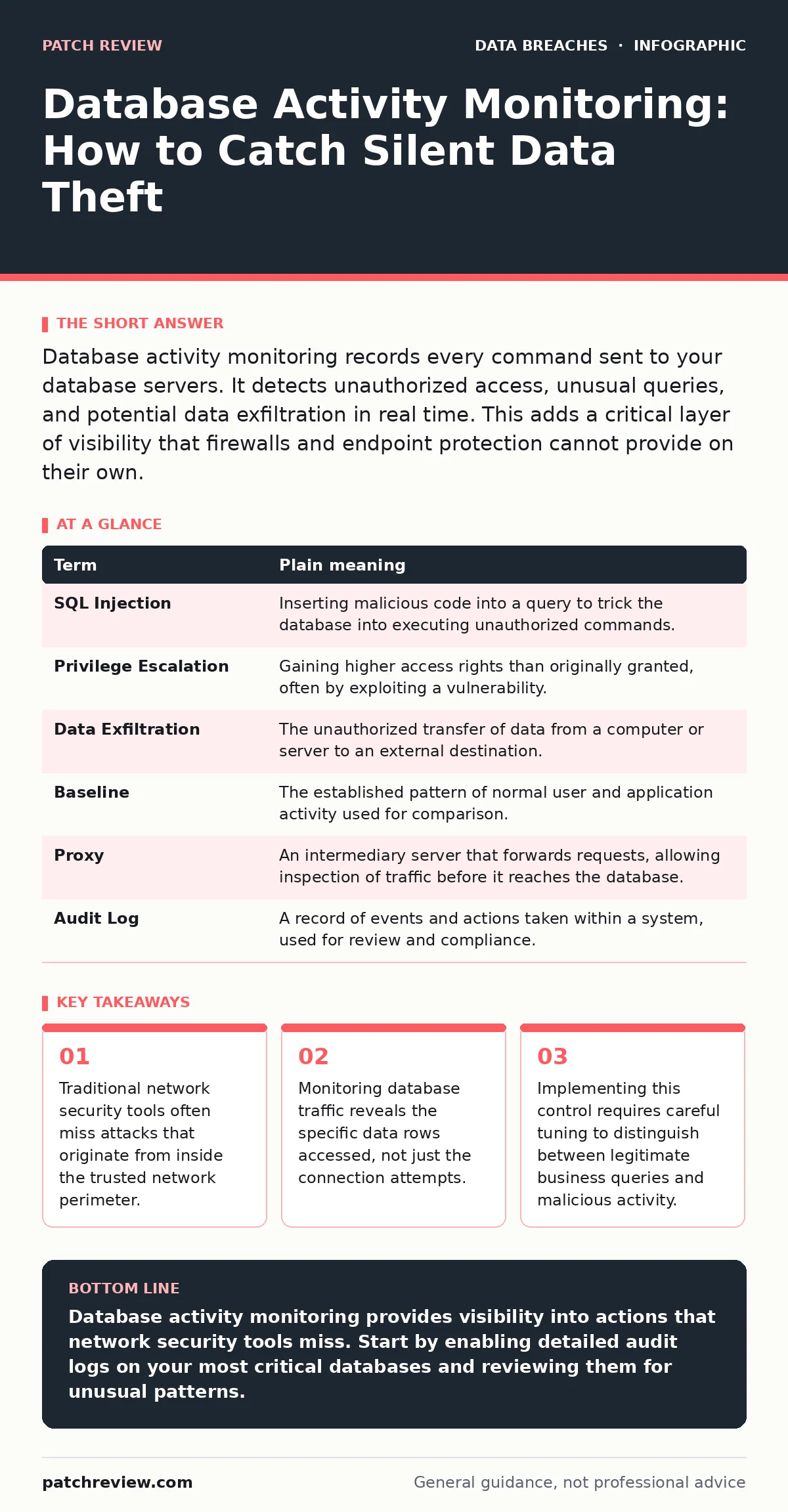
Database activity monitoring records every command sent to your database servers. It detects unauthorized access, unusual queries, and potential data exfiltration in real time. This adds a critical layer of visibility that firewalls and endpoint protection cannot provide on their own.
The Library Archive Analogy
Imagine a secure library where only authorized librarians can enter the reading room. Traditional security focuses on locking the front door. If someone has a valid key, the lock assumes they are acting properly. Database activity monitoring is the security camera that records every book pulled from the shelf and every page turned. It does not care if the person has a key. It cares about what they do once inside.
This distinction matters because attackers often steal valid credentials. Once inside, they look like legitimate users to the door lock. The camera, however, notices when a librarian suddenly copies thousands of pages in ten minutes. That behavior triggers an alert, regardless of the key used to enter.
Why Perimeter Defenses Fail
Firewalls and intrusion detection systems watch traffic moving between networks. They see connections as streams of data. They rarely understand the content of that data. If an attacker uses a stolen password to connect to your database, the firewall sees a valid session. It allows the traffic to pass.
The database itself processes the request. It executes the query. It returns the data. This happens within the trusted zone. External sensors cannot see the specific rows being accessed. They only see that a connection is active. This blind spot allows attackers to move laterally and extract sensitive information without triggering network-level alarms.
Core Mechanics of Monitoring
Database activity monitoring works by intercepting and analyzing traffic destined for the database. It can sit as a proxy between the application and the database. It can also use agents installed directly on the database server. Both methods capture the SQL commands sent by users and applications.
The system compares these commands against a baseline of normal behavior. It looks for patterns such as bulk data extraction, access to sensitive tables during off-hours, or queries that deviate from standard application logic. When the system detects an anomaly, it generates an alert for the security team to investigate.
Key Terms Defined
| Term | Plain meaning |
|---|---|
| SQL Injection | Inserting malicious code into a query to trick the database into executing unauthorized commands. |
| Privilege Escalation | Gaining higher access rights than originally granted, often by exploiting a vulnerability. |
| Data Exfiltration | The unauthorized transfer of data from a computer or server to an external destination. |
| Baseline | The established pattern of normal user and application activity used for comparison. |
| Proxy | An intermediary server that forwards requests, allowing inspection of traffic before it reaches the database. |
| Audit Log | A record of events and actions taken within a system, used for review and compliance. |
The Hidden Cost of Visibility
Monitoring everything creates noise. A busy database generates thousands of queries per second. If you alert on every unusual query, your team will ignore them. This is known as alert fatigue. You must tune the system to ignore routine administrative tasks and application updates.
This tuning requires deep knowledge of your applications. You need to know which queries are normal for your payroll system versus your marketing tool. Without this context, you cannot distinguish between a developer testing a new feature and an attacker probing for weaknesses. This adds operational overhead that many organizations underestimate.
See also: Should I Turn On Advanced Data Encryption: The Real Trade-Offs · How to Prevent Credit Card Theft Online: 5 Proven Methods
Integration with Other Controls
Database activity monitoring works best when combined with other security measures. It complements encryption key management by ensuring that even if keys are stolen, the attempt to decrypt data is visible. It supports data inventory and mapping by revealing which tables are actually being accessed in production.
It also helps detect early signs of data exfiltration. If a user starts downloading large datasets, the monitoring system can trigger a block before the data leaves the network. This proactive stance is more effective than waiting for a third-party data breach report to learn that your data was compromised.
First Practical Steps
- Identify your most sensitive databases. Focus on those containing personally identifiable information or financial records.
- Enable audit logging on these databases. Ensure logs are sent to a secure, centralized location that attackers cannot modify.
- Review the logs for anomalies. Look for queries that access large volumes of data or occur at unusual times.
Common Misconfigurations
A frequent error is logging only failed login attempts. This misses successful unauthorized access. An attacker with valid credentials will not trigger a failed login alert. You must log successful connections and query executions.
Another mistake is storing logs on the same server as the database. If an attacker compromises the database, they can delete the logs to cover their tracks. Store logs on a separate, secure server. This preserves the evidence chain even if the primary system is breached.
Key takeaways
- Traditional network security tools often miss attacks that originate from inside the trusted network perimeter.
- Monitoring database traffic reveals the specific data rows accessed, not just the connection attempts.
- Implementing this control requires careful tuning to distinguish between legitimate business queries and malicious activity.
Database activity monitoring provides visibility into actions that network security tools miss. Start by enabling detailed audit logs on your most critical databases and reviewing them for unusual patterns.
Frequently asked questions
Does database activity monitoring slow down performance?
Yes, intercepting and analyzing every query adds latency. The impact depends on the volume of traffic and the hardware used for monitoring.
Can it detect SQL injection attacks?
It can detect the resulting malicious queries. It may not stop the initial attempt if the application allows the input to reach the database.
Is it required for compliance?
Many standards require monitoring access to sensitive data. It helps prove that you can detect unauthorized access attempts.
How long should I keep the logs?
Retention periods depend on regulatory requirements. Keep them long enough to investigate incidents and meet legal obligations.
How this guide was produced: written by the Patch Review editorial team with AI assistance, checked against the public references listed below, and reviewed when the facts change. See our editorial policy or report an error.