
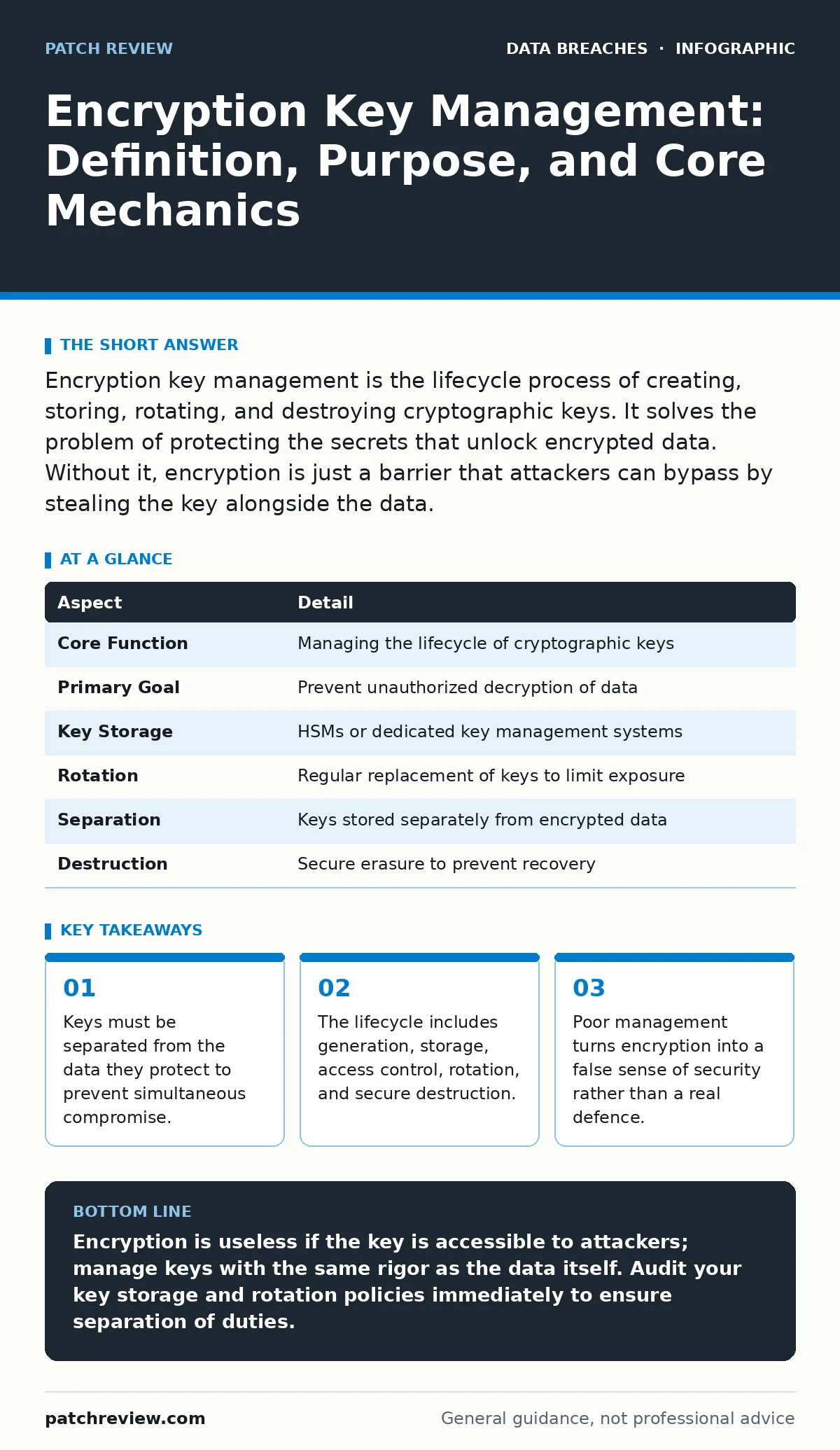
Encryption key management is the lifecycle process of creating, storing, rotating, and destroying cryptographic keys. It solves the problem of protecting the secrets that unlock encrypted data. Without it, encryption is just a barrier that attackers can bypass by stealing the key alongside the data.
The Combination Lock Analogy
Imagine you lock a heavy steel vault in your house. You store your most valuable documents inside. The vault is strong, and the lock is complex. However, if you write the combination on a sticky note and tape it to the front of the vault, the steel and the lock matter nothing. A thief does not need to pick the lock. They simply read the note.
Encryption works the same way. The algorithm scrambles your data into unreadable text. The key is the combination that unscrambles it. If the key is stored next to the data, or if it is easy to guess, the encryption fails. Encryption key management is the discipline of keeping that combination safe, changing it regularly, and ensuring only authorized people can use it.
What Problem Does It Solve?
The primary problem key management solves is the separation of data from its access credential. In many poorly designed systems, the encryption key is embedded in the application code or stored in the same database as the encrypted records. When an attacker breaches such a system, they get the data and the key in one package.
Key management ensures that even if data is stolen, it remains useless without the corresponding key. This is critical because data often outlives the systems that create it. You might delete a server, but the data backups remain. If the keys are not managed, you cannot prove the data is inaccessible. This connects directly to data exfiltration risks, where the goal is not just to steal files, but to render them readable.
The Key Lifecycle Components
Key management is not a single action. It is a continuous cycle with distinct phases. Each phase introduces specific risks that must be mitigated.
- Generation: Keys must be created using a cryptographically secure random number generator. Weak randomness allows attackers to predict keys.
- Storage: Keys must be stored in a secure repository, often a Hardware Security Module (HSM) or a dedicated key management service. They should never be hard-coded in software.
- Distribution: Keys must be delivered to the systems that need them over secure channels. This often uses key wrapping, where a key is encrypted by another key for transport.
- Rotation: Keys must be changed at regular intervals. This limits the amount of data exposed if a key is compromised.
- Revocation: If a key is suspected to be compromised, it must be invalidated immediately.
- Destruction: When keys are no longer needed, they must be securely erased. Simple deletion is insufficient.
Where It Fits in Defence
Encryption key management does not operate in a vacuum. It sits at the intersection of application security and data protection. It relies on strong identity management to decide who can request a key. It relies on network security to protect the channels used to distribute keys.
Consider database activity monitoring. This tool watches who accesses data. If it sees an unusual query, it can alert security teams. But if the encryption key is compromised, the attacker can read the data silently. Key management adds a layer of protection that monitoring alone cannot provide. It ensures that even if monitoring fails to stop an action, the attacker cannot read the result.
Similarly, data inventory and mapping helps you know where your sensitive data lives. You cannot protect keys if you do not know which data requires encryption. Knowing your data assets allows you to assign the correct key strength and rotation policy to each dataset.
| Aspect | Detail |
|---|---|
| Core Function | Managing the lifecycle of cryptographic keys |
| Primary Goal | Prevent unauthorized decryption of data |
| Key Storage | HSMs or dedicated key management systems |
| Rotation | Regular replacement of keys to limit exposure |
| Separation | Keys stored separately from encrypted data |
| Destruction | Secure erasure to prevent recovery |
Common Misconceptions
Many teams believe that enabling encryption is sufficient. They assume that if data is encrypted, it is safe. This is a dangerous misconception. Encryption is only as strong as the weakest part of the key management chain. If the key is weak, stolen, or poorly rotated, the encryption provides no real security.
Another common error is assuming that encryption keys are static. Some organizations generate a key once and use it for years. This violates the principle of least privilege and increases risk. If that single key is compromised, every piece of data ever encrypted with it is vulnerable. Regular rotation ensures that a breach only exposes data encrypted after the last rotation.
See also: Hardware Security Modules: 8 Questions Answered · Third-Party Data Breach Response: Steps to Contain and Recover
The Hidden Cost of Complexity
Good key management introduces operational complexity. Every time you rotate a key, you must update the systems that use it. If a system fails to update, it cannot decrypt data, causing outages. This is the trade-off for security. You accept higher operational overhead to reduce the risk of data theft.
This complexity affects secure data disposal. When you delete data, you must also ensure the keys used to encrypt it are destroyed or archived correctly. If you keep the keys, the data is not truly deleted. If you destroy the keys, you lose the ability to recover the data. This decision must be part of your data retention policy.
Furthermore, data sovereignty laws may require that keys be stored in specific geographic locations. If your key management system stores keys in a region that violates local laws, you face legal risks. You must configure your key management infrastructure to comply with these jurisdictional requirements.
Integration with Other Controls
Key management works best when integrated with other security controls. For instance, fraud alerts can trigger key rotation. If a system detects unusual access patterns, it can automatically revoke and rotate keys for that session. This limits the window of opportunity for an attacker.
It also supports child identity theft prevention. Sensitive personal information, including that of minors, must be protected. Proper key management ensures that this data remains encrypted and inaccessible, even if the storage medium is lost or stolen. It provides a technical guarantee that complements legal and procedural safeguards.
Final Considerations
Encryption key management is the backbone of data confidentiality. It transforms encryption from a theoretical concept into a practical defence. By managing keys carefully, you ensure that your data remains protected throughout its lifecycle.
You must treat keys as high-value assets. Protect them with the same rigor as the data they secure. Regularly audit your key management processes. Ensure that keys are generated securely, stored separately, rotated regularly, and destroyed completely. This discipline protects your organization from the most common and devastating data breaches.
Key takeaways
- Keys must be separated from the data they protect to prevent simultaneous compromise.
- The lifecycle includes generation, storage, access control, rotation, and secure destruction.
- Poor management turns encryption into a false sense of security rather than a real defence.
Encryption is useless if the key is accessible to attackers; manage keys with the same rigor as the data itself. Audit your key storage and rotation policies immediately to ensure separation of duties.
Frequently asked questions
What is the difference between encryption and key management?
Encryption is the process of scrambling data using an algorithm. Key management is the process of creating, storing, and protecting the keys that unlock that data. One scrambles, the other protects the unscrambling tool.
How often should encryption keys be rotated?
There is no single universal interval. Rotation frequency depends on the sensitivity of the data and the risk environment. High-sensitivity data may require daily or weekly rotation, while less sensitive data might use monthly or quarterly rotation.
Can I store encryption keys in a database?
You can, but it is risky. If the database is breached, the keys are stolen. It is better to use a dedicated key management system or Hardware Security Module that provides stronger isolation and access controls than a standard database.
What happens if I lose an encryption key?
If you lose an encryption key, you cannot decrypt the data. The data is effectively destroyed. This is why backup and recovery procedures for keys are critical. You must have a secure way to recover keys without exposing them to unauthorized users.
How this guide was produced: written by the Patch Review editorial team with AI assistance, checked against the public references listed below, and reviewed when the facts change. See our editorial policy or report an error.