
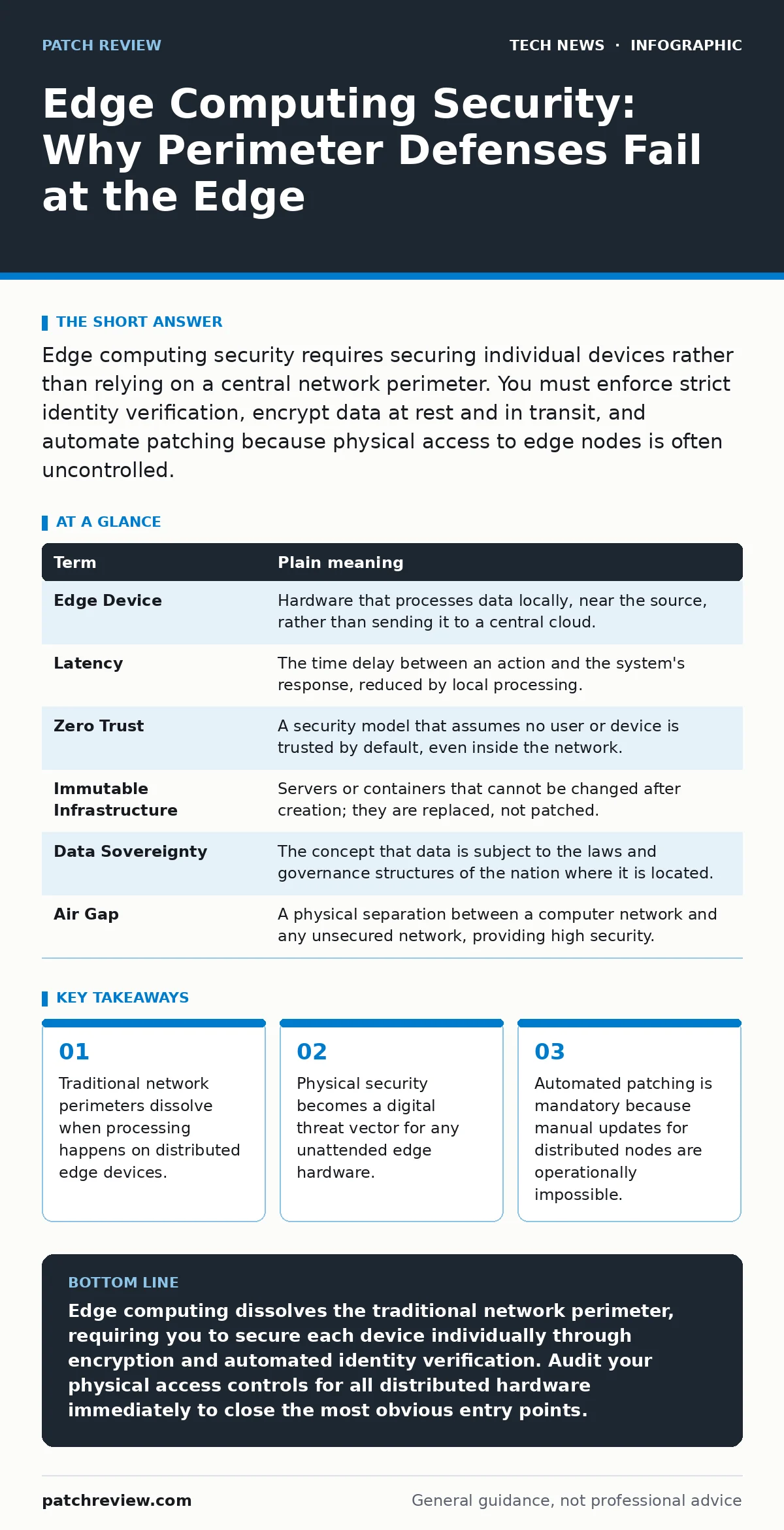
Edge computing security requires securing individual devices rather than relying on a central network perimeter. You must enforce strict identity verification, encrypt data at rest and in transit, and automate patching because physical access to edge nodes is often uncontrolled.
The Distributed Kitchen Analogy
Imagine a central kitchen where all meals are prepared. This represents traditional cloud computing. The kitchen is heavily guarded, with strict access controls and surveillance. Ingredients and finished dishes move through secure corridors. Now imagine you send chefs to every customer’s home to cook the meal. This is edge computing. The security model breaks because you can no longer guard a single door. You must trust the chef, secure the home kitchen, and ensure the recipe has not been altered.
In this model, the "chefs" are edge devices. They process data locally instead of sending it to a central server. This reduces latency, which is the delay before a transfer of data begins following an instruction for its transfer. However, it distributes the risk. A breach in one home kitchen does not necessarily compromise the central kitchen, but it ruins the meal for that customer.
Defining the Edge Architecture
To secure what you cannot see, you must understand the components. Edge computing pushes compute and storage resources closer to the source of data. This architecture supports real-time applications like autonomous vehicles or industrial sensors. The proximity to the user is the benefit, but the exposure is the cost.
| Term | Plain meaning |
|---|---|
| Edge Device | Hardware that processes data locally, near the source, rather than sending it to a central cloud. |
| Latency | The time delay between an action and the system's response, reduced by local processing. |
| Zero Trust | A security model that assumes no user or device is trusted by default, even inside the network. |
| Immutable Infrastructure | Servers or containers that cannot be changed after creation; they are replaced, not patched. |
| Data Sovereignty | The concept that data is subject to the laws and governance structures of the nation where it is located. |
| Air Gap | A physical separation between a computer network and any unsecured network, providing high security. |
The Perimeter No Longer Exists
In traditional security, you build a wall around the data center. You check everyone who enters. With edge computing, the data center is everywhere. There is no wall. This is why home router security becomes a critical component of enterprise strategy. If an employee connects to the corporate network from a poorly secured home network, the edge device becomes an entry point.
You cannot rely on network location for trust. A device on the internal network is not inherently safe. You must verify the identity of every request. This shifts the focus from protecting the network to protecting the identity and the data itself. The assumption that "inside is safe" is the most dangerous habit in modern security.
Physical Access Is Digital Access
The most overlooked threat at the edge is physical tampering. Imagine a smart camera on a factory floor. An attacker does not need to hack the network. They simply plug a USB drive into the maintenance port. If the device allows local debugging or has weak physical ports, the attacker gains root access. This is the hidden cost of distribution.
You must assume an attacker can touch your hardware. Disable unused physical ports. Use tamper-evident seals. Encrypt the storage so that even if the drive is removed, the data is unreadable. This is why understanding AES encryption is not just academic; it is your last line of defense when physical security fails.
Automating the Patching Cycle
Edge devices are often deployed in large numbers and remote locations. Manually updating each device is impossible. If you wait for a critical patch to be applied manually, the window of vulnerability remains open for weeks. Automation is not a convenience; it is a necessity.
Use over-the-air updates that are signed and verified. The device must check the digital signature of the update before applying it. If the signature is invalid, the update is rejected. This prevents an attacker from injecting malicious code into the update stream. Refer to open port management principles to ensure that the update channel is the only open path for changes.
See also: How to Implement SASE: A Step-by-Step Network Architecture Guide · USB Security Dongle: How Hardware Keys Stop Account Takeovers
Implementing Zero Trust at the Edge
Zero Trust means you verify every access request as if it originates from an open network. This applies to edge devices communicating with the cloud. The device must present a certificate. The cloud must verify the certificate. If the device is compromised, the certificate is revoked.
This approach requires a public key infrastructure. Each device gets a unique identity. When the device connects, it proves who it is. If the proof fails, the connection is dropped. This prevents rogue devices from joining the network. It also aligns with remote work security practices, where the location of the user is irrelevant to their access rights.
Try This Now
- Inventory all edge devices currently in use, including IoT sensors and routers. Note the manufacturer and last update date.
- Disable all physical management ports on edge devices that are not strictly necessary for operation.
- Configure your devices to reject any software update that lacks a valid digital signature from your trusted authority.
Securing the Data Lifecycle
Data at the edge is vulnerable at rest and in transit. At rest, it sits on the device storage. In transit, it moves to the cloud or another edge node. You must encrypt both states. Use strong encryption keys that are stored in a hardware security module if possible.
Do not store keys in the device’s main memory. If the device is compromised, the attacker gets the keys. Use a dedicated secure element. This is similar to macOS security settings that isolate sensitive data from the main operating system. The goal is to limit the damage of a single breach.
The Cost of Complexity
Edge security adds complexity. You are managing thousands of endpoints instead of one data center. The trade-off is performance for risk. You gain speed, but you lose the simplicity of a centralized perimeter. You must accept that some devices will be compromised. The goal is containment.
Design your system so that a compromised device cannot talk to other devices. Segment the network. Limit the blast radius. This is the core lesson of edge computing security. You cannot prevent every attack, but you can limit the damage.
Key takeaways
- Traditional network perimeters dissolve when processing happens on distributed edge devices.
- Physical security becomes a digital threat vector for any unattended edge hardware.
- Automated patching is mandatory because manual updates for distributed nodes are operationally impossible.
Edge computing dissolves the traditional network perimeter, requiring you to secure each device individually through encryption and automated identity verification. Audit your physical access controls for all distributed hardware immediately to close the most obvious entry points.
Frequently asked questions
Does edge computing replace cloud computing?
No, edge computing complements the cloud by handling real-time data locally, while the cloud manages long-term storage and heavy computation.
How do I secure an IoT device with no screen?
Use a mobile app or web interface for management, enforce strong authentication, and ensure the device supports secure over-the-air updates.
Is zero trust too complex for small deployments?
Basic zero trust principles, like verifying identity and limiting access, can be applied to small deployments using standard certificate management.
What happens if an edge device is stolen?
If the data is encrypted and the device identity is revoked, the stolen hardware cannot access the network or decrypt the stored data.
How this guide was produced: written by the Patch Review editorial team with AI assistance, checked against the public references listed below, and reviewed when the facts change. See our editorial policy or report an error.