
Bug bounty triage is the validation process, not the fix. Researchers submit findings; analysts verify them against business context. Most reports are duplicates or low risk. Correct triage focuses on proof of concept, impact scope, and reproducibility before escalation.
Misreading: Triage Is the Same as Remediation
Correct reading: Triage is the validation gate, not the repair shop. You verify that a reported issue exists and assess its business impact. You do not write the patch. The development team handles remediation. Confusing these roles causes bottlenecks. Analysts spend hours trying to fix logic errors instead of confirming whether the flaw actually exposes data. Clear separation keeps the pipeline moving. Analysts stay focused on verification. Developers stay focused on code changes.
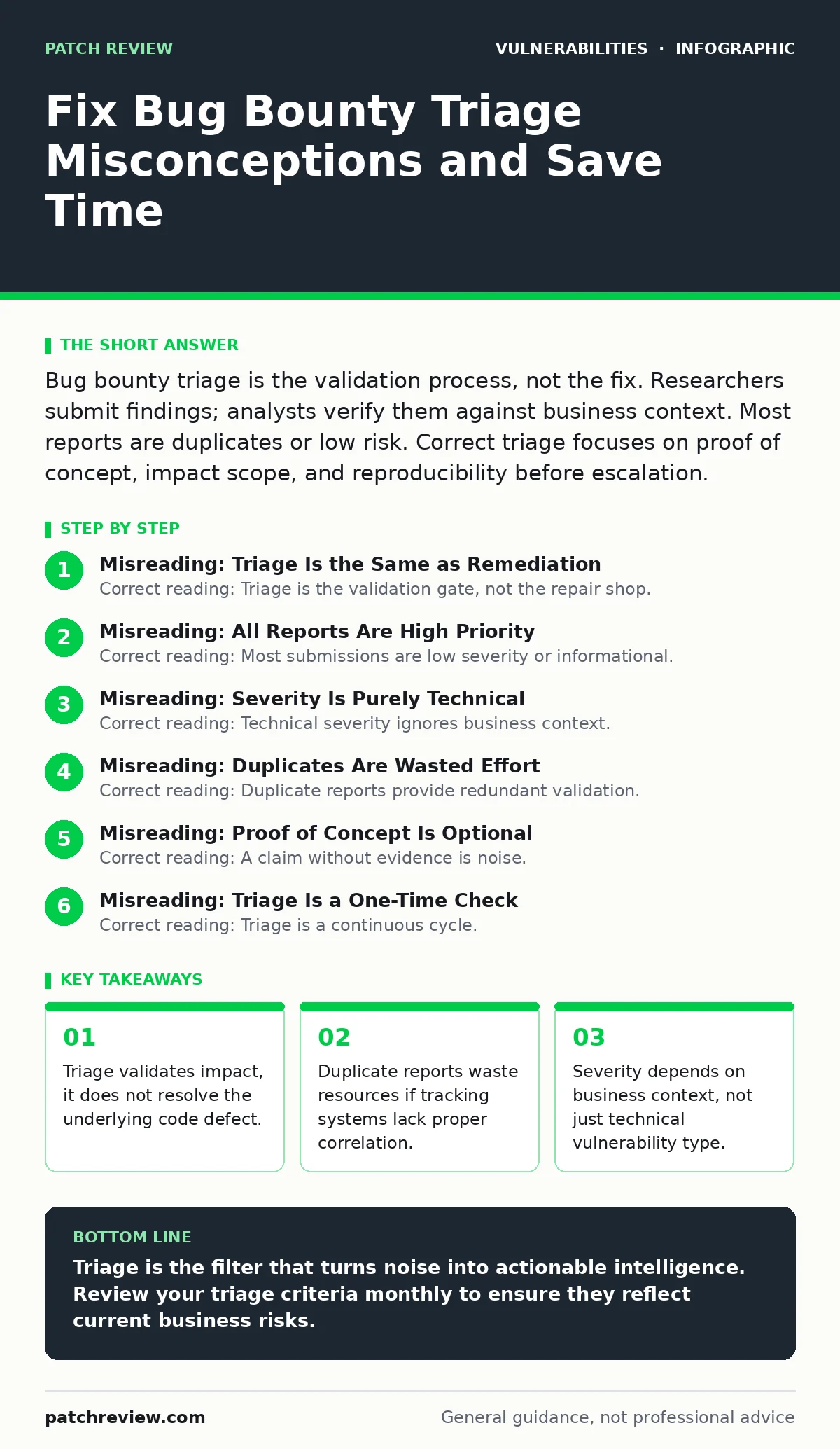
Misreading: All Reports Are High Priority
Correct reading: Most submissions are low severity or informational. A misconfigured header rarely compromises a system. A missing cookie flag might be useful but is not urgent. You must filter noise immediately. If every report gets full attention, the team burns out. Prioritize based on data exposure potential. A path traversal vulnerabilities issue that exposes source code is higher priority than a cosmetic rendering bug. Context dictates urgency, not volume.
Misreading: Severity Is Purely Technical
Correct reading: Technical severity ignores business context. A critical SQL injection in a disconnected test database has zero business impact. It is not a critical incident. You must map technical flaws to asset value. Does the affected endpoint handle payment data? Does it grant administrative access? If the answer is no, the severity drops. This approach aligns with risk-based vulnerability management principles. It ensures resources go to threats that actually hurt the organization. It prevents panic over theoretical flaws.
Misreading: Duplicates Are Wasted Effort
Correct reading: Duplicate reports provide redundant validation. They confirm that a vulnerability is reproducible by different actors. They can reveal additional attack paths or wider impact. Instead of dismissing them instantly, merge them into a single ticket. Use the additional context to refine the scope. If three researchers find the same clickjacking issue, the first report gets the credit. The others help prove the exploit chain is reliable. This builds better documentation for the fix.
Misreading: Proof of Concept Is Optional
Correct reading: A claim without evidence is noise. You need a clear proof of concept to proceed. This is a specific input or sequence that triggers the flaw. It must be reproducible in a controlled environment. Without it, you are guessing. Guessing leads to false positives. False positives erode trust with the researcher community. Require precise steps, requests, and responses. If the researcher cannot demonstrate the issue, the report remains open but unverified. Do not escalate unproven claims.
Misreading: Triage Is a One-Time Check
Correct reading: Triage is a continuous cycle. A vulnerability found today might reappear after a code merge. New features can reintroduce old flaws. You must re-verify after patches are applied. This is where secure code review complements bounty findings. Automated scans miss context. Human review catches logic errors. The triage team must confirm that the fix actually closes the attack vector. Sometimes the fix breaks another function. Continuous validation ensures the system remains secure over time.
Misreading: Researchers Know Your Architecture
Correct reading: Researchers see the outside. They do not know internal constraints. They might propose fixes that break existing integrations. They might assume a service is internet-facing when it is not. You must translate external findings into internal reality. A DNS rebinding attack might work in a lab but fail due to your proxy configuration. Explain why a report is out of scope. Provide clear boundaries. This prevents frustration and keeps the program productive. It turns adversaries into allies.
Misreading: Severity Scores Are Absolute Truth
Correct reading: Standard scoring models provide a baseline, not a verdict. A CVSS score of 9.0 does not mean immediate crisis. It means the technical potential is high. You must adjust for exploitability. Is the attack surface exposed? Is authentication required? Are there mitigating controls? A high score with no access path is low risk. A medium score with easy access is high risk. Use the score as a starting point. Apply your business logic on top. This prevents alert fatigue.
Misreading: Triage Is Purely Manual
Correct reading: Automation handles the initial filter. Tools can deduplicate reports. They can scan for known patterns. They can check scope automatically. But automation fails on logic. It cannot understand intent. It cannot assess business value. Human triage is still required for nuanced issues. Use tools to remove the obvious noise. Use humans to judge the rest. This hybrid approach scales. It keeps the team focused on high-value decisions. It reduces manual repetition.
Misreading: Triage Ends When the Fix Is Deployed
Correct reading: Triage includes post-fix validation. You must confirm the patch works. You must check for regression. You must ensure the researcher’s specific exploit no longer works. This final step closes the loop. It provides closure to the reporter. It proves to the organization that the risk is gone. Skipping this step leaves blind spots. The vulnerability might still exist in a different form. Verification is part of the triage lifecycle.
Misreading: Triage Is Separate from Development
Correct reading: Triage informs development priorities. It provides real-world attack data. Developers learn how attackers think. This feedback loop improves code quality. Triage teams should share insights with engineers. Explain why a certain flaw was exploitable. Suggest defensive coding patterns. This collaboration reduces future bugs. It builds a security-aware culture. Triage is not an isolated function. It is a bridge between external threats and internal code.
Misreading: Triage Is Only for Critical Bugs
Correct reading: Every report deserves a response. Even low-severity issues provide value. They reveal misconfigurations. They highlight documentation gaps. They improve user experience. Ignoring small reports damages trust. Researchers feel undervalued. They stop participating. Consistent engagement keeps the community active. It ensures a steady flow of high-quality findings. Treat every submission with respect. Provide clear feedback. Explain your decision. This maintains program health.
Misreading: Triage Is Static
Correct reading: Triage evolves with the threat. New attack techniques emerge. New platforms are adopted. Your criteria must adapt. A method that was safe last year might be risky today. You must stay updated on n-day vulnerabilities. You must understand new frameworks. Continuous learning is required. Your team must review past cases. Identify gaps in detection. Update your procedures. This keeps your defense relevant. It prevents stagnation.
Misreading: Triage Is Only for Security Teams
Correct reading: Triage requires cross-functional input. Developers understand code intent. Product managers understand business value. Operations understand infrastructure constraints. Security analysts understand attack methods. All perspectives are needed. A siloed triage process misses context. It makes poor decisions. Involve stakeholders early. Define clear roles. Ensure information flows freely. This creates a holistic view. It leads to better outcomes. It strengthens the entire organization.
Key takeaways
- Triage validates impact, it does not resolve the underlying code defect.
- Duplicate reports waste resources if tracking systems lack proper correlation.
- Severity depends on business context, not just technical vulnerability type.
Triage is the filter that turns noise into actionable intelligence. Review your triage criteria monthly to ensure they reflect current business risks.
Frequently asked questions
How do I handle a researcher who claims a critical bug but provides no proof?
Request a specific proof of concept. Do not escalate without evidence. If they cannot provide it, mark the report as unverified and request more information.
What is the difference between triage and remediation?
Triage validates the report and assesses impact. Remediation fixes the code. Triage is the diagnosis. Remediation is the treatment. They are distinct phases.
Should I pay for duplicate reports?
No. Credit the first valid report. Duplicates provide validation but do not warrant separate rewards. Merge them into the original ticket for context.
How do I determine the severity of a new vulnerability type?
Map the technical flaw to business assets. Assess data exposure potential. Consider exploitability and mitigation controls. Use standard scores as a baseline, not a rule.
How this guide was produced: written by the Patch Review editorial team with AI assistance, checked against the public references listed below, and reviewed when the facts change. See our editorial policy or report an error.