
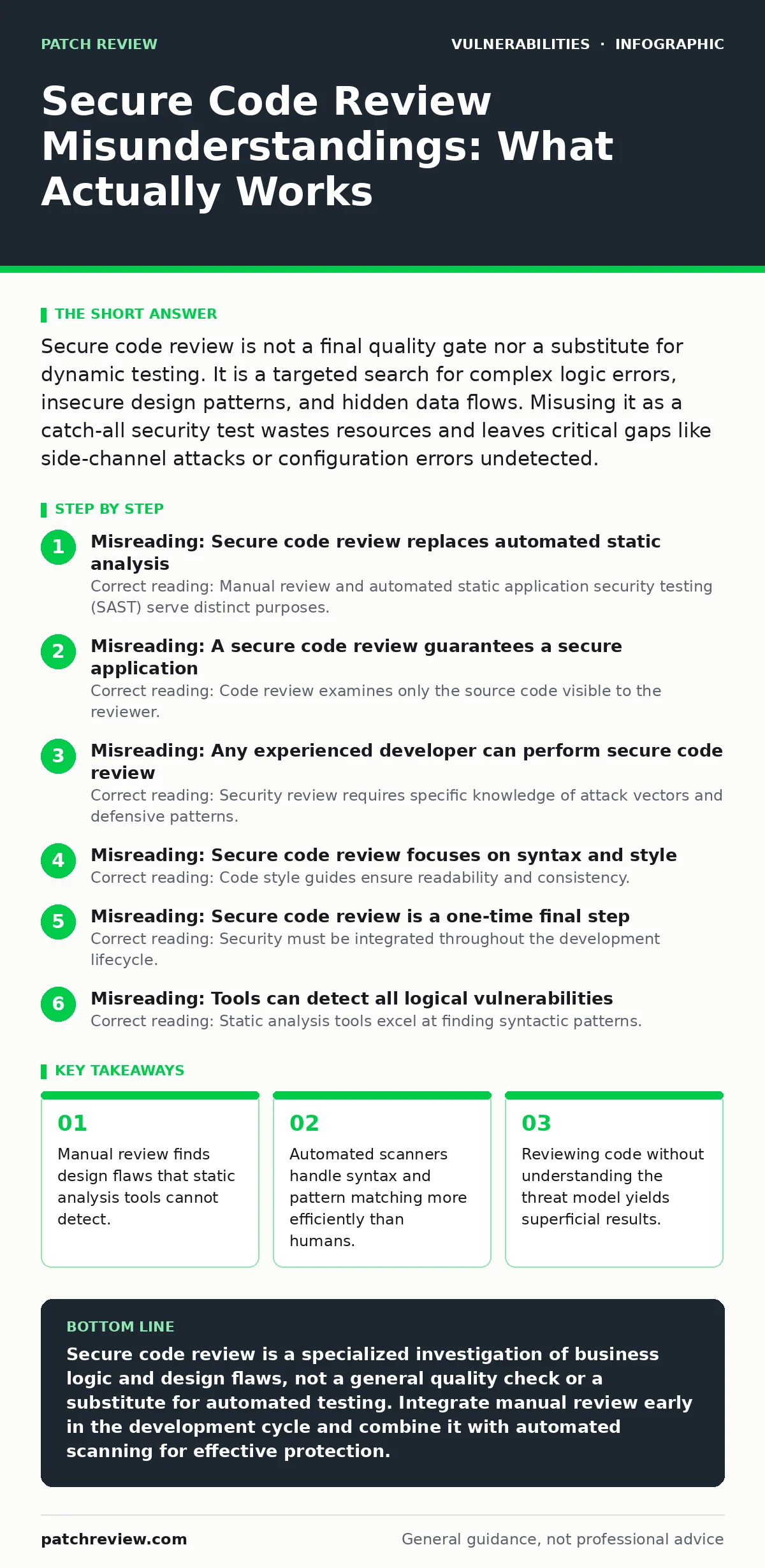
Secure code review is not a final quality gate nor a substitute for dynamic testing. It is a targeted search for complex logic errors, insecure design patterns, and hidden data flows. Misusing it as a catch-all security test wastes resources and leaves critical gaps like side-channel attacks or configuration errors undetected.
Misreading: Secure code review replaces automated static analysis
Correct reading: Manual review and automated static application security testing (SAST) serve distinct purposes. Automated tools scan source code against known vulnerability patterns, such as buffer overflows or hardcoded secrets, at machine speed. They catch simple, repetitive errors efficiently.
Human reviewers focus on complex business logic, data flow integrity, and architectural decisions that tools cannot interpret. Relying solely on manual review ignores the scale of modern codebases. Relying solely on automation misses context-dependent flaws. You must use both. Automated tools filter the noise. Humans investigate the signal. This division of labor ensures coverage without exhausting reviewer attention.
Misreading: A secure code review guarantees a secure application
Correct reading: Code review examines only the source code visible to the reviewer. It does not test the compiled binary, the runtime environment, or the deployment configuration. Vulnerabilities often exist outside the source code. Imagine a developer writes perfect encryption logic, but the system uses a weak random number generator provided by the operating system.
The code looks secure. The implementation fails. Reviewers cannot see how the application behaves under load or how it interacts with third-party libraries at runtime. Dynamic application security testing (DAST) and threat modeling complement code review. They expose gaps in the broader system. No single method provides complete protection.
Misreading: Any experienced developer can perform secure code review
Correct reading: Security review requires specific knowledge of attack vectors and defensive patterns. General programming proficiency does not translate to security expertise. A developer may write clean, efficient code that is vulnerable to logic bombs or race conditions. Reviewers must understand how adversaries exploit the specific technology stack.
For example, understanding prototype pollution in JavaScript requires knowing how object property inheritance works and how attackers manipulate shared prototypes. Without this specialized knowledge, reviewers miss subtle flaws. Organizations often assign review duties to senior developers as an afterthought. This leads to superficial checks. Dedicated security engineers or developers with formal security training should lead the review process. They bring the necessary adversarial mindset.
Misreading: Secure code review focuses on syntax and style
Correct reading: Code style guides ensure readability and consistency. Security review ensures the code behaves correctly under adversarial conditions. These are separate objectives. A reviewer checking for indentation errors will not notice an insecure direct object references (IDOR) vulnerability where a user accesses another user’s data by changing an ID parameter.
Security reviewers trace data from entry points to sensitive operations. They verify that authorization checks occur at every step. They look for assumptions about input validity that break under attack. Syntax checks belong in pre-commit hooks and automated linters. Security reviews demand deep analysis of business logic. Mixing these activities dilutes the focus. Keep style checks automated. Reserve human effort for logic verification.
Misreading: Secure code review is a one-time final step
Correct reading: Security must be integrated throughout the development lifecycle. Waiting until the end of a project to review code creates massive bottlenecks and high remediation costs. Fixing a fundamental design flaw after months of development requires rewriting large sections of code. It delays releases and frustrates teams.
Early review of design documents and architecture diagrams identifies risks before code is written. Continuous integration pipelines run automated security scans on every commit. Human reviewers examine high-risk modules as they are developed. This shift-left approach reduces the accumulation of technical debt. It allows developers to learn from feedback immediately. Security becomes a habit, not an audit.
Misreading: Tools can detect all logical vulnerabilities
Correct reading: Static analysis tools excel at finding syntactic patterns. They struggle with semantic meaning. Tools can detect if a function is called. They cannot always determine if the call is authorized in a specific business context. Imagine a feature where users can delete their accounts. The code checks if the user is logged in.
It does not check if the account is in a locked state due to a pending fraud investigation. An automated tool sees a valid function call. A human reviewer sees a business logic error. This gap is where path traversal vulnerabilities and complex injection attacks often hide. They require understanding the intent of the code, not just its structure. Human reviewers provide the context that algorithms lack.
Misreading: Code review fixes all security problems
Correct reading: Secure code review is one layer of defense. It does not replace other security controls. You still need secure configuration management, runtime protection, and incident response plans. Reviewing code does not prevent clickjacking if the deployment server lacks proper HTTP headers. It does not mitigate side-channel attacks that exploit timing differences in hardware execution.
These issues exist outside the source code logic. A holistic security strategy includes exposure management to identify assets and their risks. It includes emergency patching procedures for when vulnerabilities are discovered post-release. Code review improves the software. It does not secure the entire ecosystem.
Misreading: The OWASP Top 10 covers everything
Correct reading: The OWASP Top 10 provides a starting point for web application security. It lists common risks, not all possible risks. Focusing exclusively on these ten categories leaves other vulnerabilities unaddressed. New attack techniques emerge constantly. Legacy systems may have unique flaws not covered by current standards. Reviewers should use the Top 10 as a baseline, then expand based on the specific application’s context. Financial applications need different scrutiny than social media platforms. Custom protocols introduce unique risks. A rigid checklist approach misses novel threats. Reviewers must think beyond standard lists.
Key takeaways
- Manual review finds design flaws that static analysis tools cannot detect.
- Automated scanners handle syntax and pattern matching more efficiently than humans.
- Reviewing code without understanding the threat model yields superficial results.
- Secure review requires specific expertise in both the language and the attack surface.
Secure code review is a specialized investigation of business logic and design flaws, not a general quality check or a substitute for automated testing. Integrate manual review early in the development cycle and combine it with automated scanning for effective protection.
Frequently asked questions
How long should a secure code review take?
Review time depends on code complexity and criticality. High-risk modules require deeper analysis. Allocate time based on the potential impact of the code, not just the line count.
Can artificial intelligence replace human code reviewers?
AI can assist by highlighting suspicious patterns and reducing manual effort. It cannot yet fully understand complex business logic or adversarial intent. Human oversight remains necessary for critical decisions.
What is the difference between peer review and security review?
Peer review focuses on code quality, maintainability, and adherence to standards. Security review focuses on vulnerabilities, threat vectors, and defensive design. They have different goals and require different expertise.
How do I prioritize code for security review?
Prioritize code that handles sensitive data, manages authentication, or interacts with external systems. Review high-risk modules first. Use automated tools to scan the rest of the codebase for obvious issues.
How this guide was produced: written by the Patch Review editorial team with AI assistance, checked against the public references listed below, and reviewed when the facts change. See our editorial policy or report an error.