
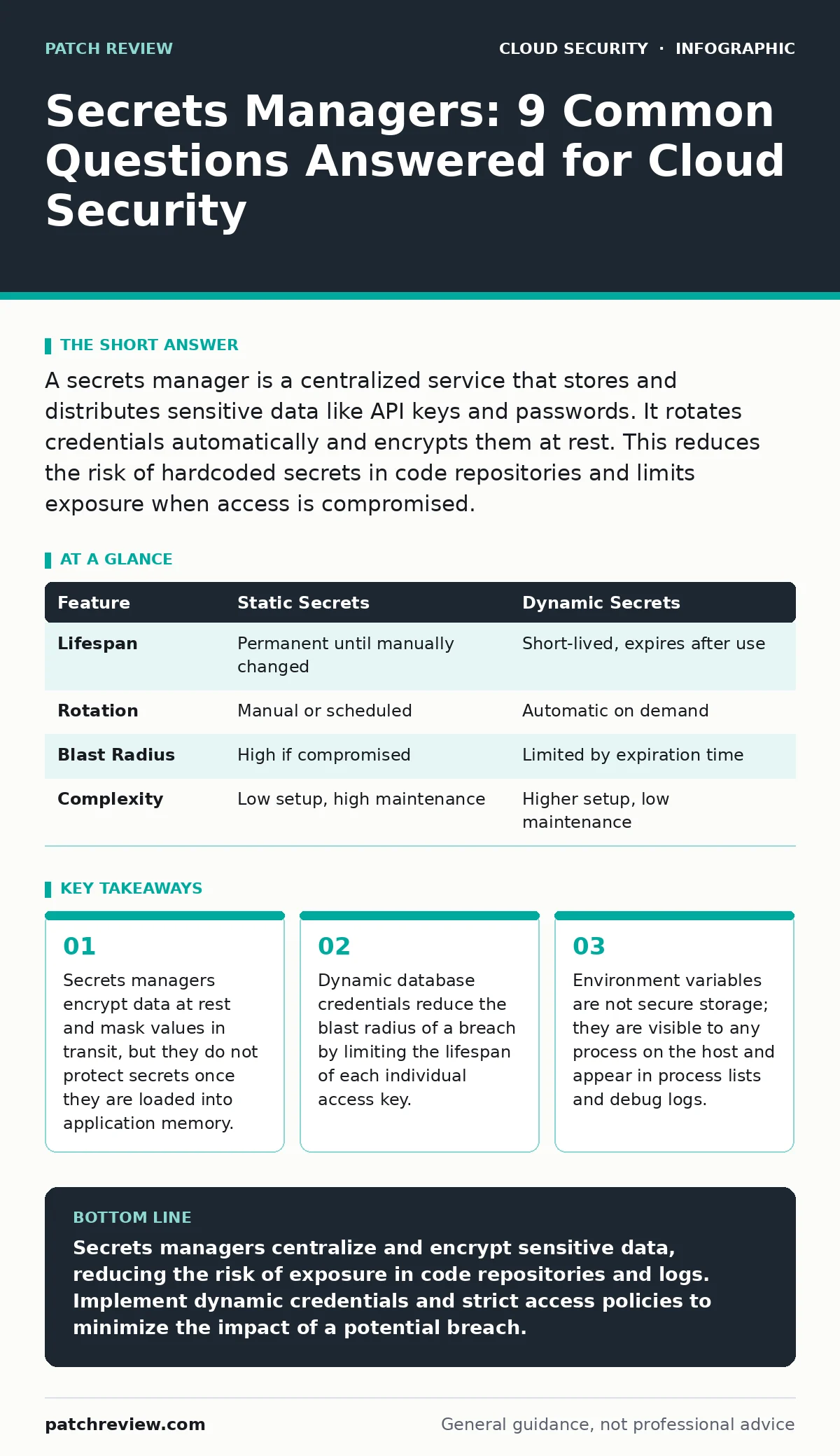
A secrets manager is a centralized service that stores and distributes sensitive data like API keys and passwords. It rotates credentials automatically and encrypts them at rest. This reduces the risk of hardcoded secrets in code repositories and limits exposure when access is compromised.
What is a secrets manager?
A secrets manager is a centralized service designed to store, manage, and distribute sensitive data such as API keys, database passwords, and encryption keys. It replaces the practice of hardcoding credentials directly into application source code. By centralizing control, you ensure that only authorized applications and users can retrieve these values at runtime.
Why not just use environment variables?
Environment variables are not a secure storage mechanism because they are easily accessible to any process running on the same host. Any user with access to the server can list these variables, and they often appear in crash dumps or debug logs. A secrets manager provides encryption at rest and strict access controls that environment variables simply do not offer.
How does a secrets manager differ from a vault?
The terms are often used interchangeably, but a vault is a specific type of secrets manager that emphasizes high-security isolation and auditing. A basic secrets manager might simply store encrypted strings, while a vault often includes features like dynamic credential generation and lease management. Both serve to protect sensitive data, but the vault model usually implies a stricter operational model with detailed audit trails.
What are dynamic credentials?
Dynamic credentials are temporary access tokens generated on demand for a specific task, such as connecting to a database. Instead of using a static password that persists for months, the secrets manager creates a new username and password with a short expiration time. This limits the damage if an attacker steals the credential, as it becomes useless after a few minutes or hours.
Do secrets managers protect against insider threats?
Secrets managers help mitigate insider threats by enforcing the principle of least privilege and providing detailed audit logs of every access attempt. They do not stop a malicious insider who has legitimate, high-level access to the system. If an employee has the permission to read secrets, the manager will provide them. The protection lies in restricting who has those permissions and monitoring for unusual access patterns.
See also: Spot Shadow IT: Warning Signs and Response Steps · Detect Leaked Cloud Access Keys Before Attackers Do
Can secrets managers rotate credentials automatically?
Yes, many secrets managers can automatically rotate credentials for supported services like cloud databases or email providers. The manager updates the secret in the backend and notifies the application to fetch the new value without downtime. This eliminates the manual effort and human error associated with changing passwords periodically, ensuring that old credentials are retired quickly.
How do secrets managers integrate with infrastructure as code?
Secrets managers integrate with infrastructure as code tools by providing plugins or APIs that retrieve secrets during the deployment phase. This allows you to define the infrastructure structure in code while keeping the actual sensitive values out of the version control system. The deployment pipeline fetches the secrets at runtime, ensuring they are never written to disk in plaintext.
| Feature | Static Secrets | Dynamic Secrets |
|---|---|---|
| Lifespan | Permanent until manually changed | Short-lived, expires after use |
| Rotation | Manual or scheduled | Automatic on demand |
| Blast Radius | High if compromised | Limited by expiration time |
| Complexity | Low setup, high maintenance | Higher setup, low maintenance |
What is the performance impact of using a secrets manager?
Retrieving secrets from a remote manager adds latency compared to reading from local environment variables or configuration files. For high-frequency operations, this latency can become a bottleneck if the application fetches a secret for every single request. The standard mitigation is to cache the secret in memory for the duration of its validity, balancing security with performance requirements.
How do secrets managers handle key management?
Secrets managers typically use a hierarchy of encryption keys to protect the stored data. A master key encrypts the data keys, which in turn encrypt the actual secrets. This separation allows for key rotation without re-encrypting every single secret immediately. You must manage the master keys securely, often by using a hardware security module or a cloud provider's key management service.
Are secrets managers vulnerable to cloud metadata service attacks?
Secrets managers are not inherently vulnerable to cloud metadata service attacks, but the applications using them can be. If an attacker exploits a vulnerability in your application to access the cloud instance's metadata service, they may obtain temporary credentials that grant access to the secrets manager. This highlights why you must restrict network access to metadata services and use tools that prevent unauthorized outbound connections. See our guide on cloud metadata service attacks for more on this vector.
Do secrets managers replace the need for policy as code?
No, secrets managers store the data, but policy as code defines who can access it and under what conditions. A secrets manager without strict policies is just a locked box with no guard. You need policy as code to enforce rules like "only the production environment can read the production database password." This ensures that even if a developer accidentally requests access, the system denies it based on predefined rules.
How do secrets managers work with Kubernetes?
In Kubernetes, secrets managers integrate via sidecar containers or init containers that inject secrets into pods at startup. This is more secure than using native Kubernetes secrets, which are stored in the cluster's etcd database in base64-encoded format that is not encrypted by default. The secrets manager ensures that the sensitive data is only present in the memory of the specific pod that needs it. Misconfigurations here can lead to exposure, so review your setup carefully. Refer to our guide on Kubernetes misconfigurations for common pitfalls.
What happens if the secrets manager goes down?
If the secrets manager is unavailable, applications that rely on it for runtime credentials may fail to start or function. This creates a single point of failure for your infrastructure. To mitigate this, you should cache secrets locally in memory and design your applications to handle authentication failures gracefully. High availability architectures for the secrets manager itself are also necessary to prevent service disruption.
Key takeaways
- Secrets managers encrypt data at rest and mask values in transit, but they do not protect secrets once they are loaded into application memory.
- Dynamic database credentials reduce the blast radius of a breach by limiting the lifespan of each individual access key.
- Environment variables are not secure storage; they are visible to any process on the host and appear in process lists and debug logs.
Secrets managers centralize and encrypt sensitive data, reducing the risk of exposure in code repositories and logs. Implement dynamic credentials and strict access policies to minimize the impact of a potential breach.
Frequently asked questions
Can I store SSH keys in a secrets manager?
Yes, you can store SSH private keys in a secrets manager to prevent them from being hardcoded in scripts. Ensure you restrict access to these keys to only the necessary automation accounts and rotate them regularly.
Is a secrets manager the same as a password manager?
No, a password manager is for human users to store personal credentials, while a secrets manager is for machines and applications to access API keys and database passwords programmatically.
Do I need a secrets manager if I use a SaaS provider?
Even with SaaS providers, you often need API keys or tokens to interact with their services. A secrets manager helps you manage these credentials securely and rotate them without exposing them in your code.
How do I audit access to my secrets?
Most secrets managers provide detailed audit logs that record who accessed which secret and when. You should forward these logs to a centralized logging system to detect unusual access patterns.
How this guide was produced: written by the Patch Review editorial team with AI assistance, checked against the public references listed below, and reviewed when the facts change. See our editorial policy or report an error.