
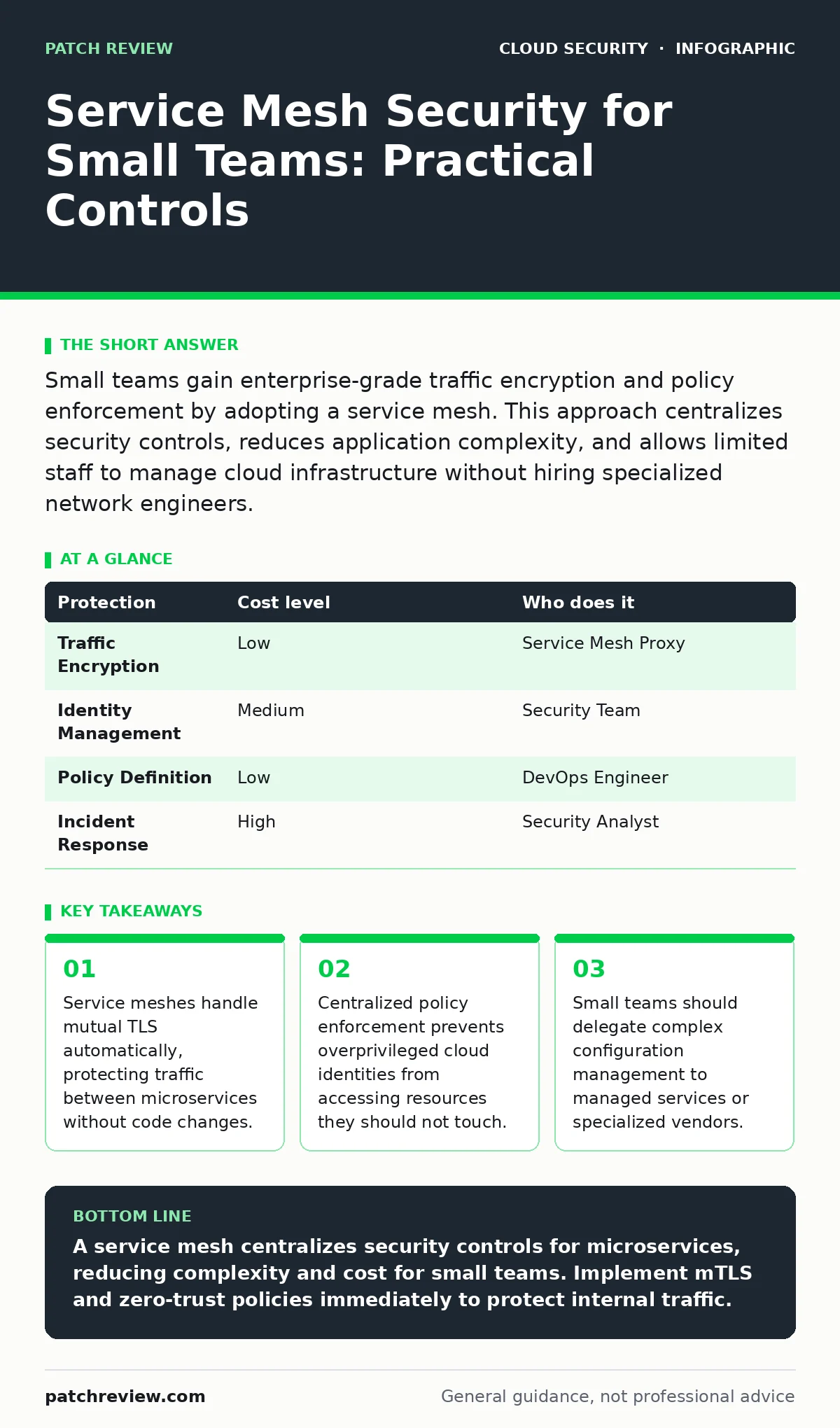
Small teams gain enterprise-grade traffic encryption and policy enforcement by adopting a service mesh. This approach centralizes security controls, reduces application complexity, and allows limited staff to manage cloud infrastructure without hiring specialized network engineers.
Why Service Mesh Matters at Small Scale
Service mesh security provides a dedicated infrastructure layer for handling service-to-service communication. You gain automatic encryption, observability, and policy enforcement without modifying your application code. Small teams often struggle with distributed systems because each new service adds configuration complexity. A service mesh abstracts this complexity. It sits between your services and handles the secure transport. This allows developers to focus on business logic rather than network security.
The primary benefit for smaller organizations is standardization. Without a mesh, each developer implements authentication and encryption differently. This inconsistency creates gaps that attackers exploit. A mesh applies the same security standards to every service. It ensures that every request is verified and encrypted. This uniformity reduces the cognitive load on your team. You maintain one set of policies instead of dozens of custom implementations.
The Mechanics of Mutual TLS
Mutual TLS, or mTLS, requires both the client and the server to present digital certificates for authentication. This differs from standard TLS, where only the server proves its identity. In a microservices environment, mTLS ensures that only authorized services can communicate. The service mesh manages the certificate lifecycle automatically. It issues, rotates, and revokes certificates without human intervention.
This automation is critical for small teams. Manually managing certificates for dozens of services is error-prone and time-consuming. Certificates expire, keys get compromised, and configurations drift. The mesh handles these operational tasks. It ensures that traffic is always encrypted in transit. It also verifies that the sender is who it claims to be. This prevents impersonation attacks where a malicious actor tries to pose as a legitimate service.
Policy Enforcement and Access Control
A service mesh allows you to define fine-grained access policies. You specify which services can talk to each other and on which ports. This is known as zero-trust networking. You assume that no traffic is trusted by default, even if it originates inside your network. The mesh enforces these rules at the network layer. If a service tries to connect to a resource it is not allowed to access, the mesh blocks the request.
This approach mitigates risks associated with cloud privilege escalation. If an attacker compromises one service, they cannot easily move laterally to other parts of your infrastructure. The mesh restricts their movement. You define allowlists for each service. This minimizes the blast radius of a breach. Small teams benefit because they do not need to implement complex access control logic in every application. The mesh handles it centrally.
Affordable Implementation Strategies
Deploying a service mesh does not require expensive proprietary software. Open-source projects like Istio and Linkerd provide robust features. These tools are free to use and have large communities. Small businesses can start with lightweight versions that consume fewer resources. This keeps cloud computing costs low. You pay only for the compute resources the mesh proxies use.
Managed cloud services also offer service mesh capabilities. Some providers include basic mesh features in their Kubernetes offerings. This reduces the operational overhead. You do not need to manage the control plane yourself. The provider handles updates and scaling. This is an affordable way to get enterprise-grade security. You trade some customization for simplicity and lower maintenance costs.
| Protection | Cost level | Who does it |
|---|---|---|
| Traffic Encryption | Low | Service Mesh Proxy |
| Identity Management | Medium | Security Team |
| Policy Definition | Low | DevOps Engineer |
| Incident Response | High | Security Analyst |
What to Delegate to Vendors
Small teams should not build security tooling from scratch. Delegate the management of the service mesh control plane to a vendor or managed service. They handle the complexity of certificate authority management and policy distribution. You focus on defining the security policies that match your business needs. This division of labor allows your team to be more efficient.
You should also delegate monitoring and alerting setup. Configuring dashboards and alerts for a distributed system is complex. Use built-in observability features provided by the mesh or the cloud provider. This gives you visibility into traffic patterns and potential anomalies. Do not try to build custom logging solutions. Rely on established tools that integrate with your existing stack. This approach reduces the risk of cloud logging gaps that could hide an attack.
See also: Prevent Overprivileged Cloud Identities: A Precise Checklist · Cloud Privilege Escalation Mistakes and Fixes
Questions for IT Providers
When evaluating managed service mesh offerings or consulting with IT providers, ask specific questions. You need to understand how they handle security updates and incident response. Do not accept vague promises about security. Ask for concrete details about their processes. This ensures that you are not inheriting hidden risks.
- How do you handle certificate rotation and expiration?
- What is the process for applying security patches to the mesh control plane?
- How do you monitor for anomalies in service-to-service traffic?
- Can you provide examples of how you enforce zero-trust policies?
- What is the impact on latency when the mesh is enabled?
Common Pitfalls to Avoid
A common mistake is assuming that a service mesh solves all security problems. It does not protect against application-level vulnerabilities. You still need to secure your code and manage secrets properly. Overreliance on the mesh can lead to neglecting other areas. Ensure you address secrets managers and prevent leaked cloud access keys. The mesh handles transport security, not data security at rest.
Another pitfall is misconfiguring the mesh policies. If you set the policies too broadly, you defeat the purpose of zero-trust. Regularly review and audit your policies. Ensure they align with your business requirements. Avoid the trap of Kubernetes misconfigurations that expose the mesh control plane. Keep the control plane isolated and access-restricted. This prevents attackers from tampering with your security policies.
Integrating with Existing Tools
Your service mesh should integrate with your existing identity providers. This allows you to leverage your current authentication infrastructure. You do not need to create a new identity system. Connect the mesh to your cloud identity platform. This ensures that services use the same identities as your users and administrators. It simplifies access management and reduces the risk of overprivileged cloud identities.
Use the mesh to complement your cloud security groups. Security groups control traffic at the network perimeter. The mesh controls traffic between services. Together, they provide defense in depth. The mesh adds an extra layer of verification that security groups cannot provide. This combination makes it harder for attackers to move through your environment. It also provides better visibility into internal traffic flows.
Key takeaways
- Service meshes handle mutual TLS automatically, protecting traffic between microservices without code changes.
- Centralized policy enforcement prevents overprivileged cloud identities from accessing resources they should not touch.
- Small teams should delegate complex configuration management to managed services or specialized vendors.
A service mesh centralizes security controls for microservices, reducing complexity and cost for small teams. Implement mTLS and zero-trust policies immediately to protect internal traffic.
Frequently asked questions
Does a service mesh replace a firewall?
No, a service mesh handles internal traffic between services. Firewalls protect the perimeter. You need both for defense in depth.
Is a service mesh suitable for monolithic applications?
Service meshes are designed for microservices. They add overhead to monolithic apps. Use traditional security controls for monoliths.
How much latency does a service mesh add?
A service mesh adds minimal latency, usually milliseconds. Modern proxies are optimized for performance. Monitor your specific use case.
Can I use a service mesh with serverless functions?
Some service meshes support serverless, but integration varies. Check compatibility with your specific cloud provider and function framework.
How this guide was produced: written by the Patch Review editorial team with AI assistance, checked against the public references listed below, and reviewed when the facts change. See our editorial policy or report an error.