
Data retention policies are often confused with backup schedules or legal holds. You must distinguish between active data, archived records, and deleted information. Over-retention increases exposure to data breaches and complicates secure data disposal. Define clear expiration dates for every data class to minimize risk.
Misreading: Retention Equals Storage Capacity
Correct reading: Data retention policy defines how long you keep data, not how much you store. Many teams assume that if they have the disk space, they should keep everything indefinitely. This creates a false sense of security. Storing obsolete data increases the value of your environment to attackers. A larger dataset means a more impactful data breach. You must classify data by its active utility. Once the business purpose expires, the data becomes a liability. Storage costs are secondary to the risk of holding unnecessary information. Define deletion triggers based on data class, not volume limits.
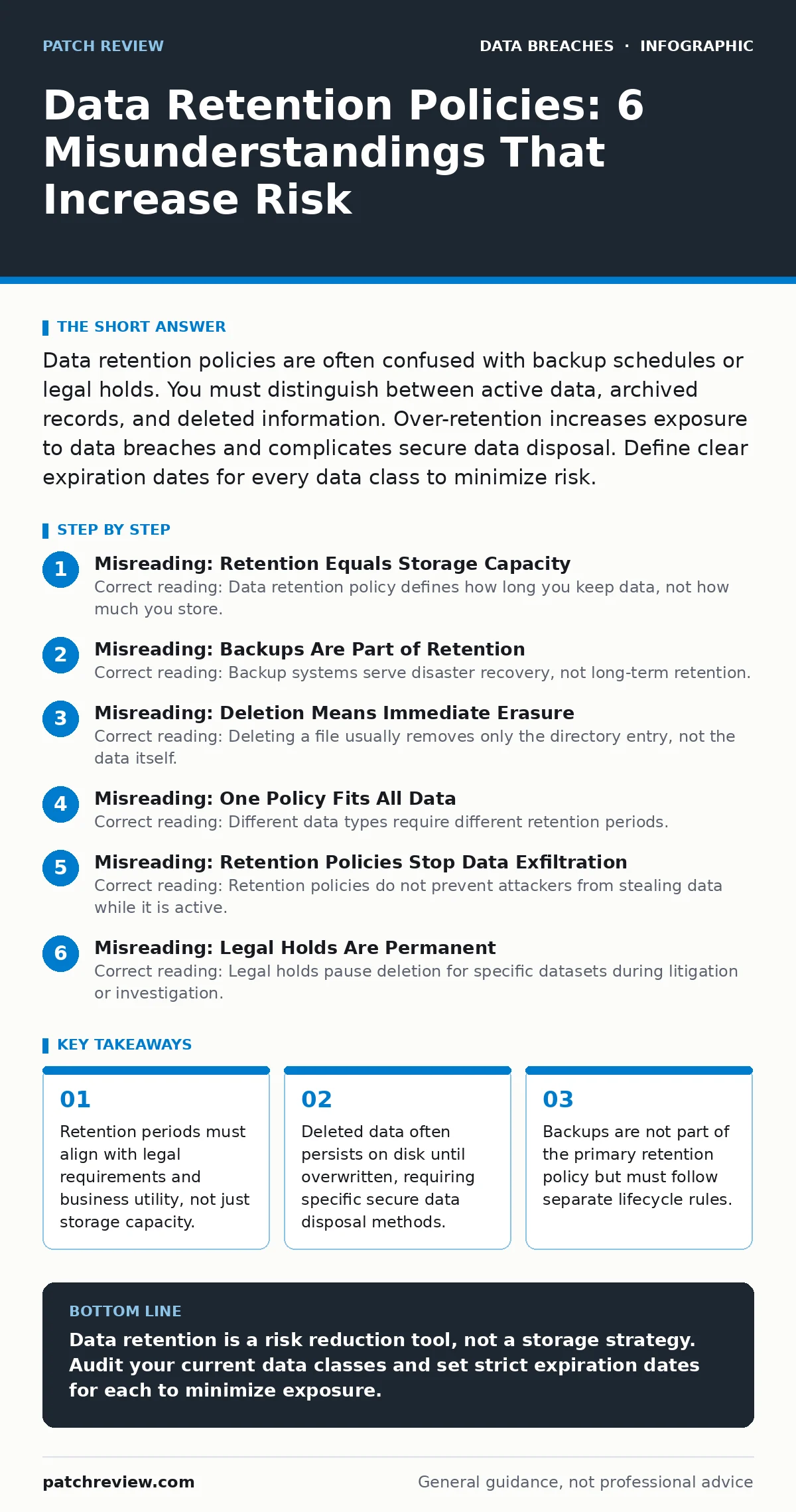
Misreading: Backups Are Part of Retention
Correct reading: Backup systems serve disaster recovery, not long-term retention. A common error is treating backup tapes or snapshots as the primary record of data lifecycle. Backups must be excluded from standard retention schedules to ensure you can restore systems after an incident. If you apply retention deletion to backups, you lose recovery capability. If you apply backup schedules to retention, you keep data forever by accident. Separate the two processes. Use log retention for operational history and backups for system state. This separation ensures you can recover from ransomware without violating privacy laws.
Misreading: Deletion Means Immediate Erasure
Correct reading: Deleting a file usually removes only the directory entry, not the data itself. The sectors on the disk remain accessible until overwritten. This distinction is critical for security. If an attacker gains physical access or uses forensic tools, they can recover "deleted" files. You must implement secure data disposal procedures for sensitive information. This involves overwriting the storage sectors multiple times. For solid-state drives, standard overwriting is less effective due to wear leveling. Use manufacturer-specific secure erase commands. Understanding this mechanism prevents false confidence in simple delete operations.
Misreading: One Policy Fits All Data
Correct reading: Different data types require different retention periods. Applying a single rule to all files creates compliance gaps and operational inefficiency. Financial records may require long-term storage for audit trails. Temporary session logs might only need short-term retention for debugging. You must categorize data by sensitivity and regulatory requirement. Health records, payment information, and user profiles each have distinct legal mandates. Create a matrix that maps data classes to specific retention durations. This granularity reduces the amount of sensitive data you hold at any given time.
Misreading: Retention Policies Stop Data Exfiltration
Correct reading: Retention policies do not prevent attackers from stealing data while it is active. They only limit the window of opportunity and the volume of available data. Attackers often target data that is currently in use because it is encrypted less frequently or has fewer access controls. Relying on deletion schedules to stop data exfiltration is a fundamental error. You must combine retention limits with strong access controls and monitoring. If you do not encrypt data at rest, short retention does not mitigate the risk of a successful breach. Encryption protects the data regardless of how long you keep it.
See also: How to Prevent Credit Card Theft Online: 5 Proven Methods · Chain of Custody Form: How to Preserve Digital Evidence Integrity
Misreading: Legal Holds Are Permanent
Correct reading: Legal holds pause deletion for specific datasets during litigation or investigation. They are not a permanent extension of retention. Many organizations apply broad holds that freeze entire databases, creating massive overhead. This practice slows down systems and increases storage costs unnecessarily. A legal hold should target specific records relevant to the case. Once the legal matter concludes, the hold is lifted, and the standard retention policy resumes. Failing to release holds creates a backlog of data that should have been deleted years ago. This accumulation increases the risk of accidental exposure.
Misreading: Encryption Replaces Retention Needs
Correct reading: Data encryption protects confidentiality but does not define lifecycle. Some teams believe that if data is encrypted, they can keep it indefinitely without risk. This ignores privacy regulations that mandate deletion of personal information when no longer needed. Encrypted data that is no longer required is still a compliance violation if retained. You must delete the data and the associated encryption keys. Without the keys, the data becomes unrecoverable, which is a form of destruction. This approach aligns with encryption key management best practices. It ensures that even if the ciphertext remains, it is useless.
Misreading: Chain of Custody Applies to All Data
Correct reading: Chain of custody procedures are for evidence, not routine data. Applying forensic-level tracking to every file creates administrative bloat. You only need strict chain of custody for data involved in investigations or legal proceedings. Routine data should follow standard retention and deletion protocols. Distinguishing between evidence and operational data reduces overhead. It also ensures that forensic integrity is maintained where it matters. Mixing these processes can lead to evidence tampering claims or lost data due to procedural errors. Keep the workflows separate to maintain clarity and efficiency.
Key takeaways
- Retention periods must align with legal requirements and business utility, not just storage capacity.
- Deleted data often persists on disk until overwritten, requiring specific secure data disposal methods.
- Backups are not part of the primary retention policy but must follow separate lifecycle rules.
Data retention is a risk reduction tool, not a storage strategy. Audit your current data classes and set strict expiration dates for each to minimize exposure.
Frequently asked questions
How do I handle data retention for cloud services?
Cloud providers offer lifecycle policies that automate deletion. Configure these rules to match your internal retention schedule. Verify that deleted objects are permanently removed from the provider's storage systems.
What is the difference between retention and archival?
Retention is the period data is kept for active use or compliance. Archival is moving data to cold storage for long-term preservation. Archival data should still have a defined deletion date.
Can I extend retention for backup purposes?
Yes, but backups must be treated as a separate system. They should not be subject to the same deletion triggers as primary data. Ensure backups are encrypted and access-restricted.
How do I prove data was deleted?
Maintain logs of deletion actions. Use secure data disposal tools that generate certificates of destruction. These records demonstrate compliance during audits or legal inquiries.
How this guide was produced: written by the Patch Review editorial team with AI assistance, checked against the public references listed below, and reviewed when the facts change. See our editorial policy or report an error.