
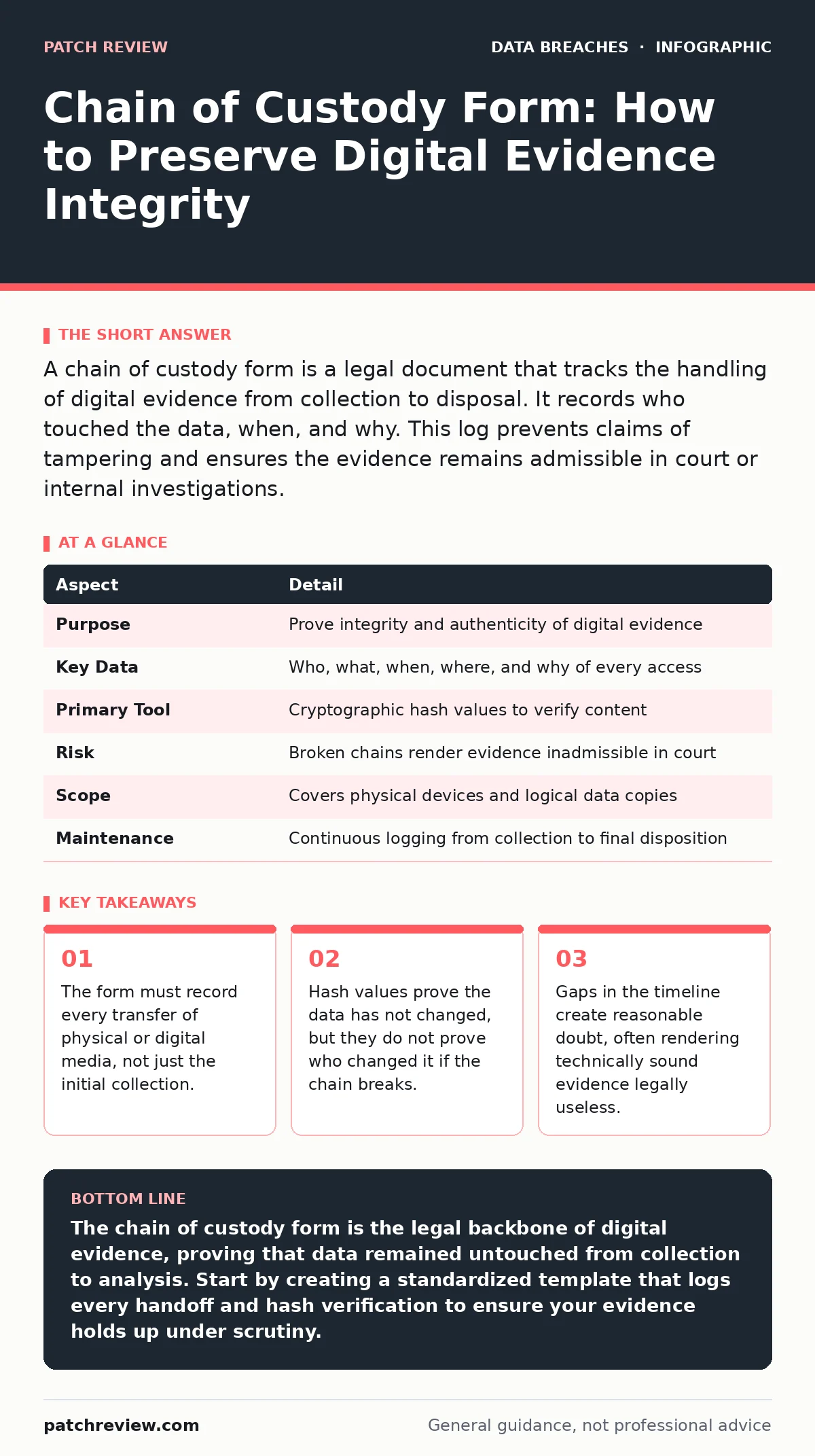
A chain of custody form is a legal document that tracks the handling of digital evidence from collection to disposal. It records who touched the data, when, and why. This log prevents claims of tampering and ensures the evidence remains admissible in court or internal investigations.
The Post Office Analogy for Digital Evidence
Imagine mailing a sealed envelope containing a signed contract. You write the recipient’s address and stick a stamp on it. The post office scans it at every sorting facility. If the envelope arrives torn, the recipient knows someone interfered. Digital evidence works the same way. The chain of custody is the series of scans. It proves the envelope traveled straight from sender to receiver without being opened or altered.
In cybersecurity, this concept protects data during an incident. You cannot simply copy files from a compromised server and email them to a lawyer. You must document the entire lifecycle. The chain of custody form serves as the receipt for every step. It links the raw data to the final report. Without this link, the data is just information. With it, the data becomes evidence.
| Aspect | Detail |
|---|---|
| Purpose | Prove integrity and authenticity of digital evidence |
| Key Data | Who, what, when, where, and why of every access |
| Primary Tool | Cryptographic hash values to verify content |
| Risk | Broken chains render evidence inadmissible in court |
| Scope | Covers physical devices and logical data copies |
| Maintenance | Continuous logging from collection to final disposition |
What a Chain of Custody Form Actually Is
A chain of custody form is a structured log that documents every person who handles a piece of evidence. It is not a one-time signature. It is a living record that grows with each interaction. The form captures the identity of the handler, the date and time of the transfer, the reason for the access, and the condition of the evidence. It also records the method used to transport or store the item.
The goal is to create an unbroken timeline. If an investigator hands a hard drive to a forensic analyst, both parties sign the form. The form notes the serial number of the drive and the hash value of its contents. This hash value acts like a digital fingerprint. It is a unique string of characters generated by a mathematical algorithm. If even one bit of data changes, the hash value changes completely. The form ensures you can verify that fingerprint at any future date.
How the Process Works in Practice
The process begins the moment you identify potential evidence. You must isolate the source to prevent further modification. This might mean disconnecting a server from the network or powering down a workstation. You then create a forensic image, which is an exact bit-by-bit copy of the storage medium. You calculate the hash value of this image and record it on the form.
Next, you transfer the evidence. Each transfer requires a new entry. The person receiving the evidence verifies the hash value against the recorded value. If they match, the receiver signs the form. If they do not match, the process stops. A mismatch indicates corruption or tampering. You must document the discrepancy immediately. The evidence is now suspect. You continue this logging until the evidence is presented in court or destroyed. The form travels with the evidence, physically or digitally, ensuring no gap in the record.
Who Is Affected by These Records
This process affects anyone who touches digital evidence. Forensic investigators create the initial records. Legal teams review them to assess admissibility. System administrators may provide access logs that support the chain. Even storage vendors play a role if evidence is held in third-party facilities. The chain of custody binds these parties to a standard of care.
It also affects the subjects of the investigation. Their rights depend on the integrity of the evidence against them. A broken chain can lead to case dismissal. For organizations, it affects liability and compliance. Regulators may audit these logs to verify proper handling. The HIPAA Security Rule often requires strict tracking of protected health information during breaches. Failure to maintain these records can result in significant penalties and loss of trust.
What People Usually Get Wrong
Many professionals believe that copying files is sufficient for preservation. They ignore the metadata and the timeline. They assume that if the file content is intact, the evidence is valid. This is incorrect. The context of the data is as important as the data itself. When did the file exist? Who created it? What was the system state? These questions require rigorous logging.
Another common error is treating the chain of custody as a legal formality rather than a technical necessity. Investigators often focus on finding the "smoking gun" and neglect the paperwork. They document the collection but skip the intermediate steps. They forget to log when the evidence sits on a shelf. They assume silence means safety. In reality, silence means a gap. A gap means doubt. Doubt means the evidence loses its power.
You must also understand the difference between physical and logical chains. Physical custody tracks the device. Logical custody tracks the data. You can lose physical custody of a server while maintaining logical custody of its image. The form must reflect this distinction. Mixing them up leads to confusion and errors.
See also: Cloud Ransomware Response: Containment and Recovery Steps · Emergency Patching: How to Fix Critical Flaws Without Breaking Systems
Integrating with Other Security Controls
The chain of custody does not exist in isolation. It relies on other security measures to function. Encryption key management ensures that the evidence remains confidential while in transit. If the keys are lost, the evidence is unreadable, breaking the chain of utility. Data retention policies define how long you keep the records. If you delete the logs too early, you cannot reconstruct the history.
Database activity monitoring can provide the raw data needed for the chain. It logs every query and change to the database. These logs become part of the evidence package. Log retention practices must align with legal requirements. If you overwrite logs before the investigation concludes, you destroy the chain. Secure data disposal is the final step. You must document the destruction of evidence to prove it no longer exists. This prevents future misuse.
Using the Chain of Custody Form Effectively
To use the form effectively, you must standardize your process. Create a template that includes all necessary fields. Train every staff member who might handle evidence. Conduct regular audits of the logs. Check for gaps, inconsistencies, or missing signatures. Test your process with mock incidents. See where it breaks. Fix those weaknesses.
Remember that the form is only as good as the data entered into it. Vague entries like "handled evidence" are useless. Specific entries like "copied 500GB image to drive X, verified hash Y" are defensible. Precision matters. Consistency matters. The chain of custody form is your shield against accusations of fraud. It proves you did your job correctly. It transforms raw data into credible truth.
Key takeaways
- The form must record every transfer of physical or digital media, not just the initial collection.
- Hash values prove the data has not changed, but they do not prove who changed it if the chain breaks.
- Gaps in the timeline create reasonable doubt, often rendering technically sound evidence legally useless.
The chain of custody form is the legal backbone of digital evidence, proving that data remained untouched from collection to analysis. Start by creating a standardized template that logs every handoff and hash verification to ensure your evidence holds up under scrutiny.
Frequently asked questions
Can I use a digital signature for the chain of custody form?
Yes, digital signatures are acceptable if they are cryptographically secure and tied to a specific user identity. They provide a stronger audit trail than handwritten signatures.
What happens if I lose the original chain of custody form?
You must attempt to reconstruct the chain using secondary logs, such as system access records or email trails. However, the evidence may be deemed inadmissible if the reconstruction is incomplete.
Do I need a chain of custody for internal HR investigations?
Yes, internal investigations often lead to legal action. Maintaining a proper chain ensures the evidence is defensible if the case moves to litigation or arbitration.
How long should I keep the chain of custody records?
Retain the records for as long as the evidence is relevant, plus any statutory limitations for litigation. Align this with your organization's data retention policies.
How this guide was produced: written by the Patch Review editorial team with AI assistance, checked against the public references listed below, and reviewed when the facts change. See our editorial policy or report an error.