
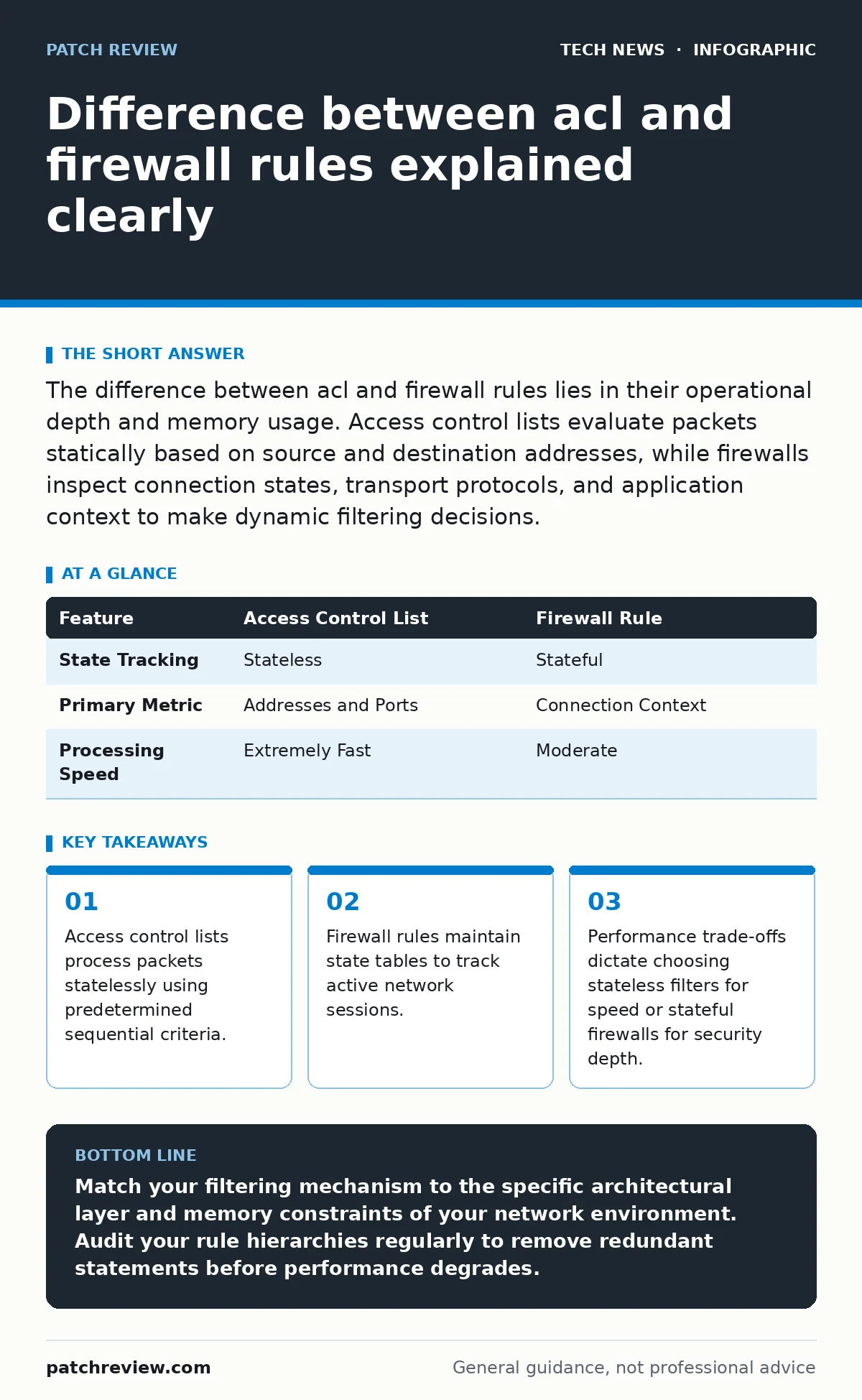
The difference between acl and firewall rules lies in their operational depth and memory usage. Access control lists evaluate packets statically based on source and destination addresses, while firewalls inspect connection states, transport protocols, and application context to make dynamic filtering decisions.
What is the exact difference between acl and firewall rules?
The difference between acl and firewall rules involves architectural state and inspection layers. Access control lists operate as stateless filters checking packet headers independently, while firewalls function as stateful gatekeepers monitoring entire communication sessions from handshake to termination.
3 primary operational distinctions separate these mechanisms:
- Session awareness tracking active handshakes
- Payload inspection depth analyzing application data
- Memory allocation for connection state tables
You must evaluate these architectural layers when securing network boundaries, much like evaluating open-source software security before integrating external code repositories into production environments.
| Feature | Access Control List | Firewall Rule |
|---|---|---|
| State Tracking | Stateless | Stateful |
| Primary Metric | Addresses and Ports | Connection Context |
| Processing Speed | Extremely Fast | Moderate |
How do stateless access control lists process network traffic?
Stateless access control lists evaluate every arriving packet in absolute isolation without remembering previous network interactions. Network devices scan incoming headers against a linear list of sequential statements until a matching condition triggers an explicit permit or deny action.
Packet evaluation fails silently if no matching criteria exist, defaulting to an implicit drop behavior. You experience this stateless limitation when return traffic gets blocked because you forgot to create a corresponding mirror rule for inbound responses.
Why do stateful firewall rules require connection tracking memory?
Stateful firewall rules require dedicated memory to maintain active connection tables that track the lifecycle of every network flow. Network security devices record source addresses, destination ports, and sequence numbers to determine whether an incoming packet belongs to an established, authorized conversation.
Active connection tracking consumes RAM resources rapidly during distributed connection floods, potentially exhausting device memory and causing legitimate traffic drops. You encounter similar resource starvation issues when configuring bring your own device policies that force network gateways to authenticate thousands of unmanaged endpoints simultaneously.
When should you choose router filters over perimeter firewalls?
Router filters provide maximum throughput for high-speed core networks where deep packet inspection introduces unacceptable forwarding latency. Network engineers deploy these static mechanisms at internal routing boundaries to drop obviously malicious spoofed addresses before packets reach expensive security appliances.
Raw processing speed comes at the direct expense of contextual visibility, leaving internal network segments blind to sophisticated application-layer attacks. You gain line-rate performance but sacrifice the ability to detect malicious commands hidden inside legitimate web traffic protocols.
What hidden performance costs emerge from complex rule ordering?
Complex rule ordering creates hidden latency penalties because devices evaluate statements sequentially from top to bottom for every single packet. Network throughput degrades measurably as rule lists grow longer, forcing processors to cycle through dozens of dead checks before finding a match.
Poorly structured rule hierarchies introduce subtle logic traps where broad catch-all statements accidentally override specific security exceptions placed further down the list. You eliminate these invisible bottlenecks by auditing rule sequences regularly and removing obsolete entries that no longer match active traffic patterns.
See also: ARP Spoofing Detection: How to Spot and Stop Layer 2 Attacks · Network Segmentation for Security: Isolating Threats and Limiting Damage
How do packet inspection depths change administrative overhead?
Packet inspection depths dictate administrative overhead by multiplying the number of variables you must configure and maintain over time. Stateful systems demand continuous fine-tuning of application timeouts and protocol parsers, whereas static address lists require simple updates whenever network topology changes.
Increased administrative complexity naturally leads to human configuration errors, opening accidental windows of vulnerability in corporate perimeters. You balance this overhead by automating rule deployments through version-controlled templates rather than making manual edits directly on production hardware.
What edge cases cause asymmetric routing failures in rule evaluations?
Asymmetric routing causes severe firewall failures when outbound packets leave through one monitored gateway while return packets enter through an unmonitored path. Stateful inspection drops these orphan return packets because the receiving security device lacks the initial connection state entry in its memory table.
Imagine a redundant enterprise network where dynamic routing protocols shift active paths mid-session due to transient link congestion. Network connectivity breaks instantly for legitimate users until you synchronize state tables across redundant gateways or enforce symmetric path routing.
Key takeaways
- Access control lists process packets statelessly using predetermined sequential criteria.
- Firewall rules maintain state tables to track active network sessions.
- Performance trade-offs dictate choosing stateless filters for speed or stateful firewalls for security depth.
Match your filtering mechanism to the specific architectural layer and memory constraints of your network environment. Audit your rule hierarchies regularly to remove redundant statements before performance degrades.
Frequently asked questions
Can an access control list inspect the contents of an encrypted HTTPS packet?
Access control lists cannot inspect encrypted payloads because they lack cryptographic keys and application-layer parsing engines. These static filters read only superficial layer transport headers.
Why do firewalls drop valid packets during high traffic volume events?
Firewalls drop valid packets when their connection tracking memory tables fill completely during traffic surges. This protective mechanism prevents total device crashes by rejecting new session requests.
Are static router filters safer than dynamic application firewalls?
Static router filters are not safer than dynamic application firewalls for protecting modern web services. Static filters lack the intelligence required to block application-specific exploit payloads.
How often should security teams audit active rule bases?
Security teams should audit active rule bases continuously or at least quarterly to eliminate obsolete permissions. Unreviewed rules accumulate over time and expand the attack surface unnecessarily.
How this guide was produced: written by the Patch Review editorial team with AI assistance, checked against the public references listed below, and reviewed when the facts change. See our editorial policy or report an error.