
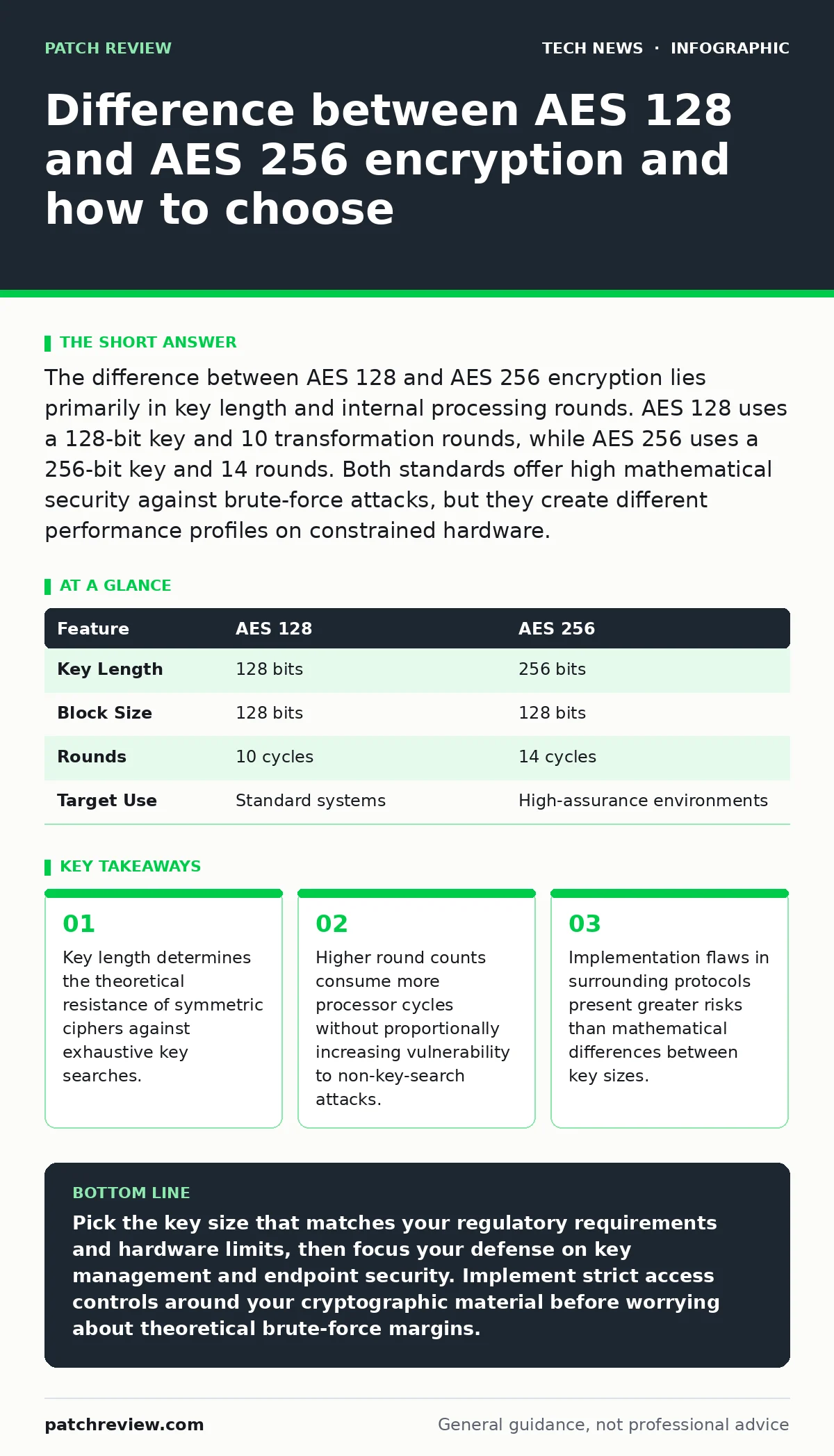
The difference between AES 128 and AES 256 encryption lies primarily in key length and internal processing rounds. AES 128 uses a 128-bit key and 10 transformation rounds, while AES 256 uses a 256-bit key and 14 rounds. Both standards offer high mathematical security against brute-force attacks, but they create different performance profiles on constrained hardware.
What is the actual difference between AES 128 and AES 256 encryption?
The difference between AES 128 and AES 256 encryption involves the size of the secret key and the number of transformation cycles applied to the data. Advanced Encryption Standard is a symmetric cipher algorithm that relies on substitution and permutation networks to obscure plaintext.
| Feature | AES 128 | AES 256 |
|---|---|---|
| Key Length | 128 bits | 256 bits |
| Block Size | 128 bits | 128 bits |
| Rounds | 10 cycles | 14 cycles |
| Target Use | Standard systems | High-assurance environments |
Every round mixes the data further, making statistical analysis of the ciphertext infeasible for observers who lack the key.
Why does key length matter for theoretical security?
Key length dictates the number of possible combinations an attacker must test during an exhaustive search. 256-bit keys offer an astronomical increase in possible combinations compared to 128-bit keys, far exceeding the energy output limits of any plausible computing architecture.
| Security Level | Operations to Break | Relative Margin |
|---|---|---|
| 128-bit | Two to the power of 128 | Baseline |
| 256-bit | Two to the power of 256 | Squared baseline |
Practical attacks never target the mathematical core of the algorithm. Adversaries bypass the cipher entirely by stealing keys from memory or compromising endpoints, rendering astronomical key spaces irrelevant to actual outcomes.
How do transformation rounds affect performance?
Transformation rounds consume processor cycles, meaning higher round counts demand more computing power and battery life. AES 256 requires 14 rounds of processing, whereas AES 128 requires only 10 rounds.
Battery-powered sensors and low-power microcontrollers notice the performance difference during continuous file transfers. Developers working on embedded systems or choosing a laptop for cybersecurity work must weigh CPU overhead against data classification requirements.
When should you select AES 128 instead of AES 256?
AES 128 remains appropriate for standard commercial data, web traffic, and general application layers where the threat model excludes nation-state adversaries with infinite resources. Government agencies mandate the larger key size for classified material up to top secret, while commercial entities adopt the smaller key size for everyday efficiency.
| Criterion | Choose AES 128 | Choose AES 256 |
|---|---|---|
| Hardware Constraints | High priority | Low priority |
| Regulatory Mandate | Commercial standard | Government classified |
| Threat Model | Standard criminals | Advanced persistent threats |
Matching the cipher to the data value prevents wasted engineering effort while maintaining adequate protection against automated scanning tools.
Can side-channel attacks bypass key differences?
Side-channel attacks bypass key differences by measuring physical characteristics like power consumption or electromagnetic radiation during cipher execution. These techniques extract secret keys directly from hardware chips regardless of whether the system uses 128-bit or 256-bit parameters.
| Attack Vector | Vulnerable Element | Mitigation Strategy |
|---|---|---|
| Power Analysis | Electrical fluctuations | Constant-time execution |
| Timing Leakage | Processing duration | Hardware masking |
| Cache Timing | Memory access patterns | Isolated execution cores |
Engineers mitigate these physical vulnerabilities by ensuring software routines execute in constant time, preventing timing variations that leak key material to local observers.
See also: Video Conferencing Security Checklist: Protecting Calls From Eavesdropping · What does one time password mean and how authentication works
What happens if implementation errors weaken the cipher?
Implementation errors weaken the cipher by introducing predictable flaws in how keys are generated, stored, or managed across systems. A mathematically unbreakable cipher provides zero security if the application reuses initialization vectors or hardcodes secret keys into source code repositories.
Proper key lifecycle management requires integrating secure practices into DevOps security pipelines to prevent accidental exposure of cryptographic secrets during automated deployments. Flawed integration remains the primary vector for unauthorized data access across modern cloud infrastructures.
How do related cryptographic components interact with AES?
Related cryptographic components interact with AES by providing secure key exchange mechanisms, integrity verification, and digital signatures. Symmetric ciphers like AES require secure methods for two parties to agree on a shared secret without transmitting it in the clear over public networks.
Transport Layer Security protocols combine asymmetric key exchange algorithms with AES data encryption to secure web traffic and video conferencing security streams against interception. Relying on AES alone without proper authentication leaves encrypted payloads vulnerable to tampering and bit-flipping attacks.
Key takeaways
- Key length determines the theoretical resistance of symmetric ciphers against exhaustive key searches.
- Higher round counts consume more processor cycles without proportionally increasing vulnerability to non-key-search attacks.
- Implementation flaws in surrounding protocols present greater risks than mathematical differences between key sizes.
Pick the key size that matches your regulatory requirements and hardware limits, then focus your defense on key management and endpoint security. Implement strict access controls around your cryptographic material before worrying about theoretical brute-force margins.
Frequently asked questions
Is AES 128 considered quantum resistant?
AES 128 is not considered fully quantum resistant because quantum algorithms reduce its effective security margin to 64 bits. Organizations anticipating mature quantum computers handling large-scale decryption tasks should migrate to AES 256 to maintain an adequate safety margin.
Does AES encryption protect data while it is being processed in memory?
AES encryption only protects data while it is stored at rest or moving across a network, not while it resides in active memory. Adversaries with memory access can extract plaintext data and unencrypted keys directly from RAM during application execution.
Why do some protocols default to AES 128 in Galois Counter Mode?
Protocols default to AES in Galois Counter Mode because it provides both confidentiality and authentication while executing efficiently on modern processors. This mode prevents tampering while maintaining high throughput for high-volume network links.
Can an improperly sized initialization vector break AES security?
Reusing an initialization vector with certain cipher modes allows attackers to deduce patterns in plaintext and recover secret data. Initialization vectors must be unique for every encryption operation under the same key to preserve confidentiality.
How this guide was produced: written by the Patch Review editorial team with AI assistance, checked against the public references listed below, and reviewed when the facts change. See our editorial policy or report an error.