
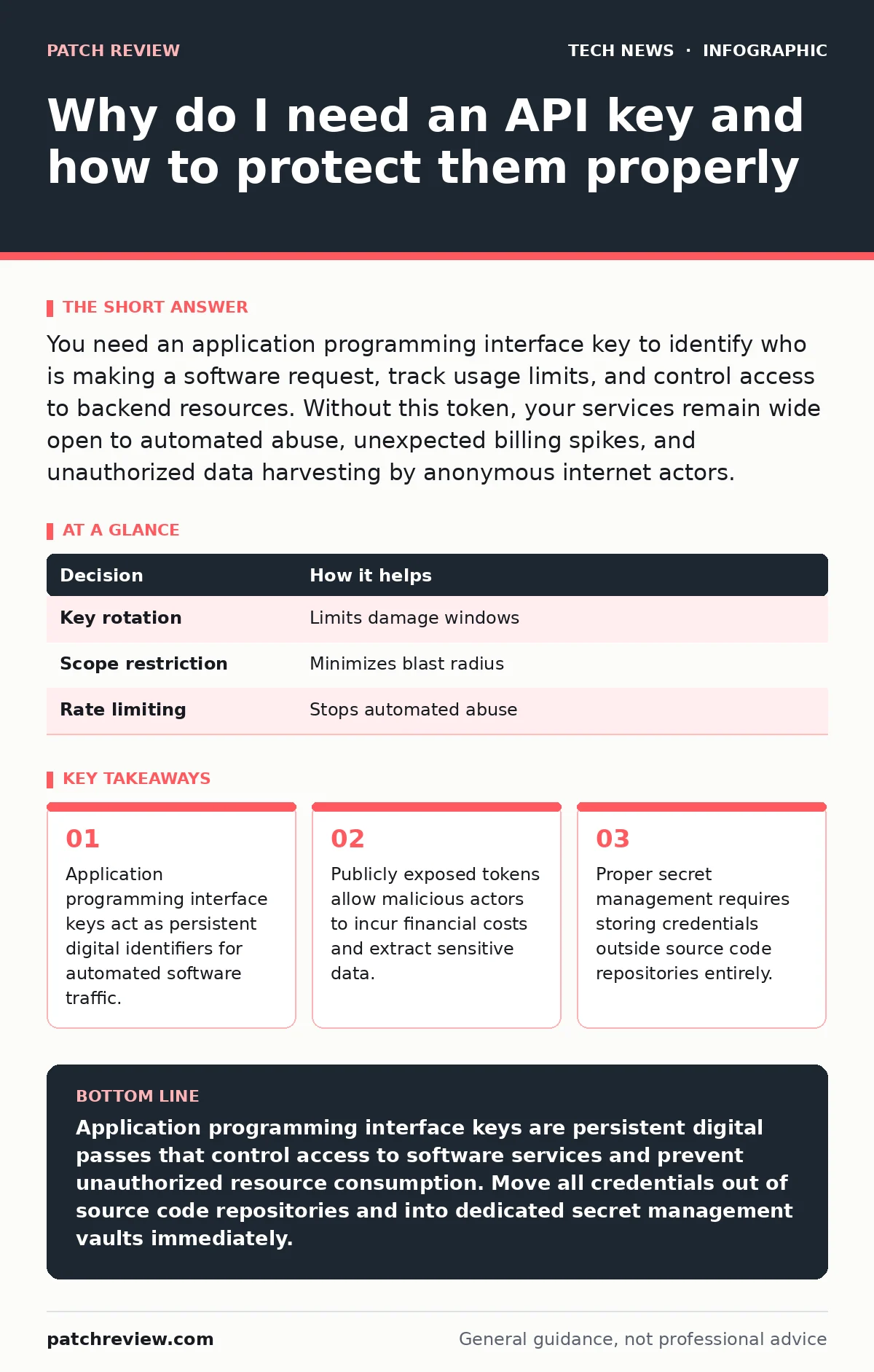
You need an application programming interface key to identify who is making a software request, track usage limits, and control access to backend resources. Without this token, your services remain wide open to automated abuse, unexpected billing spikes, and unauthorized data harvesting by anonymous internet actors.
Why do I need an API key for software communication
You need an application programming interface key to establish accountability and control when two software systems communicate over a network. Modern applications rely on modular services that trade data constantly, requiring a mechanism to verify which client is knocking on the door. Software interfaces lack human faces, so they depend on unique strings of text to prove identity.
Applications use these tokens to enforce rate limits, ensuring one faulty script does not overwhelm the entire infrastructure. Without unique identifiers, service owners cannot trace errors back to specific integration projects or bill organizations accurately for resource consumption. This structural requirement shapes how developers approach modern DevOps security principles during system design.
Token verification protects backend capacity by stopping unauthenticated traffic before expensive database queries execute. Anonymous requests consume memory and central processing unit cycles, degrading performance for legitimate users. Requiring a token shifts the burden of proof onto the caller, filtering out casual scanners and unsanctioned scrapers instantly.
What goes wrong without proper token controls
Unprotected software endpoints invite malicious traffic that can drain financial accounts and leak private records. Imagine an application hosting a weather forecasting service without any token requirements on its backend data routes. Automated bots will discover the public endpoint quickly and scrape the entire database for resale, bypassing user registration walls entirely.
Unauthorized callers can abuse unconstrained interfaces to relay spam, mount distributed denial of service attacks, or mine cryptocurrency using your cloud compute quotas. Cloud providers bill by resource usage, meaning a leaked secret can generate catastrophic invoices overnight. Organizations often discover these exposures only after receiving alerts from their payment processors.
Hidden costs emerge when compromised credentials leak into public source code repositories during routine development tasks. Once published online, automated scrapers harvest the secret within minutes, often before the developer even commits a fix. Manual revocation becomes necessary, causing downtime for legitimate integrations while systems update.
How application tokens function under the hood
Application programming interface keys operate as static bearer tokens transmitted inside Hypertext Transfer Protocol headers during every request. The receiving server inspects the incoming string, checks it against an internal database or cache, and decides whether to fulfill the request. This stateless design allows distributed servers to validate callers independently without maintaining heavy session states.
Bearer tokens grant access to whoever holds them, meaning security relies entirely on keeping the string secret during transit and storage. Transport Layer Security encryption prevents interception on the wire, but local storage vulnerabilities still threaten the secret on endpoints. Security architects often compare these tokens to physical brass keys that open specific doors regardless of who turns them.
| Decision | How it helps |
|---|---|
| Key rotation | Limits damage windows |
| Scope restriction | Minimizes blast radius |
| Rate limiting | Stops automated abuse |
Where developers make mistakes with secret storage
Developers frequently store sensitive tokens in environment configuration files that accidentally get committed to public version control systems. Hardcoding secrets directly into source code makes rotation difficult and scatters credentials across multiple repositories. This oversight violates fundamental rules taught in standard password policies training across the industry.
Another common error involves granting overly broad permissions to a single token used across multiple microservices. If an attacker acquires that master key, they gain administrative access to every connected database and storage bucket. Applying the principle of least privilege ensures a compromised token only exposes a tiny fraction of your overall architecture.
See also: Website Defacement Prevention Checklist for Web Security · Hardening WordPress: A Step-by-Step Security Implementation
What to do with your credentials today
Audit your existing codebases immediately to locate hardcoded secrets, configuration files, and database connection strings hiding in plain sight. Move all discovered tokens into dedicated secret management tools that encrypt data at rest and in transit. These platforms inject credentials into runtime environments securely without exposing them to developers or logs.
Implement automated scanning tools in your continuous integration pipelines to catch accidental credential leaks before code reaches production environments. Configure alerts to notify security teams whenever an application programming interface key exhibits unusual traffic patterns or geographic spikes. Rotate your production tokens on a regular schedule to minimize the risk posed by undetected compromises.
Establish clear revocation procedures so you can kill compromised credentials instantly without deploying new application code. Document which team owns each token to prevent orphaned secrets from lingering indefinitely in legacy systems. Pair these operational practices with robust firewall rules to restrict inbound traffic to known IP ranges.
Key takeaways
- Application programming interface keys act as persistent digital identifiers for automated software traffic.
- Publicly exposed tokens allow malicious actors to incur financial costs and extract sensitive data.
- Proper secret management requires storing credentials outside source code repositories entirely.
Application programming interface keys are persistent digital passes that control access to software services and prevent unauthorized resource consumption. Move all credentials out of source code repositories and into dedicated secret management vaults immediately.
Frequently asked questions
Can I use an API key to authenticate individual human users?
Application programming interface keys identify software clients rather than specific people, making them poorly suited for individual user login systems.
Why do my tokens stop working after I change my cloud provider settings?
Backend routing changes or invalidated environment variables often break the connection between your application and the secret store.
How do attackers find hidden API keys in public repositories?
Automated bots continuously crawl public code hosting platforms looking for high-entropy strings and known credential patterns.
What is the difference between an API key and a password?
Passwords verify human identity for account access, whereas application tokens authorize automated software systems to communicate with specific interfaces.
How this guide was produced: written by the Patch Review editorial team with AI assistance, checked against the public references listed below, and reviewed when the facts change. See our editorial policy or report an error.