
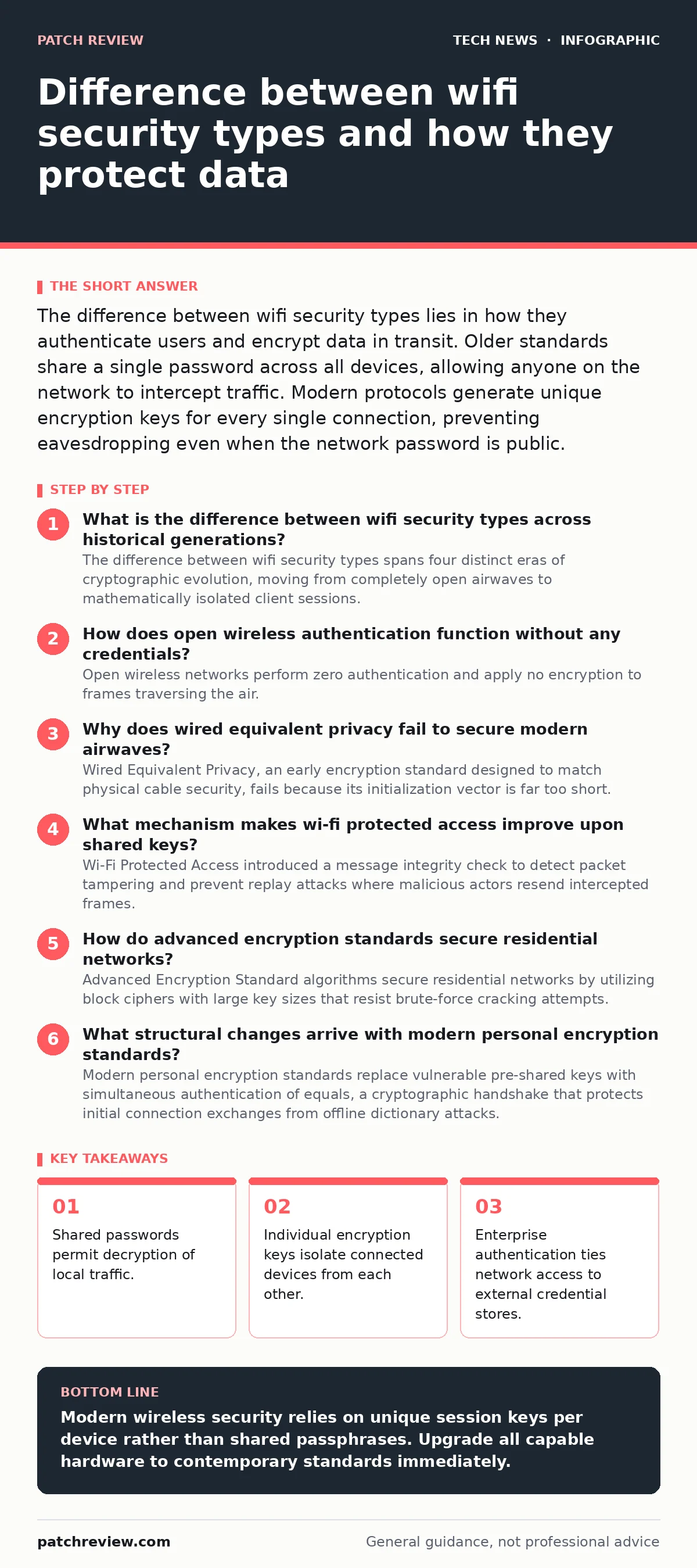
The difference between wifi security types lies in how they authenticate users and encrypt data in transit. Older standards share a single password across all devices, allowing anyone on the network to intercept traffic. Modern protocols generate unique encryption keys for every single connection, preventing eavesdropping even when the network password is public.
What is the difference between wifi security types across historical generations?
The difference between wifi security types spans four distinct eras of cryptographic evolution, moving from completely open airwaves to mathematically isolated client sessions. Wireless signals broadcast in all directions, making encryption mandatory for privacy. Early systems relied on static keys that repeated patterns, while current standards use dynamic session keys that change constantly. Understanding these generational shifts helps you evaluate whether your router configurations protect against modern local sniffing attacks.
How does open wireless authentication function without any credentials?
Open wireless networks perform zero authentication and apply no encryption to frames traversing the air. Radio transmitters simply broadcast packets in cleartext, meaning anyone within range reads the exact data payloads moving between your device and the access point. Public hotspots frequently operate this way to minimize connection friction. Protecting sensitive data on these networks requires upper-layer protections, and you should maintain strict password policies and active network monitoring when traveling.
Why does wired equivalent privacy fail to secure modern airwaves?
Wired Equivalent Privacy, an early encryption standard designed to match physical cable security, fails because its initialization vector is far too short. This initialization vector is a pseudo-random value added to the encryption key to generate cipher streams. Because the vector repeats quickly on busy networks, mathematical collisions allow observers to recover the secret key within minutes using passive packet capture tools.
What mechanism makes wi-fi protected access improve upon shared keys?
Wi-Fi Protected Access introduced a message integrity check to detect packet tampering and prevent replay attacks where malicious actors resend intercepted frames. This interim standard used the temporal key integrity protocol, which dynamically changes keys per packet to defeat the mathematical weaknesses plaguing older systems. Hardware limitations of legacy routers meant this protocol had to fit existing chipsets, creating an architectural bridge rather than a permanent fix.
How do advanced encryption standards secure residential networks?
Advanced Encryption Standard algorithms secure residential networks by utilizing block ciphers with large key sizes that resist brute-force cracking attempts. Counter Mode Cipher Block Chaining Message Authentication Code Protocol, commonly known as WPA2, combines these robust mathematical blocks with robust key management. Each client device negotiates a unique pairwise master key during the four-way handshake, meaning two devices on the same home network cannot easily decrypt each other's unicast traffic even if both know the shared passphrase.
| Protocol | Authentication Type | Encryption Algorithm | Primary Vulnerability |
|---|---|---|---|
| WEP | Static Shared Key | RC4 | Rapid IV collision |
| WPA | Pre-Shared Key | TKIP | Message integrity flaws |
| WPA2 | Pre-Shared Key | AES | KRACK key reinstallation |
| WPA3 | Simultaneous Authentication | AES-GCMP | Downgrade attacks |
See also: Difference between AES 128 and AES 256 encryption and how to choose · Why do I need an API key and how to protect them properly
What structural changes arrive with modern personal encryption standards?
Modern personal encryption standards replace vulnerable pre-shared keys with simultaneous authentication of equals, a cryptographic handshake that protects initial connection exchanges from offline dictionary attacks. Passive listeners recording the connection attempt cannot later crack the password through brute force in a laboratory. This upgrade eliminates a major flaw where capturing a single handshake let attackers test millions of guesses against your home passphrase without interacting with your router again.
Why does enterprise wireless authentication require a centralized server?
Enterprise wireless configurations require a centralized authentication server because they verify users individually rather than relying on a single shared passphrase for every employee. Remote Authentication Dial-In User Service backends handle credential verification against directory stores, mapping each person to specific network privileges. Network administrators combine this setup with disciplined open port management to ensure authenticated users only access internal services they actually require for daily operations.
How does enterprise protocol deployment handle individual client certificates?
Enterprise protocols handle client validation by requiring digital certificates installed directly onto user hardware instead of traditional passwords. Extensible Authentication Protocol frameworks manage these exchanges, verifying both the server's identity to the client and the client's identity to the network. Mutual authentication stops rogue access points from tricking your computer into connecting and leaking credentials, neutralizing credential harvesting tactics used by local adversaries.
Key takeaways
- Shared passwords permit decryption of local traffic.
- Individual encryption keys isolate connected devices from each other.
- Enterprise authentication ties network access to external credential stores.
Modern wireless security relies on unique session keys per device rather than shared passphrases. Upgrade all capable hardware to contemporary standards immediately.
Frequently asked questions
Can someone steal my data if I use a password-protected home router?
Yes, if your router uses older pre-shared key protocols, anyone who knows the password can capture local traffic and decrypt it later. Modern standards prevent this by generating unique encryption keys for every connected device.
Why do public networks ask you to log into a web page after connecting?
Those captive portals operate on open networks to verify your identity or accept terms of service before granting internet access. The connection itself remains unencrypted until you launch applications that use transport layer security.
Does hiding your router network name improve wireless security?
Hiding your service set identifier offers virtually no security benefit because devices constantly broadcast that name while searching for known networks. Real protection comes from strong encryption protocols rather than obscuring names.
What happens when a wireless device falls back to an older protocol?
Protocol fallback allows legacy hardware to connect by using weaker cryptographic methods, which creates an opening for attackers to force downgraded connections. Disabling legacy support on your router blocks these downgrade paths.
How this guide was produced: written by the Patch Review editorial team with AI assistance, checked against the public references listed below, and reviewed when the facts change. See our editorial policy or report an error.