
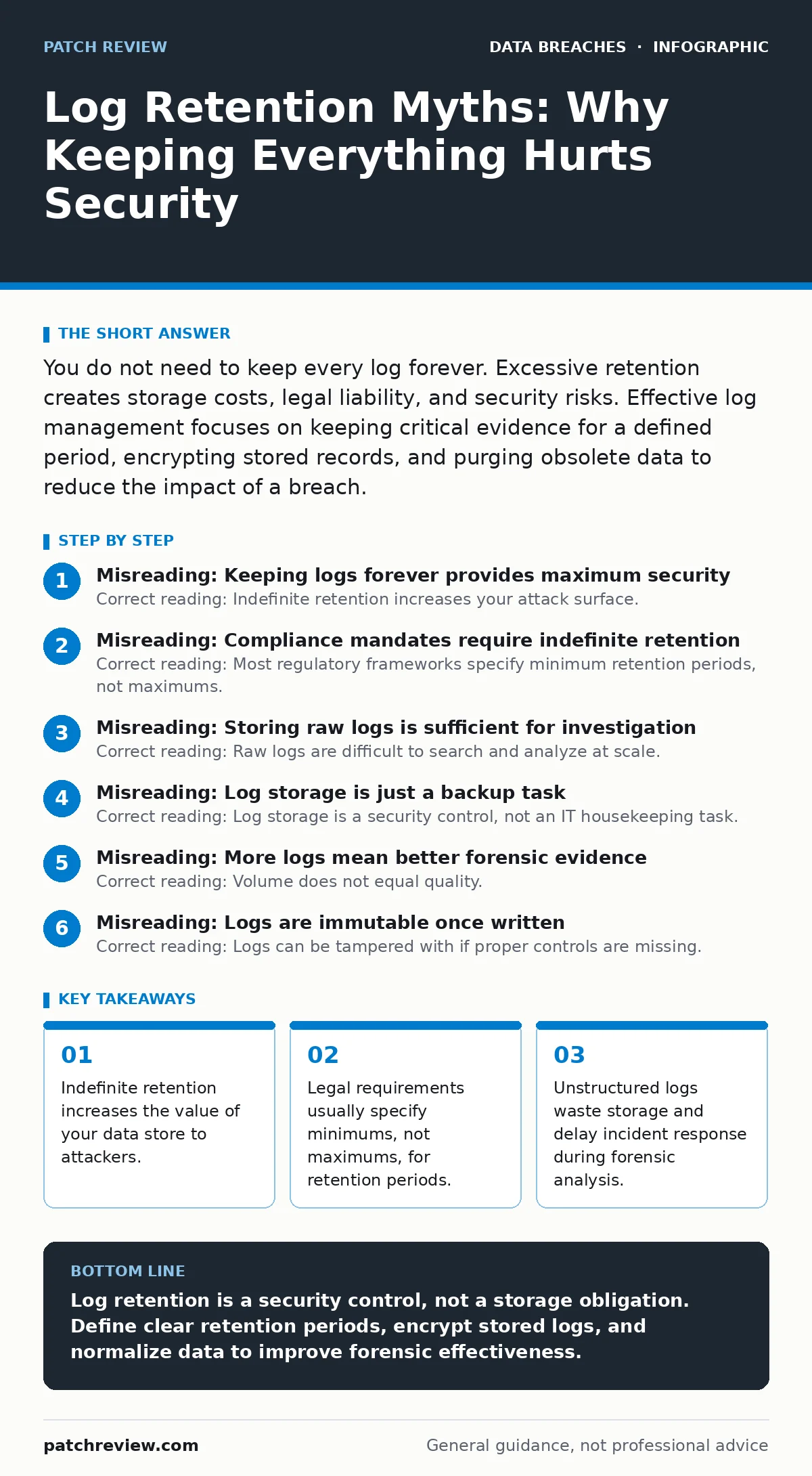
You do not need to keep every log forever. Excessive retention creates storage costs, legal liability, and security risks. Effective log management focuses on keeping critical evidence for a defined period, encrypting stored records, and purging obsolete data to reduce the impact of a breach.
Misreading: Keeping logs forever provides maximum security
Correct reading: Indefinite retention increases your attack surface. Every log entry is a potential source of sensitive information. Attackers who gain read access to your logging infrastructure can harvest years of user activity, IP addresses, and system errors. This historical data helps them map your network and identify lateral movement paths. Storing more data than necessary creates a larger target.
Security improves with relevant, recent data, not with volume. Old logs often contain outdated system states that confuse forensic investigators. They also consume storage resources that could be used for real-time monitoring. You must balance the need for historical evidence against the risk of exposing that evidence.
Misreading: Compliance mandates require indefinite retention
Correct reading: Most regulatory frameworks specify minimum retention periods, not maximums. Laws like the HIPAA Security Rule require you to keep audit logs for 6 years. They do not require you to keep them for 60 years. Keeping data longer than required exposes you to unnecessary liability. You should review data retention policies regularly to align with current legal obligations.
Retaining data beyond the legal requirement creates a compliance risk. If a breach occurs, you must disclose the exposure of historical data. This can lead to higher fines and reputational damage. Aligning your retention schedule with the strictest applicable law is sufficient. You can safely delete logs that exceed this window.
Misreading: Storing raw logs is sufficient for investigation
Correct reading: Raw logs are difficult to search and analyze at scale. Without normalization, similar events from different systems use different formats. This inconsistency delays incident response. Attackers can exploit this delay to cover their tracks. You must normalize logs into a common format, such as JSON or CEF, before storing them.
Normalization allows you to correlate events across different systems. It also enables automated detection tools to identify patterns. Raw logs often contain redundant information that clutters the dataset. Removing noise during ingestion improves the signal-to-noise ratio. This makes it easier to spot anomalies during an investigation.
Misreading: Log storage is just a backup task
Correct reading: Log storage is a security control, not an IT housekeeping task. Backup systems often lack the security controls required for sensitive data. Logs may contain personally identifiable information or credentials. Storing them in unencrypted backups violates data privacy principles. You must treat logs as sensitive data assets.
Encryption protects logs from unauthorized access. You should encrypt logs at rest and in transit. Access controls must be strict. Only authorized personnel should be able to view or modify logs. Regular audits of log access help detect insider threats. This approach aligns with encryption key management best practices.
Misreading: More logs mean better forensic evidence
Correct reading: Volume does not equal quality. Thousands of verbose logs from low-risk systems drown out critical signals. Forensic investigators struggle to find relevant events in a sea of noise. This phenomenon, known as alert fatigue, leads to missed detections. You should prioritize logging critical systems and high-risk actions.
Focus on logs that indicate authentication, authorization, and data access. These logs provide the most value during an investigation. Verbose debug logs are useful for troubleshooting but rarely aid in security forensics. Disable verbose logging in production environments. This reduces storage costs and improves analysis speed.
See also: Encryption Key Management: Definition, Purpose, and Core Mechanics · Third-Party Data Breach Response: Steps to Contain and Recover
Misreading: Logs are immutable once written
Correct reading: Logs can be tampered with if proper controls are missing. Attackers often delete or modify logs to cover their tracks. This is a common step in data exfiltration. You must ensure log integrity through write-once-read-many storage or cryptographic hashing. Immutable storage prevents unauthorized modification.
Regular integrity checks detect tampering. Hashing log files and storing the hashes separately ensures authenticity. If a hash mismatch occurs, it indicates tampering. This evidence is critical for legal proceedings. It supports the chain of custody required for evidence admissibility. Without integrity controls, logs are unreliable.
Key takeaways
- Indefinite retention increases the value of your data store to attackers.
- Legal requirements usually specify minimums, not maximums, for retention periods.
- Unstructured logs waste storage and delay incident response during forensic analysis.
Log retention is a security control, not a storage obligation. Define clear retention periods, encrypt stored logs, and normalize data to improve forensic effectiveness.
Frequently asked questions
How long should I keep security logs?
Keep logs for the minimum period required by applicable laws and regulations, typically 6 to 7 years. Longer retention increases risk without adding security value.
Can I delete logs before the retention period ends?
No, deleting logs before the required period violates compliance. However, you can archive or move them to colder, more secure storage to reduce costs.
Should I log all user activity?
Log critical actions like logins, privilege changes, and data access. Logging every keystroke or mouse click creates noise and privacy issues.
How do I ensure log integrity?
Use write-once storage or cryptographic hashing. Store hashes separately from the logs. Regularly verify hashes to detect tampering.
How this guide was produced: written by the Patch Review editorial team with AI assistance, checked against the public references listed below, and reviewed when the facts change. See our editorial policy or report an error.